




Address correspondence to geoff.fischer@veri.co.nz
26 November 2025
KiwiSaver
KiwiSaver is a five fold scam on the working class, concocted by Labour and National working in cahoots.
It is a scam on the working class because it takes a chunk out of the miserable wages of workers and uses that money to finance their own exploitation. All the funds taken out of wages go to capitalists, and principally to foreign capitalists. (The individual worker might get back some of it at the end of their lives if three things happen. First, the worker lives beyond the normal lifespan of their class, to an age more commonly attained by the privileged classes. Second, their KiwiSaver provider does not screw up their investment portfolio. Third, that global and colonialist capitalism does not screw up the entire world and/or its own economic system over the next few decades).
It is a scam on the working class because it encourages the preposterous notion that workers can find salvation through individualism and capitalism - i.e. their own personal KiwiSaver account.
It is a scam on the working class because it is subverting the principle of universalism which is the only assurance of a reasonably happy retirement for the working class in the last years of their lives.
It is a scam on the working class because those of the working class who can't afford KiwiSaver still pay the government contribution to their bosses' bloated KiwiSaver accounts through PAYE and GST.
It is a scam on the working class because those of the working class who can't afford KiwiSaver completely miss out on the employer contribution to which they are theoretically entitled.
KiwiSaver has just one goal: to make New Zealand society more unequal and more unfair than it already is. We should not be discussing how to make it an even more effective scam. We should be discussing how to rid ourselves of it completely and entirely.
13 November 2025
The Follies of Fonterra: Analysing the Lactalis deal
The New Zealand dairy cooperative Fonterra has agreed to sell its "consumer products" operations to French global dairy company Lactalis.
In response New Zealand political leaders (with the exception of Winston Peters) have been quick to assert "It is the shareholders' right to decide" and offered no further comment. Christopher Luxon, Chris Hipkins and David Seymour all agree on that much.
Yet the statement that "It is the shareholders' right to decide" is a self-evident legal fact which really goes without saying. Does it mean that the rest of us should not have or express a view on the matter?
30 August 2025
Jacob and the Genocide
The Bible story of Esau and Jacob has come to public attention since it has been used to justify the ethnic cleansing of the Palestinian territories by the Jewish State of Israel. However the story itself and its meaning is not well understood among atheists or Christians and in particular it is not well understood among Jews.
The key to the story is found in the line from Genesis 25 "Esau was a cunning hunter, a man of the field; and Jacob was a plain man, dwelling in tents".
25 August 2025
What is happening to the economy? Reader comment from Bryce Edwards Integrity Institute substack
A large section of the commentariat assumes that the economy is behaving differently because the government is not using its economic levers in the time-honored ways. It may be true that the government is doing things differently. It is not necessarily true that to revert to the old ways would change the outcome.
15 July 2025
A Tale of Two Genocides
At the executive level there is little difference between the German genocide of the Jews ("the Holocaust") and the Jewish-American genocide of the Palestinians. In both cases the purpose is to eliminate a people and the principle means to that end is to bring them together into a small space where various methods of killing can be efficiently applied. The principle of concentration is fundamental to the commission of genocide. People need to be herded into ghettos, refugee camps, or concentration camps if the business is to proceed efficiently and effectively. So far, so good. That is a simple tactical and logistical problem which both the Germans and the Americans know how to solve.
But that is where the German way diverges from the American way (and I will make it clear later why this genocide is being conducted in a specifically American way). The Germans set about their genocide in a systematic, methodical and organized fashion. For the Germans genocide was, as Hannah Arendt points out, a bureaucratic process. In its peak expression at Auschwitz, both the victims and the perpetrators were uniformed and numbered. The Germans took the industry of genocide as seriously as any other industrial process.
At this operational level, Gaza is different. In Gaza, genocide has become a sport. It is genocide done in the American way. The Gaza Humanitarian Foundation guards are the hunters, the Palestinians are their prey, the trucks are the bait. Each day a crowd of hungry people come seeking food. Every day the guards are there waiting. Every day the guards open fire for a few brief diverting minutes. It is chaotic, it is exhilarating and it can be hilarious. It is always fun. This is a Hollywood genocide, taken out of a dystopian comedy. Therefore it is a genocide characteristic of all those who have adopted the American culture and assented to its values. It is no less vile than the German holocaust. It may even be worse. At least the Germans were guided by a perverted sense of their own decency. They bizarrely believed that they were building a better world. But now, genocide has become just a case of the boys having fun.
8 July 2025
Reader comment from Bryce Edwards' Integrity Institute substack
Every year NBR publishes its "Rich List" and every year commentators of the right and the left respond with moral judgements which are utterly predictable because they are purely ideological and do not even pretend to have any empirical basis.
The right will insist that the Rich Listers have been rewarded for their "hard work". Yet no effort is made to demonstrate in every particular case that "hard work" is the explanation for their wealth. Even the most cursory examination of the list reveals that inheritance is a large factor in the wealth of most of the individuals and families. "Who you know", whether in politics or business, is also of vital importance.
"Hard work" is the definitive explanation of wealth only if we include the hard work of our parents and grandparents, and of all the people in their employ, as well as all the people that we ourselves may have employed in the process of acquiring wealth. But that simple and obvious truth would hardly suit the purposes of the ideologues of capitalism.
The left takes a similarly dogmatic ideological position. The wealth of the rich, they insist, should be taxed for the greater good of society. Yet it is only a presumption that the state would spend that wealth in better ways than the rich themselves...
8 July 2025
Reader comment from Bryce Edwards' Integrity Institute substack
New Zealand is in the grip of systemic corruption. Not the casual corruption where regulators get "taken out to lunch" in the manner that most of us have seen all too often in our working lives, but of the systemic type where the institutions of government openly collaborate with powerful financial interests without being subject to any moral inhibitions or legal restrictions.
30 June 2025
A dialogue with a Te Tiriti activist
Is Westminster democracy in England a colonialist system?
My answer would be 'not'.
I agree, it is not colonialist in England, although let's just call it the "Westminster system". Whether it is democratic (whether it really functions to express the popular will) is a moot point. Within itself, that is within the House of Parliament, many democratic principles are applied. For example there is an open ballot (everyone must know how an MP votes and the identity of every MP is known), continuous election (through "the confidence of the House"), and self-determined non-uniform constituencies (party caucuses) . The very same rangatiratanga democratic principles that should apply in society as a whole, but do not. There is also the problem of an having an unelected head of state (King Charles) which is no way consistent with democracy.
Additional Note: If parliament uses sound democratic principles in its internal processes, which could be emulated in the popular sphere to the advantage of democracy, then why is unseemly, petty and divisive behavior so prevalent within the parliament?
In answer I would say that the appearance may be deceptive. Parliamentarians of all parties have surprisingly good and close relationships within parliament itself, which are not always evident to the general public. There are many cross party personal friendships (as well as rivalries and personality conflicts within parties) and the impulse to "bipartisan" politics is strongly felt within the major parties. Bipartisan policy was traditionally associated with foreign policy (which was managed by the British government until 1947) but now de facto extends to a range of economic and social policies, such as superannuation policy. Political antagonisms are generated by the need to compete for the popular vote and therefore are a product of the external electoral process. I believe that radical reform at the popular level, giving genuine agency to the people, would have a major beneficial impact at the representative level.
26 April 2025
After Anzac Day
The way in which Anzac Day is commemorated reflects the state of New Zealand politics and society in our times. By and large, those who organise these events wish us to remain ignorant about the real history of all the wars in which New Zealand has participated, both the causes of those wars, and the way in which they were fought.
They want to us concentrate our attention on just one aspect of war, which is only half reality and another half myth: the courage and sacrifice of the ordinary soldier. The reality, of course, is complex. The Anzacs, Australian and New Zealand troops, have covered the full gamut from hero to coward, noble idealist to perpetrator of the most atrocious war crimes.
15 March 2025
"One of the most difficult things": New Zealand's changing partners
(Based on an article originally published in "The Daily Blog")
When New Zealand Foreign Minister Winston Peters sacked Phil Goff as New Zealand High Commissioner to the United Kingdom he declared "It's seriously regrettable and one of the most difficult things one has had to do in his whole career." Goff is a Labour Party professional career politician, one of the breed who trained to be a politician in his youth and has never been anything other than a politician. He was one of the cabal of Rogernomes in the Fourth Labour government, a one time Labour leader, and Winston Peters' predecessor as New Zealand's Minister of Foreign Affairs. Goff signed the New Zealand-China Free Trade Agreement at a time when Peters was arguing that New Zealand was "being colonised without having any say in the numbers of people coming in and where they are from", with specific reference to the inflow of immigrants from China. Goff and Peters come from opposite sides of the political divide (which to be fair is a very small and shallow divide in New Zealand), they were rivals in the foreign affairs and trade space, and they had different views on the ethnic and cultural basis of New Zealand society. It is also quite possible that Peters would like to assume the High Commission role himself, if or when he retires from active political life in New Zealand.
So was Peters being disingenuous when he claimed that sacking Goff was the hardest thing that he ever had to do in politics? Were these crocodile tears? At the very least political hyperbole?
1 January 2025
Everything is connected
(This item was originally posted as a comment to The Daily Blog)
I think that Martyn is under estimating the extent of the problem facing the New Zealand economy. He may want to see it as a consequence of the policies of the present government, and no doubt those policies are a factor. However while for reasons of political partisanship it may be tempting to put the whole blame on the present government we should resist the temptation to do so.
I believe that the problem is primarily structural and is not strictly economic. To understand that you need to step back from the multi-partisan consensus that has prevailed in New Zealand since the fourth Labour government, which holds that politics and economics operate in separate spheres. As it happens this is a "neo-liberal", "monetarist" and "free market" doctrine, but more importantly, it is a false doctrine. The assumption of the Lange government was that New Zealand could have a neo-liberal economic system sitting alongside a caring social welfare state, and that it could have a productive economy dominated by foreign capital and dedicated to foreign trade while pursuing an independent foreign policy. Thirty years ago Bruce Jesson explained why this could not be the case, but who was listening? At the time it seemed to the left that these things were not connected, or, if they were, they could be effectively disconnected. The folly of that belief is now becoming more apparent, as the neo-liberal "global capitalist" New Zealand state pursues a militaristic overtly pro-American foreign policy, adopts policies towards the poor which range from indifference (under Labour) to outright contempt (under the present ACT dominated coalition) and seeks to nullify the Treaty of Waitangi. In other words, all the areas which we were told neo-liberalism would "not be allowed touch" it has now taken into its maw.
So the first thing we have to do is get rid of the notion that nothing is connected. From what we eat for breakfast to the drugs we take to foreign policy and economic policy, everything is connected. Is the government's provision of free vaping kits unrelated to its foreign and economic policy? Not at all. It is out to corner the drug market on behalf of the British and American tobacco companies which financed it into power. It's social policies are predicated on getting a whole generation of New Zealanders addicted to licit drugs.
To come back to the economic "crisis" (actually only a 1% decline in GDP, but seriously hurting a large number of people who have been thrown out of work) I can confidently predict that it will not be overcome under any colonialist government. I can also safely predict that a solution to New Zealand's predicament will not come without a great deal of struggle and sacrifice on our part. Regardless of what we choose to do, one way or another the colonialist regime will make us suffer. It is better that we should suffer in the fight for our nation and our freedom than as abject slaves of Anglo-American imperialism.
20 December 2024
The Retirement of the State
For the span of almost exactly a century, from the late nineteenth until the late twentieth, the colonialist state achieved remarkable feats of capital development. It built roads and railways, a telephone network, hydro and geothermal power stations, a national grid, public broadcasting system, schools, universities, hospitals, houses, civic buildings and military bases. It brought in farmland from the bush, planted exotic forests on a scale rarely seen in the world, commissioned saw mills, a pulp and paper mill, a steel mill and an oil refinery. It mined coal. It ran two airlines, a shipping company, a railway company, a fleet of buses, a tourist hotel company, a postal service, an insurance company and a bank.
Then one day, suddenly and quite unexpectedly for some, the state went into retirement. It alienated most of its accumulated assets in a reverse mortgage deal which was intended to see it right for the rest of its days, and to be fair it has spun that money out pretty well. A century of working followed by forty years of reasonably comfortable retirement. Not too bad really. But the funds from the reverse mortgage are running low and the colonialist is getting a bit doddery. You could say that he seems to be losing his marbles. A younger guy is now making the running. We can call him Tangata Motu. He seems to be making better decisions than the old man. He has a way to go before he can match the political and economic achievements of his predecessor, but hey, it is still early days.
So what happened to New Zealand colonialism? Did it betray and then disinherit us? You could say that, but I prefer to think that it just got tired and threw in the towel. This tiredness afflicted the entire body of colonialism. The right and the left, National and Labour, the state and private capital. The collective unconscious of the colonialist regime was saying "We are not long for this world". While the state was disposing of its assets, private capital was giving power of attorney to corporate raiders like Ron Brierley, Bruce Judge and Alan Gibbs. That didn't work out too well because the attorneys were on to a fiddle, and the younger brother, colonial capital, saw its hard won wealth ebb away even faster than that of the older brother, the colonialist state. (Yes, that is right, despite what some Marxists may try to argue, in a colonial society the state is the older brother to capital).
So this is the big picture. It is not about National, ACT or New Zealand First. It is not about Labour or the Greens. It is about us and our relation to the colonialist entity which has ruled us for nearly two centuries but has now exhausted whatever capacity it once had to do good.
(This item was originally posted as a comment to The Daily Blog)
9 December 2024
What is Rangatiratanga?
"All New Zealanders have tino rangatiratanga, the right to self-determine..." writes the ACT Party leader David Seymour. Seymour evidently believes that this right to self-determine extends to the right to self-determine the meaning of documents such as the Treaty of Waitangi and words such as "rangatiratanga". He is mistaken of course. In particular he is wrong about "rangatiratanga" which he defines as "self-determination". In fact, "self-determination" is a concept close to "mana motuhake" while "rangatiratanga" is equivalent to "sovereignty".
We know this by reference to nineteenth century Maori texts...Read more...
9 December 2024
The Three Spheres of Te Puapua and the Treaty Principles Bill
This article was also published in "The Daily Blog" of 18 November 2024 and as a comment on "The Democracy Project"
The situation in Aotearoa/New Zealand is less complicated than it seems, once we have all the pieces of the puzzle at hand. In a nutshell, since first contact and up to the present day we have had two social orders, Maori and European, which have conflicting claims to sovereign authority going back to Te Tiriti o Waitangi. At times the Crown has been troubled by Maori claims to sovereignty, because it has been unable to tolerate the idea of a parallel Maori authority in the land. So we had the nineteenth century invasion of Maori lands by British and Australian forces, in the immediate aftermath of which Premier Julius Vogel contemplated a final war of extermination against Maori, before deciding that mass immigration of European settlers would offer the same gain for less pain. Read more...
9 December 2024
The Fruits of Defeat?
New Zealand entered the Vietnam war on behalf of the United States in 1963 with a small force of artillery and infantry and other military personnel. 37 New Zealand soldiers died and 187 were wounded. These losses were modest compared to the previous world wars which New Zealand had fought on behalf of Britain, and the subsequent Korean war fought for the United States....Read more...
9 December 2024
The Future of Forestry in Aotearoa
Production forestry is not rocket science. Almost anyone who applies themselves to the subject can understand its basic principles. By the same token it is possible to misunderstand those principles, and quite easy to miss them entirely. ...Read more...
9 December 2024
Sovereignty
(Originally published in "The Daily Blog")
The ACT Party's Treaty Principles Bill has opened a proverbial can of worms. For decades New Zealand politicians have used the concept of "treaty principles" to avoid the issue of te Tiriti itself. ACT's attempt to dramatically alter the legal meaning of "treaty principles" has blown that consensus out of the water, and people, including Professor Jane Kelsey, are now questioning the whole notion of "treaty principles". ( https://theconversation.com/rewriting-history-how-the-treaty-principles-evolved-and-why-they-dont-stand-up-to-scrutiny-238406)
Kelsey is a professor of law, and the Treaty of Waitangi is a legal instrument. Professionally, Kelsey would tend to a strict interpretation of the document. That is how lawyers first approach any legal instrument. Then, if they find the document to be vague or ambiguous they interpret in a way that "avoids .. absurdity" and gives effect to the presumed intentions of the parties. That is as far as a good lawyer will normally go. Loose construction only applies where strict interpretation has failed. ...Read more...
6 September 2024
Mission Accomplished: The Treaty Principles Bill
There is general agreement that the ACT Party's Treaty Principles Bill is going nowhere. To be precise, that it will not get past the first reading in parliament because the National Party has now said unequivocally that it will not support a second reading and we can take the party at its word in this matter, even if not in any other. It is not hard to see that the bill is bad law, bad politics and evidence of shoddy thinking on the part of its drafters.
So how did it even get this far? Why try to flog a dead horse through the House of Parliament? Why squander the time of that august institution and the wealth of the taxpayers who fund it?
The ACT party seem to be saying that it is being done to give the public a chance to debate serious constitutional issues. It is all about democracy and giving a voice to the people. But parliament is not a debating chamber for the general public. Speeches are not permitted from the public gallery (although waiata may be these days). Even in select committee the public are only present to make submissions to, and answer the questions of, elected representatives. They are not there to debate among themselves. Public debates are held in the press, over the airwaves, on social media, over the kitchen table, in the lunchroom, town hall and marae, on the street or absolutely anywhere but in the house of parliament. So ACT's stated reason for bringing the bill to the House is unpersuasive, and National's reason for supporting it to the first reading is even less persuasive.
A common view is that a proportion of voters who supported the ACT party at the last election are, to put it bluntly, anti-Maori and that ACT has to throw them a bone in order to win their vote next time around, presumably in 2026. National, for its part, needed to humor ACT in order to form a coalition and so we have the charade of the Treaty Principles Bill first reading and public submissions. This sounds rather disrespectful of the institution of parliament which is supposed to be a legislative assembly committed to serious and effective law-making, rather than a place of political theatre. That may be one of the reasons why Winston Peters, who has a genuine respect for the institution, has not joined Christopher Luxon in unequivocally declaring that he will refuse the bill a second reading.
Having said all that, the bill does have a serious purpose which does not require that it ever comes close to becoming the law of the Realm. To understand that purpose we have to step back to early 2016 and the iwi document "He Whakaaro Here Whakaumu Mo Aotearoa: The Report of Matike Mai Aotearoa - the Independent Working Group on Constitutional Transformation" followed by the better known "He Puapua" which was "the 2019 report commissioned by the New Zealand Government to inquire into and report on appropriate measures to achieve the goals set out by the United Nations Declaration on the Rights of Indigenous Peoples". These initiatives were representative of attempts within Maoridom to fashion a system of "co-governance" with the Crown which honoured Te Tiriti o Waitangi. Though well-intentioned and based on the principle of collaboration between Maori and the Crown, once they came to light for the general public they excited immediate and ferocious opposition stirred up by the ACT Party, New Zealand First, the Hobson's Pledge organisation, media personalities usually categorised as "far right" and political journalist Christopher Marshall Trotter (about whom I will have more to say later).
At this point I should disclose that I believe that He Puapua and its antecedents were deeply flawed and were "never going to fly" for two reasons. Firstly, because a formal collaboration between the Crown and Maori could always be interpreted or represented as a threat to the "equal status" of non-Maori New Zealanders who constitute more or less 80% of the population. Secondly, because the Crown has always been duplicit in its dealings with Maori and it seems naive to suppose that it was about to change its character of the past 184 years. Even if we charitably retract the notion of "duplicity", the Crown has always been an unreliable partner for Maori and the simple mechanics of the electoral cycle will see it remaining that way.
The problem is that Matike Mai Aotearoa, the Independent Working Group on Constitutional Transformation, which was formed at a meeting of the Iwi Chairs’ Forum at Haruru in February 2010, carried with it the hopes of many Maori for a Maori-Crown collaboration which honoured te Tiriti. The group had conducted hundreds of hui around the motu, and its large team had worked tirelessly to develop the proposals which later surfaced as He Puapua. When the right (including Chris Trotter) successfully turned He Puapua into an election issue those Maori who had shepherded the idea of Crown-Maori collaboration saw themselves cut off at the pass.
The real purpose of the Treaty Principles Bill is not to be enacted as would normally be the case for a legislative proposal. The bill was never going to make it into law, anymore than He Puapua was going to form the basis of a new constitution. The sole purpose of the bill was to proclaim to Maori from the seat of government that co-governance was a dead duck. So now we have two dead ducks, He Pua Pua and the Treaty Principles Bill, to be buried in the same hole. This is how "Treaty partnership" ends.
For the right and for the Crown that would indeed be the end of the story. But not for Maori.
We have seen the full range of reaction in protest from Maori: hikoi, hui, protest marches, strikes, road blocks, public statements, and a wave of social media outrage. Perhaps most telling was the incandescent rage of Kiri Tamihere-Waititi, Te Pati Maori Chief of Staff on Tik-Tok (June 2024?). Her anger is understandable, because despite its reputation as a "radical Maori nationalist" party, Te Pati Maori as a parliamentary party has nowhere to go if the door is closed to meaningful collaboration between the Crown and Maori. Kiri's speech has been decried as a "rant" and a "rave" and denounced for "profanity" by the same right-wing players who damned He Puapua and orchestrated the Treaty Principles Bill. However Christopher Trotter, speaking to Sean Plunket on The Platform, responded rather more rationally, warning that Tamihere-Waititi's speech may be representative of widespread anger among Maori, and that it would be wise to call a constitutional convention in order to deal with that anger. Trotter, if not exactly ahead of the game, is certainly ahead of many of the less astute players on his team. He sees that in accomplishing its mission of fatally striking down Matike Mai and He Puapua, the Treaty Principles Bill generated anger on a scale that is difficult to assess but is certainly substantial, and which may open Maori up to more revolutionary strategies than Crown-Maori collaboration based on Te Tiriti. Therefore he is suggesting a constitutional convention as a way to side track Maori and those non-Maori who are sympathetic to Maori or who find the present colonialist regime in any way problematic. A constitutional convention called by the Crown carries with it certain risks for the regime, but those risks can be managed far more easily than a massive wave of grass-roots anger which might evolve into a revolutionary movement for social and political change.
However I suspect that the time for such a Crown orchestrated "constitutional convention" may already have passed. The regime has stuck doggedly to its imperial connections for 184 years, with successive heads of the colonialist government arguing that while independence (mana motuhake) is "inevitable" it "will not happen on their watch". Meanwhile the situation on the ground has been shifting inexorably. Tangata motu no longer need an avenue provided by the regime in order to advance the cause of rangatiratanga. It is happening independently. A constitutional convention clearly designed to sideline this organic evolutionary process may be no more likely to succeed than the well-intentioned He Puapua or the deliberately mischievous Treaty Principles Bill. Mr Trotter may be left holding the body of a third dead duck to be thrown into the same hole as the first two.
Colonialist politicians constantly proclaim their desire to avert social or ethnic division and to promote a "constructive public conversation" about constitutional issues, yet everywhere they knowingly sow discord and seldom do they facilitate genuine pubic debate about the nature of New Zealand's colonialist society. So it must fall to tangata motu to establish kotahitanga among our people, to develop the principles of rangatiratanga, and to restore mana motuhake through te Whakaminenga.
21 July 2024
Electricity duplicity - Why your electricity charges are sky-rocketing.
Step back three years to a press release by Minister Megan Woods (Labour) and we see the true duplicity of the privatized electricity industry in which the state continues to play a pivotal role. The Minister's statement is in italics. My comment is interspersed in regular text.
17 September 2021
Power bill changes bring fairness to charges
A key recommendation of an independent panel to make electricity charges fairer across all households will be put in place, the Energy and Resources Minister Megan Woods has announced.
How independent was this panel? The privatized retail electricity retailers were heavily represented in a body supposedly intended to direct their conduct of the electricity market. It is a classic story of state-capital relations in the privatized New Zealand economy where monopolistic suppliers are invited to tell the government how they should be regulated, if at all.
"Phasing out the regulations on 'low-use' electricity plans will create a fairer playing field for all New Zealanders and encourage a switch to electric technologies," Megan Woods said.
The regulations will be phased-out over five years, starting from 1 April, 2022, with support for households who might be affected by the changes.
Currently, the cost of delivering electricity through lines charges to those on low-use plans is supplemented by other households on standard-use plans.
"Supplemented" is not the correct word to use here. "Subsidized' might be, except that it would not be true in this instance and so "supplemented" was used instead. The "low use" charges provided the option of consumers paying a lower fixed cost (daily charge) and a higher unit rate for electricity actually used. People on the "standard" plan (actually a minority of consumers) paid a lower rate per unit of electricity used and a higher fixed daily charge. There is nothing inherently unfair about granting such choices to consumers. But why do we have daily charges in the retail electricity industry at all, when we do not have them in grocery or hardware stores? The standard capitalist business model is that the capital and operating costs of a business are covered by or included in the unit cost of the product. When we buy a loaf of bread from PaknSave the cost of building and running the store and its distribution system - trucks, buildings and so on - is included in the price of that loaf of bread. There are some exceptions to this rule. For instance Costco supermarket requires customers to make an initial capital contribution in the form of a membership fee. However this is a one-off charge, not a daily charge, and anyone who lacks the ability to pay it can go to a PaknSave or Countdown supermarket instead. Thus there is some degree of freedom of choice in how we shop for groceries, at least in the larger cities. That is no longer the case in the electricity market where all the major gentailers function as a cartel, adjusting their prices in unison. Furthermore, all taxpayers combined to make an initial capital contribution to the New Zealand electricity network in the years before 1984, and all new homeowners make a capital contribution when their home is connected to the electricity grid. The problem we have now is that a monopolistic electricity industry is imposing a large fixed daily charge on top of those capital contributions and is determined to allow no alternatives. In brief, the combination of daily charges and variable charges is not normal market practice and neither is it logically justifiable. Modest daily charges were tolerated by the public, but the massive 600% increase being "phased in" goes against the market choice of at least 59% of electricity users. The very fact that it needs to be "phased in" over a period of years is acknowledgement of just how unpalatable this change is to the majority of electricity consumers.
During the phase-out, about 60 per cent of households are likely to benefit from lower power bills.
That is a curious statement given that 59% of households are currently on the low user plan and will be subjected to hugely higher fixed charges as the changes progress. Actually households have not benefited at all. Over the past three years electricity prices have risen remorselessly for all domestic consumers regardless of which plan they are on as the state and private investors seek to maximize their profits. There was never any genuine expectation that the "phase out" would lower power costs. The intention was always to increase revenues to the electricity companies and therefore costs to the consumer.
The 2019 Electricity Price Review panel found the low fixed charge regulations are poorly targeted and are not equitable - or fair to everybody - and recommended the change.
"While the low fixed charge regulations were intended to help some struggling households, they can put more of a financial burden on those who don't qualify for low fixed charges, particularly larger families and those living in poorly insulated homes who have higher electricity needs and have to pay the much higher standard fixed charge," Megan Woods said.
This is Megan Woods at her most disingenuous. To be clear, "struggling households" were precisely the group that the low fixed charges were designed for, and they all "qualified". If you want to help large families living in poorly insulated homes, you build them properly insulated homes. You do not make it prohibitively expensive for them to buy electric power by dramatically increasing daily charges for electricity. If low income families could not afford electricity at 2021 prices, how will they afford it when daily charges are raised by a factor of six?
About 59 per cent of households are now on low fixed charge plans, so that means those on standard-use plans are charged more to make up for the under-recovery of fixed charges from those on the lower rates. This change will mean the sector can implement new, fairer pricing plans for distributing electricity.
"Ultimately, this will help the industry to more efficiently manage the load on the network during peak times, avoiding costly network upgrades and helping to keep prices lower for consumers," Megan Woods said.
The truth is that networks have maximum scope to manage demand at peak times through variable pricing when the entire cost of electricity is in the form of variable unit charges. There is nothing 'fair' about daily charges so high that they constitute a barrier to the poor and thereby limit their access to electricity, while giving wealthy consumers unrestricted access to cheaper electricity. It gets worse than that. The industry gave free electricity to well-heeled owners of Tesla and other electric vehicles. No daily charges. No nothing. Meanwhile the poor are accused of not carrying their share of the burden while actually paying more than the standard rate for electricity.
Minister Woods says there are some perverse outcomes from low fixed charge regulations.
"Wealthier households with low fixed charges have more options to reduce their power use through energy-saving measures like double glazing, smart appliances and solar panels.
"But low-use households who are also low-income households can under-heat their homes to save on power bills because their variable rates on electricity use are high," Megan Woods said.
The only perversion here comes courtesy of Megan Woods herself. "Low-use households who are also low-income households" are by definition comprised of people who are of necessity frugal and conscientious in their use of electricity. When daily charges are increased they will have even less ability to heat their homes, and that is exactly what we are finding now. Wealthy people always have more options. That is the nature of an unequal society. You can't correct that situation of inequality in wealth by increasing the fixed charges upon less wealthy households and it is ridiculous for Megan Woods to assert that you can.
"High variable rates also discourage households from switching from higher carbon technologies like gas heating, to low carbon technologies like EVs and heat pumps.
Now we are getting to the nitty gritty. The new distribution of costs, if "fairly" applied would help those with electric vehicles and heat pumps in every room, not to mention air conditioning, heated spa pools and electric patio heaters. But note the contradiction between this passage of Woods' text, and the passage that preceded it. In the preceding passage Woods is critical of "wealthier households" being enabled to conserve energy ("by double glazing and smart appliances") and to produce it (through "solar panels"). Now she is claiming to encourage the very electricity responses that she previously categorized as giving wealthy households an unfair advantage. She cannot have it both ways. Note also that Woods wrongly classifies the production of energy by households as "energy conservation". Why is that? Because from the point of view of the electricity industry, which set her policy and probably even drafted her statement for her, household production has the same effect as household conservation of energy. It reduces demand for energy produced commercially by the electricity companies.
The passage that followed confirms this. While households are being discouraged from conserving or producing energy, they are being encouraged to consume more energy in "EVs and heat pumps". This energy however will be additional generation purchased from the bulk electric power generators, distributors and retailers. It will not be produced in households or made available by household conservation. The government's plan is to reduce household production and conservation of energy while increasing the demand for electricity among the 41% of more privileged consumers, and thus increasing the profits of the electricity companies, all at the expense of the poor.
"Cleaner, low emissions technologies are important for achieving our goals to have net zero carbon by 2050. We need regulations that make it easier for people to switch from fossil fuels to electric alternatives, not harder," Megan Woods said.
If honestly applied the changes would make it easier for high income households to electrify, but would make it harder for low income households to do so. But there has never been any serious intention to apply the changes in an honest way. The whole process has been marked by mendacity, casuistry and dissembling. No domestic consumer has benefited. Woods is also being dishonest when she suggests that "net carbon zero" is a motivating factor. Any increase in electricity consumption in New Zealand comes from fossil fuel generation, while renewables provide the baseline supply. In this situation we can only move towards net carbon zero by reducing energy consumption, and low daily charges with higher unit charges are one way to minimize excess electricity consumption. The problem is that reduction of demand and consumption is the last thing that the electricity industry wants because that implies reduction of revenues, and that is why they are trying to increase fixed charges to protect their profits at the expense of the most vulnerable New Zealanders.
The electricity sector is developing a $5 million power credits scheme to help with the transition for some households on low fixed charges who may face higher power bills. Details on the scheme are being finalised.
Like the "phase out" strategy, the transitional "help" to some poorer consumers is an implicit acknowledgement that the changes hurt low-income families. The plan is to ease their transition to a harder reality, rather than to spare them that reality. The "compassion" of the electricity industry is shown by only slowly tightening the screw on the poor.
Now that the changes are in progress, the electricity industry is trying to shift the blame onto government, while government, like Pontius Pilate washes its hands of the whole business claiming that electricity retailers are free to abolish or lower daily charges if they see fit. Like two criminals charged with the same crime, they blame one another when the truth is that both are culpable. Government and private capital are colluding in this savage attack upon New Zealand's cost of living and quality of life. Government gave a nod and a wink, and the electricity industry has gone for the consumer's throat. Before Megan Woods approved the electricity industry plans in 2021, electricity prices in New Zealand had been rising only slowly. Immediately after she gave her approval, prices accelerated rapidly and have continued to do so in the three years since.
Genesis Energy is one among many that try to blame government, saying: "The government owns 51% of power companies like us, Meridian and Mercury, due to this we are phasing out of the Low User Plan" implying that the government (in the first instance a Labour government, now the National led coalition government) is using its shareholding to force Genesis, Meridian and Mercury to phase out the Low User Plan which made electric power more affordable for poor families who were prepared to limit their use.
Genesis is suggesting that the New Zealand government is using its 51% shareholding to deliver a sharp slap in the face to low-income households, and is insisting that government is entirely responsible. That is simply untrue. To be blunt it is a lie. Government has not given direction to Genesis Energy. The board and management of Genesis Energy made that decision themselves with the sole motive of increasing revenues and profits. Government allowed the high daily charge to be brought in because it has a financial interest in higher profits from the energy retailers, so it is culpable, but government did not make it happen and private capital cannot be so easily let off the hook. The deregulation of fixed charges was a Labour government initiative, and the National led coalition government is only following Labour's lead - as it would. In fact there is a cosy relationship between the government as shareholder, the government as regulator, the private shareholders and the management of the electricity retailers all conspiring together against ordinary New Zealand households. Government is profiting from the new high daily charges, but it is the companies themselves which have imposed those increased charges.
Domestic electricity supply is a conspiracy between the state and private capital in which they divvy up the profits of super-exploitation on a fifty-fifty basis, and structure the charging systems so that the poor pay a higher unit price for electricity than the rich. The wealthier you are, and the more electricity you are able to consume, the less you pay on average per unit. This whole system sits within a murky legal environment saturated with official disinformation, obscurantism and electricity supplier strong-arming of their customers.
Selected comment from The Daily Blog:
John Layes July 22, 2024 At 9:33 am
Just imagine how much this is affecting solar panel users. They are extremely low users having to pay increasing daily charges. This may slow the installation of household solar systems. Green party - take notice!!
Geoff Fischer:
Yes John, owners of domestic solar panels can be "extremely low users" which means they are not good customers for "big electric" and at the same time they are competitors to the big generators. Because the shareholding in the big generators overlaps with that of the retail electricity distributors and the transmission companies, domestic producers of electricity are not a welcome part of the system and they will be presented with all kinds of obstacles as they try to gain a foothold in the system. In addition, because they are small dispersed producers they have little leverage and will be exploited by the retailers regardless of the interests of the big generators. There is no quick or easy fix to this, and I would not hold my breath waiting for the Green Party to do something about it. One approach is to organise with other domestic producers to achieve a scale where you can have some leverage and even install the technology which will allow you supply power direct to close neighbours. I understand that activity of this kind is already underway in some parts.
One other thing. By its pricing policies, with regard to both consumers and suppliers, big electricity is saying "You are either for us or against us. You will be either entirely off-grid or solely on-grid. We will not allow a middle way". That is a risky strategy for the industry to adopt. It may work, or it may degrade and eventually collapse the grid. Global capital (to be precise Anglo-American capital) is taking the same course in geopolitics in a desperate effort to stave off an emerging multi-polar world order. The colonial government is placing all its bets on the success of the "for us or against us" strategy across the board. I have a hunch that it will end in disaster, and possibly within the space of a few years rather than many decades.
John Trezise July 21, 2024 At 9:08 pm
I'm probably a moron, but I thought the point of the fixed charge is to pay for the maintenance of the lines that supply the electricity; that no matter how much or little a household uses, that house needs to be connected.
Geoff Fischer:
That is certainly the argument for fixed charges. However fixed charges for any product are not the norm in the market, and if they were to become the norm they would make for lazy and inefficient industries. If you can take money to cover your overheads from people who don't really want to buy your product, or want to buy it only in small amounts, then you will have no incentive to do anything particularly efficient or imaginative in your production, distribution and marketing. For better or for worse government can impose fixed charges. We call them rates, taxes and levies. But quite properly few private producers enjoy that privilege, and whatever you may think about road user charges, congestion charging and so on, it is worth noting that even governments are considering moving away from the fixed charge model (although in this country it will be done by a combination of taxes (user fixed cost) and charges (user variable costs) that further disadvantage the poor and benefit the affluent, just as in the electricity market and the "health" system). The separation of lines from electricity retailing was always based on a false logic which left the lines companies free to impose what they themselves call a "rental charge" on consumers (although strictly speaking it is not, it is just a privately administered tax) while the retailers just pay bills and send out bills. Basically clipping the ticket, and doing very well out of it, thank you. The electricity industry has been brilliantly structured according to the number one principle of state and capital in New Zealand, which is that no one in a position of power should be accountable for their actions or lack of action. Look at the kind of people that stack the boards and management of these companies. Folk who do little and risk nothing while getting paid handsomely for their lack of effort.
Michael Delceg July 21, 2024 At 3:28 pm
I have described before in this blog how I participated in a Grey Power lobbying initiative where we met Megan Woods and spoke against dropping the Low Fixed User Charge which was Grey Power policy. I pointed out then that this was an example of a Utilitarian argument and that the greatest accepted critique of Utilitarianism was that minorities suffer when the "greatest good" position is taken uncritically. The room was full of industry representatives. As we were leaving Woods shook my hand and said "We really do care." All I could manage politely was to say nothing and stare her straight in the eye. I have solar panels, a battery and a plug in hybrid car so I'm also aware of the problem of low payment for the extra power we don't use that we send to the grid. NZ compares poorly with most other countries in this regard and the problem has been recognized in recent reviews of the current system. It is a serious disincentive to increasing distributed generation, something that is sorely needed here. Now the position taken amongst electricity providers is that we must pay to upgrade the current grid and ensure future stability and sufficient production. This is instead of reducing profit taking and using that source for such investment. One could also go to the banks for loans as was once the custom, but one suspects that the same people who have shares in the electricity system also have shares in the banks, and don't want to have to lend themselves money. The 51% Kiwi share could be a tool for changing these discrepancies but it requires a government that is truly left wing and not neoliberal like Labour or, God help us, the current right wing bunch.
Geoff Fischer:
Yes, Michael, the electricity industry has virtually admitted that it does not want households to produce their own power through solar panels or any other form of generation. Household generation of electricity may be good for the environment but it is a threat to their business model. Therefore don't expect them to buy your electricity unless it is offered at a very large discount. It is a feature of the electricity industry (and of capitalism in New Zealand more generally) that it is reluctant to do the one thing that capitalists are meant to do, which is to stump up the capital necessary to establish and maintain their enterprises. Instead they let government, central and local, make the initial capital investment. Our fine capitalists then step in and take over the assets created. Over time, they distribute profits generously among shareholders, while allowing the assets to run down. Then they turn around and demand that someone else - the government, their consumers or their suppliers (like yourself, Michael) - provide a fresh tranche of capital. If no one is willing, they turn the whole enterprise over to some hedge fund running out of New York. This is the story of New Zealand Railways, Air New Zealand and all the privatized state assets, and it is symptomatic of the rapacious nature of colonial capitalism and the colonialist state.
13 July 2024
The Joe Biden fiasco
The urgent necessity for continuous election and the open ballot throughout the western world is illustrated nowhere better than in the United States. With an open ballot there would be no possibility of electoral fraud, or of false allegations of electoral fraud. With continuous election we would be spared Joe Biden's catastrophic election campaign.
The fundamental problem is not Biden's dementia. It is the fact that the political establishment refuses to acknowledge his condition, claiming that he is "sharp as a tack" and fit to be president for another four years. Congressional Speaker Kevin McCarthy testifies that Biden is "very professional, very smart, very tough" in private meetings. Biden's inner circle echo that assessment. UK Prime Minister Keir Starmer and New Zealand Prime Minister Christopher Luxon both express their confidence in Josesph Biden's capacity to "rule the world" (as Biden himself puts it). Yet Biden is a man who confuses Iraq and Ukraine, Vladimir Putin and Volodymyr Zelensky, and, perhaps most astonishingly, his political adversary Donald Trump and his own vice-President Kamala Harris. Eight billion people know that Biden is suffering from dementia, they have seen and heard the evidence with their own eyes and ears, yet they are powerless to act against the wishes of the US political establishment.
With continuous election this situation would be quickly corrected, in fact with continuous election this situation would never have arisen. The American people, given the opportunity, would not allow their country and the world to be brought into grave jeopardy by the joint phenomena of natural cognitive decline and the chicanery of political cliques.
11 July 2024
The Darleen Tana fiasco
Some people have been slow to draw the appropriate conclusions from Green MP Darleen Tana's fall from grace. Should Darleen resign from Parliament? If she doesn't, should the Green Party invoke the waka jumping legislation? Was Darleen elected to parliament solely on the sponsorship of the Green Party? Who can say? Electors voted for a Green Party list. Darleen was on the list. Did her presence on that list attract votes, meaning she has as much right as Chloe Swarbrick to remain in parliament? No one knows. That is the point. No one knows anything. No one knows for certain if Darleen was in the wrong in the migrant labour exploitation scandal and no one knows for certain what support she has among Green voters, so no one knows if she has a moral right to stay in parliament. Who should make that decision? In a democracy, the people who elected her would. Trouble is that in the New Zealand system they have no way of doing that. In a democracy there would be continuous election with an open ballot - in a word, rangatiratanga - and Darleen would either be confirmed in her position or she would be gone. No drama, no pontificating, no endless screeds of vehement opinion on blogs, no Green Party agonising over compromising principles by invoking the Electoral (Integrity) Amendment Act. It would be boring by comparison with what we have now, but hey, democracy is like that.
1 July 2024
A Maori Parliament?
As one might expect the first book to be printed in New Zealand was written in te reo Maori. It was "Te Rongopai ki te Ritenga a Ruka" translated from the original Greek and published in 1835. Chapter 3 opens with the words "Na i te tekau ma rima o nga tau o te rangatiratanga o Taipiria Hiha i a Ponotia Pirato e kawana ana i Huria...".
The readers of Te Rongopai a Ruka knew that the Kawana (Governor) of Judea, Pontius Pilate, was subordinate to the rangatira (Emperor) Tiberius Caesar, and that similarly the kawana of New South Wales, then Sir Richard Bourke, was subordinate to the rangatira, Kuini Wikitoria (Queen Victoria). Today few of us know of Richard Bourke, but most of us are familiar with Victoria. Why is that? Because Victoria, te rangatira, was sovereign. Bourke was a mere Kawana who served at Her Majesty's pleasure.
So here is clear and irrefutable evidence that for Maori Te Tiriti o Waitangi which gave kawanatanga to the British and retained rangatiratanga for Maori was not a cession or surrender of sovereignty. The intention and expectation as declared in te Whakaputanga of 1835 and confirmed in Te Tiriti of 1840 was that New Zealand would become a British protectorate (retaining its own sovereignty) and not a British colony. The duplicitous actions of the British Crown sabotaged this arrangement, leading to the wars of resistance of 1845 to 1873, and more than a century of civil resistance which followed on from the wars.
However the fact remains that Maori sovereignty was never surrendered, and that the present colonialist regime in New Zealand is therefore illegitimate.
There are two ways of determining the legitimacy of a government. One is by the "relay race" principle, whereby legitimacy is passed on from one runner to the next if "the baton" has been correctly handed on by due process. So by this reasoning the present colonialist system ("The Realm of New Zealand") inherited legitimacy from the Dominion of New Zealand, which in turn inherited it from the Colony of New Zealand. But what if the Colony of New Zealand at the start of the chain was itself illegitimate? What if its authority was obtained through duplicity and unprovoked violence, as indeed it was? Then illegitimacy has been passed down through the generations, not legitimacy.
In answer colonialists will take another tack, arguing that a regime which expresses the popular will is ipse facto legitimate. Even though the Colony of New Zealand was neither legitimate nor democratic, the Realm of New Zealand is democratic and therefore legitimate, or so its supporters claim. That argument is weak on both logical and empirical grounds. Logically, a regime that has an un-elected Head of State (King Charles), and which demands that all legislators and electors of government (that is, members of parliament) pledge allegiance to that un-elected sovereign, can hardly be classed as democratic. Empirically, the people of Aotearoa do not feel that the colonialist government is a government "of the people, for the people and by the people". They do not believe that they control the government, and their feeling is well founded to the point of being incontrovertible.
The colonialist regime is illegitimate if we follow the Maori version of the Treaty of Waitangi, but the English version can be used to give the impression that in 1840 Maori ceded sovereignty to Queen Victoria (although it is significant that no right of succession is mentioned). From 1840 to 1975 New Zealand politicians by and large chose to ignore the contradiction between the two texts.
Then, when the issue could no longer be ignored, the Treaty of Waitangi Act of 1975 was enacted "to provide for the observance, and confirmation, of the principles of the Treaty of Waitangi by establishing a Tribunal to make recommendations on claims relating to the practical application of the Treaty and to determine whether certain matters are inconsistent with the principles of the Treaty" stating in the preamble "Whereas on 6 February 1840 a Treaty was entered into at Waitangi between Her late Majesty Queen Victoria and the Maori people of New Zealand: And whereas the text of the Treaty in the English language differs from the text of the Treaty in the Maori language.And whereas it is desirable that a Tribunal be established to make recommendations ... "
With the Treaty of Waitangi Act colonialist politicians had ceased to ignore the problem, but they did not set out to resolve it themselves. Instead, they passed the conundrum over to a tribunal. The tribunal is a quasi-judicial body which has been assigned a political task. It went about that task as well as it was able, coming up with common sense solutions based on concepts of partnership and fairness. In other words, the role of the tribunal was not to resolve the irreconcilable contradiction between the two texts, but to smudge it over. The tribunal's approach was a political "solution" (not a strictly judicial one) which needed a political movement, a political programme and a political consensus to make it work. However while there was a measure of good will on all sides, there was no political programme, no broad political movement and therefore no genuine consensus around the "Treaty principles". De facto, both sides continued to hold to the meaning of their own version of the treaty. Then eventually and inevitably along came a programme of sorts, He Puapua, the cogovernance strategy document which unintentionally upset the Waitangi tribunal apple cart.
The "far right" colonialist faction responded with ACT's fatuous "Treaty Principles Bill" which "redefines" the Treaty in a way that has nothing to do with either the English or Maori version and so amounts to a blatant repudiation of the Treaty. So after nearly half a century, the Waitangi Tribunal has now brought us back to the starting point, with two irreconcilable views on the question of sovereignty.
The New Zealand political establishment chooses to talk around the Treaty of Waitangi rather than talk about it. No one wants to admit that the Treaty is a dead horse, but on the side of the Crown no one is willing or even able to fully and simply honour the Treaty.
Faced with the clear though unacknowledged reality that neither Te Tiriti as a state document nor "the principles of the Treaty" offer a viable way forward for our nation as a whole, Te Pati Maori parliamentary party is now floating the idea of a Maori parliament, without specifying how it would work, how it might differ from the colonialist parliament, and from where or from whom it would derive authority.
Would it be a reconstitution of Te Whakaminenga of 1835? Te Whakaminenga o Aotearoa is the logical alternative to the institution of the Realm of New Zealand and rangatiratanga is the corresponding alternative to the Westminster system of representation. That is why the flags of the whakaminenga and rangatiratanga are flown together, one standing for the institution of governance and the other for the principles under which it operates. Nga rangatira were the legitimate authorities in 1835, and that legitimacy has been passed down from generation to generation, being manifest in various forms such as the kotahitanga and kingitanga movements, and perhaps less visibly in the enduring structures of iwi and hapu governance.
Rangatiratanga was not just for Maori. Pakeha were assimilated into rangatiratanga from the start of the nineteenth century, and in many cases as well as drawing upon the democratic and cooperative features of rangatiratanga, they had a reciprocal influence upon the moral and social values of Maori. In exchange, Pakeha received the benefits of rangatiratanga in the form of physical and social security and a voice in the community.
Rangatiratanga is sometimes incorrectly depicted as a system of hereditary rule by a chiefly class. Nothing could be further from the truth. Rangatiratanga is a system under which people choose their own leaders. Unlike the Westminster system in which you may make a choice of leader only to find that your choice has been over-ruled by a so called majority. If on the other hand your choice is allowed (which means your own choice has been used to negate the choice of others) you then wake to find that the representative you chose is not accountable to you in any way for the next three to four years, and after that time has passed your only recourse will be to substitute another candidate who will be no more accountable than the first.
It is a frankly ridiculous situation. In rangatiratanga you choose to follow a rangatira for so long as he or she genuinely serves your interests and you are individually free to withdraw your mandate at any time. You are in control of your own mandate. Consequently the rangatira can be relied on to genuinely consider your interests and to act on your behalf.
But rangatiratanga represents more than just a state of equality between the mandating individual and his or her rangatira. Rangatiratanga is based on genuine communities - whanau, hapu and iwi - rather than the artificial "communities" (more correctly "diversities") created by the Westminster system's uniform geographical political constituencies. As a member of a whanau, hapu or iwi, people engage with the community in which they have their being, not with some ersatz and essentially non-existent community to which they are assigned by the Westminster state, or, in reality, vested interests which have no connection to the community.
It is obvious why rangatiratanga appeals to Maori, and it is equally obvious why it is also attractive to Pakeha. Even if Pakeha do not relate to community based on whakapapa (which quite a few would) they have other communities of interest in which they feel at home and where they have a genuine voice and which function as their equivalent to whanau, hapu or iwi. They would welcome the opportunity to control their leaders, rather than being controlled by them. They would also welcome the opportunity to ditch the presumed authority of an un-elected foreign head of state.
So what would a Maori Parliament look like? There would be little advantage to having a Maori parliament which indiscriminately replicated the features of the current New Zealand parliamentary system. The goal should be to reconstitute the whakaminenga, functioning under the principles of rangatiratanga, and then to enlist the participation of other groups. That would be a huge step forward for democracy in this country, everyone would benefit and the colonialist system would rapidly become redundant.
In order for a Maori parliament to function in terms of rangatiratanga you would not have geographical constituencies of uniform size, you would not have a fixed term of office, and you would not have a secret ballot. Constituencies would be communities of variable size and the state would have no say in their establishment. The only job of the state would be to recognise such communities once formed, whether they be based on hapu, iwi or some other common interest. The process of election would be continuous, open and transparent and consequently government would be engaged with and responsive to its community.
But there is one other way in which a Maori parliament would have to be different to the colonialist parliament. In the colonialist system all members of parliament must swear allegiance to King Charles. The purpose of the oath is to force acceptance of the fundamental principle of the colonialist state, which is that it exists to keep New Zealand as a subordinate member of the Anglo-American imperial order. Tangata motu have a different view of the world. A rangatira sees his or her duty and allegiance being to hapu and iwi rather than to some person or institution based in London or Washington. This is one of the principles of rangatiratanga (also a fundamental principle of democracy) which cuts right across the raison d'etre of colonialism. In rangatiratanga authority comes from below, it comes from the people themselves, and that is why Maori members of parliament have consistently tried to resist the demand that they swear allegiance to King Charles or his predecessor Queen Elizabeth. So it is inconceivable that the members of a Maori parliament could be required to swear allegiance to a British sovereign, and for the same reason it is only barely conceivable that a Maori parliament can ever be instituted as a component of the colonialist political system.
A Maori parliament that merely replicated the workings and system of representation of the present colonialist parliament would be a retrograde step, but a Maori parliament that reconstituted the Whakaminenga under the principles of rangatiratanga would be a huge advance for democracy in Aotearoa.
24 May 2024
Will Alexander on hunger strike
The headline read "Former Shortland Street actor Will Alexander goes on hunger strike over NZ government's complicity in Gaza genocide". It came to my attention through a number of on-line sources including Scoop, The Daily Blog and RNZ. Though not given prominence, the story should not be ignored.
I don't take any interest in Shortland Street and I did not know Will Alexander. I confess to some surprise that an actor in "soap opera" should feel so strongly about a moral issue and choose to make such a major personal sacrifice, perhaps the ultimate sacrifice, but my surprise reflects no credit on me. My scant knowledge of the Bible should have told me that it was not the teachers of religion or the professors of moral philosophy who hearkened to the call of the Christ, but those who might have been least expected to do so, from tax collectors to fisherfolk.
Before considering the implications of Alexander's decision, I note that there are a few things which I accept as givens in this situation.
The first "given" is that the State of Israel is committing genocide in Gaza, and a second is that New Zealand government is complicit in the genocide. Alexander addressed both those issues in his statement announcing the hunger strike (which is reproduced below). I would add that the New Zealand government's complicity is cowardly. Cowardly, because it is a spineless response to pressure from the United States of America which is Israel's main supplier of war material, funding and political support, and also because the New Zealand government is trying to cover its tracks, preparing in advance a defence that it did not really support the genocide, that it had "called for a ceasefire", and was "appalled" by the massive number of civilian casualties. A critical examination shows all of these government claims are misleading, disingenuous or plain false. The reality is, as Will Alexander points out, that the Realm of New Zealand has sent military personnel to assist in the genocide and is moving into a closer political and military partnership with the genocidal power of the United States.
My third "given" is that the majority of New Zealanders are genuinely appalled by the genocide, and do not want to be any part of it. My reasons for believing that are anecdotal, but still solid. I am not aware of any published survey data, which I think speaks for itself. If there was significant public support for the genocide we would have been told all about it.
The Gaza genocide has opened up a fault line between the people of Aotearoa and the political establishment of the New Zealand state. One consequence of the gap between the public and politicians is that the public has been seized with a sense of impotence. They no longer trust that they can have influence within the political system. This marks a crisis of democracy. The public do not feel able to reason with the politicians, pressure them, or use moral suasion as a means to an end. One common response to the problem is avoidance. Surveys show that an increasing number of New Zealanders actively avoid reading or hearing "the news" while many question the reality of anything that is reported to be happening outside their immediate social environment. When the world beyond is presented to people as uniformly awful, and when they are provided with no constructive ways of dealing with its problems, denial of reality is a natural response. These are signs of a social psychosis which is becoming widespread within the populations of western liberal democracies. But while denial is a natural and common response, perhaps the predominant one, some people will continue to seek more effective ways to address these problems, which also means ways that have more extreme consequences for themselves or others. Will Alexander's hunger strike is one example of that.
Coupled with the avoidance phenomenon (which should not be confused with apathy) is the idea that New Zealand's involvement in the Israeli and Palestinian conflict is an anomaly which can and should be kept separate from New Zealand domestic politics. However that is not the case. The anomaly is New Zealand's self image of a caring society and an independent nation that promotes its humanitarian ideals on the international stage. That image derives from a popular culture shared by Maori and Pakeha, but only in rare and exceptional circumstances has it been true of the state itself, or of social forces which normally control the state. The normal for New Zealand is what we have now, an overtly colonialist regime that callously pursues the interests of colonialism at home and abroad. While it is normally possible to maintain a distinction between domestic and foreign policy, Will Alexander's hunger strike changes that picture, by pitting the life of one of our own against the power of the New Zealand state in the context of that state's complicity in the Gaza genocide. It is no longer just about what is happening in Gaza. It becomes about what is happening here, what kind of people we are, and what kind of state we have to live under.
So let us dispassionately consider the hunger strike as a tactic of popular opposition to political regimes which have lost all moral sense.
Among the questions to be asked are "Do hunger strikes work?" and irrespective of whether they work, "Are they the right thing to do?".
We can say with some confidence that hunger strikes usually do not have any immediate effect upon the powers-that-be. Governments rarely if ever yield to the demands of hunger strikers. In this respect Will Alexander makes three entirely reasonable demands of the New Zealand government which are that it
Withdraw NZ troops from the Red Sea.
Stop NZ company Rakon from supplying components for weapons used by Israel.
Resume and then double humanitarian funding for UNRWA.
The government could accept those demands, and it should accept them but if it was truly open to accepting them those demands would not have been necessary in the first place. It is a reasonable assumption that a government which is prepared to engage in genocide will be deaf to the moral suasion of a hunger strike. It will let Will Alexander die, just as it has condoned and assisted in the killing of over 35,000 innocents in Gaza. In modern times there have been hundreds of cases of governments faced with hunger strikes all over the world and in most cases the governments rejoice at the deaths of those they see as implacable political opponents.
However there is a longer term consideration. During the Vietnam war, people in New Zealand and other western democracies went on hunger strike or burned themselves to death in protest against the killings in Vietnam. Western governments, including the New Zealand government, were visibly unmoved. The bombs kept falling, the napalm and the white phosphorus kept raining down and helpless villagers like those at My Lai continued to be massacred. But in the end, the military forces of the western democracies were forced to give up the mass killing and to return to their own lands. While the hunger strikers and the self-immolators had been ignored by governments, eventually their cause had been won. Even though the state had refused to listen to them, God Almighty had heard their blood crying up from the ground. Is this a sufficient ground on which to say that hunger strikes might work? That is a metaphysical question that I cannot easily answer.
Regardless of whether it "works" or not, is a hunger strike the right thing to do? To a pragmatist, if a tactic does not work then by definition it is not a right tactic, but those who go on hunger strike with a serious intent are not pragmatists. They are idealists, and to an idealist the right thing to do is the right thing to do, even if it is doomed and futile. That means that we need to consider the hunger strike from the idealist's point of view. The argument in favour of the hunger strike is that it is the ultimate self-sacrifice, a non-violent way of trying to bring an end to a great and intolerable evil. Among the arguments against are that it is moral coercion or even moral blackmail and involves a form of violence against the self. It is easy to dispose of the first of these arguments. If those who claim that the hunger strike is "moral blackmail" are themselves adopting a position that is morally reprehensible, such as supporting genocide, then their claim is disingenuous. They are really saying that it is disgraceful that the blood of their victims should be allowed to cry up from the ground and that we should all remain decently silent while they go about their horrific work.
I have more sympathy for the alternative argument that the hunger strike, particularly a hunger strike to the point of death, is violence against the self. One could respond that by such an act of extreme self-denial one shows an alternative to the spirit of blind selfishness which drives the present government of the Realm of New Zealand, and to that extent the hunger strike is justified. But that is also a deeply metaphysical argument. A more common sense response is that Christopher Luxon, Winston Peters, David Seymour and Judith Collins are the problem here. Not Will Alexander. That is why I wrote elsewhere "I would have preferred a campaign of civil disobedience to a hunger strike. I would even have preferred an insurrection...".
Will Alexander has presumably decided on a hunger strike because it is something that he can do on his own, as a way of discharging his personal sense of moral responsibility. Can one man by an act of self-sacrifice redeem a nation from its sin? Theologically, Christopher Luxon might agree that is possible, but Luxon has already taken upon himself the role of Pontius Pilate, washing his hands of the matter and insisting that he has done everything he can to avert the death of a righteous man. If it comes to that it will be an indictment not just upon Luxon, Peters, Seymour and Collins but upon all of us. To avoid such an outcome we need to find more assertive and collective ways of combating a government which has embarked on a campaign of international genocide in defiance of the feelings of the majority of its people.
We should not ignore the enormity of the problem posed by the New Zealand state, which extends far beyond Luxon, Peters, Seymour and Collins. Even if New Zealand is a democracy (which is highly contestable) democracies have shown that they are capable of doing great evil. The question of whether a state such as Israel or the Realm of New Zealand is a "democracy" is irrelevant in the face of crimes such as genocide. It is rather like suggesting that we should show leniency to a mass murderer because he comes from a good home. Instead we should be questioning what that home really looks like. At the end of the day, it doesn't matter whether Israel, the United States or New Zealand are democracies, degenerate democracies, or not in the least democratic. These are states that willfully engage in genocide.
Below I provide a copy of the announcement of Will Alexander's hunger strike:
Former Shortland Street actor Will Alexander goes on hunger strike over NZ government's complicity in Gaza genocide
When an Israeli tank hit 6-year old Hind's car, she witnessed her family die in front of her. She managed to call the Red Crescent, which sent an ambulance. The Israeli forces then attacked the ambulance, killing everyone inside. Hind, the little Palestinian girl, was found dead two weeks later in the car surrounded by the decomposing bodies of her family members.
Hind was one of over 14,000 Palestinian children killed by Israel so far, not including those still buried under the rubble.
This story has moved Will Alexander, a former Shortland Street actor, to take action. At yesterday's Christchurch rally in support of Palestine, he started his hunger strike and vowed to continue until the government stops supporting Israel's genocide in Gaza.
"I can no longer stand by while my own government is complicit in an on-going genocide committed by Israel against the Palestinian people. Innocent children are being killed in the thousands. Israel has violated international law for decades with full impunity granted by Western governments like New Zealand."
Will has three demands for the NZ government:
Withdraw NZ troops from the Red Sea.
Stop NZ company Rakon from supplying components for weapons used by Israel.
Resume and then double humanitarian funding for UNRWA.
New Zealand troops have been deployed to the Red Sea to support its ally, the United States of America, in bombing Yemen for disrupting commercial shipments linked to Israel.
"It doesn't matter whether our troops are cleaning latrines or pressing the button. Their presence there means that New Zealand is actively supporting the bombing of Yemen just to keep weapons flowing into Israel" said Alexander.
"Rakon is a multinational company with headquarters in Auckland that manufactures components used in bombs and missiles that are ultimately killing Palestinian children. It is a disgrace and something I think all New Zealanders would be against if they knew about it" said Alexander.
"Israel has rained down some of the most advanced weaponry on 2.3 million captive civilians for 7 long months. And not only is New Zealand supporting Israel in doing this, but we have also suspended humanitarian funding to UNRWA despite a famine caused by Israel's months long siege on Gaza. We shouldn't be pausing funding - we should be doubling it", said Alexander.
NZ suspended funding to UNRWA in January when Israel made baseless allegations against the agency. Most donor countries have resumed funding since an independent report for the UN found no evidence for Israel's allegations. UNRWA is one of the largest humanitarian organisations supporting Palestine through the Israel occupation. UNRWA also provides education and health care to Palestinian refugees in multiple countries in the Middle East.
Famine is one of the weapons of genocide being used against the Palestinian people by Israel. Only UNRWA has the skills, the capacity and the personnel to deliver the massive humanitarian aid needed for 2.3 million Palestinians across Gaza - funding other groups will not be effective in ending the famine.
"Christopher Luxon is choosing to send support for more bombs while freezing aid for starving Palestinians. It's a disgrace", said Alexander.
Israel is standing trial at the International Court of Justice, which found it is "plausible" that Israel has committed acts that violate the Genocide Convention. Under the Genocide Convention, to which New Zealand is a signatory, New Zealand has an obligation to prevent genocide.
Will Alexander is part of the Palestinian Solidarity Network Aotearoa (PSNA).
29 April 2024
Colony or Nation?
That was the title of a book about New Zealand's chronic colonialist condition which was written by Dr William Ball Sutch and published in Sydney, Australia, in 1966. After sixty years, are we any closer to finding an answer? The irony of the fact that Sutch's book was not published in New Zealand itself says something, but there are many other tests that can be applied. The defenders of the present colonial regime continue to insist that the Realm of New Zealand is a nation state rather than a colonialist construct, but...
If your "founding document" is purportedly a cession of sovereignty to a foreign state, then you are a colony.
If you have a foreign head of state not of your own choosing, then you are a colony.
If all your legislators must pledge allegiance to the head of a foreign state, then you are a colony.
If you can betray your country as a matter of principle, then you are a colony.
If your flag is an adaptation of the flag of a foreign state, then you are a colony.
If the formal name of your state implicitly references a foreign ruler, then you are a colony.
If your largest city, your capital city, and seven other cities from among the twenty largest cities are named in honour of the builders of empire, then you are a colony.
If the main streets and parks of your cities are named in honour of the builders of empire, then you are a colony.
If all your institutions of state are modeled on those of a foreign state, then you are a colony.
If your fundamental laws are copied from those of a foreign state, then you are a colony.
If the agents of a foreign state occupy high positions in your military, intelligence, police and civil administration, then you are a colony.
If your young people need to leave their own country to find fulfilment in life, then you are a colony.
If your rulers replace the labour of your own people with cheap overseas migrant labour, then you are a colony.
If you have a social and economic policy of mass immigration, then you are a colony.
If your "closest traditional allies" are foreign states which previously invaded your lands to suppress a movement for independence, then you are a colony.
If your most sacred day commemorates the deaths of your own people killed while fighting in defence of a foreign power, then you are a colony.
If your foreign and domestic policies are kept "in lock step" with a foreign state, then you are a colony.
If your banks are foreign owned, then you are a colony.
If your major industries are foreign owned, then you are a colony.
If your leading food and retail chains are foreign owned, then you are a colony.
If your economy depends on catering to the needs or whims of foreigners, then you are a colony.
If your produce sells for higher prices in the domestic market than in foreign markets, then you are a colony.
If many of your farms and homes are owned by foreigners, then you are a colony.
... and yet, some people are still trying to argue that "New Zealand is not a colony"...
29 April 2024
Let's talk about Te Kooti
Few of us, whether Maori and Pakeha, talk about the legacy of Te Kooti's war which ran from 1868 to 1873. There are exceptions of course, including some Pakeha academics and those who follow the Ringatu faith. But by and large we prefer to talk about the heroic defence of Ruapekapeka, Rangiriri, Orakau or Pukehinahina, where the patriotic forces followed rules of engagement articulated by Henare Taratoa, rules which correspond to the provisions of the modern-day Geneva Convention. We find it easier to honor Heni Karamu, the Maori wahine with Pakeha ancestry who took water to the wounded British troops lying on the battlefield, than Eru Peka Makarini, the brilliant tactical commander of Te Kooti's forces.
But we need to take another look at Te Kooti's war because it is relevant to the current behaviour of New Zealand's colonialist administration on the international scene.
Let's put Te Kooti in context. The British arrived here in force in the nineteenth century. Initially, they endeavoured to work cooperatively alongside the native population, gradually acquiring areas of land from them, and increasing the number of British settlers. This phase reached its climax in 1840 with Te Tiriti o Waitangi which formalized the roles of Maori signatories and the British Crown. After that, the British became more assertive, seeking more land and greater political authority. British and Maori came into conflict, with the northern war in 1845-1846, Taranaki wars 1860-1863, British invasion of the Waikato 1863-1864 and Tauranga war of 1864 among others. After that came the British confiscations of Maori land and various other affronts to Maori rights which led to Te Kooti's war from 1868-1872. The British made much of the fact that, contrary to the teachings of Henare Taratoa, Wiremu Tamehana, Heni Karamu and others who fought in the earlier conflicts, Te Kooti killed European settlers along with British soldiers. The event most cited by the British was the "Matawhero massacre". Like Taratoa, Tamehana and Karamu, Te Kooti was a religious believer and his followers were driven and sustained by a Biblical faith. Yet they acted in ways that seem harsh and that were able to be represented as "savage" and "barbaric" by the British. The difference was that while the earlier resistance to British rule by Tamehana, Taratoa and others was largely based in New Testament Christian doctrines, Te Kooti's Ringatu faith owed more to the books of the Old Testament. The irony of the condemnation of Te Kooti's actions is only apparent to those who can see Te Kooti's war in context, as the end result of a long history of conflict in which those who had followed the Christian gospel of the New Testament were subject to violent dispossession and oppression, opening the way to a later movement which reverted to the Old Testament rules of "an eye for an eye".
The "barbarism" was not one sided. The Crown paid a bounty for the severed heads of Te Kooti's fighters, and even before the war against Te Kooti was yet fully concluded, the British Premier of New Zealand, Julius Vogel, was openly canvasing in the colonialist parliament the prospect of a "war of extermination" against Maori - what we would now know as a planned and systematically organized genocide. By the grace of God he stepped back from that plan, deciding that mass European immigration would be a cheaper and more effective way of ensuring permanent British dominance over the motu.
By now most of those who have chosen to read this far will have seen the connection to the on-going, repeated wars in Palestine and the current Gaza genocide. They will see that contrary to the more humane responses (humane? you may ask, but yes, humane compared to the mooted alternative of genocide) which allowed an end to the wars of the nineteenth century in our own country, in respect of Palestine the colonialists are returning to and even going beyond their crudest colonial passions, supporting on-going oppression, dispossession and genocide. At the same time, they are taking a harder line against Maori, which may foretell future troubles for our people.
It should also be apparent that the Palestinian Hamas organisation, which New Zealand's colonialist administration has labelled as a "terrorist entity" is Palestine's whakarau and the events of 7 October in southern Israel are equivalent to Te Kooti's dramatic escape from unjustified imprisonment at Wharekauri which preceded the killings at Matawhero.
So where does that leave us? There are two aspects to consider. The first is the immediate and pressing situation of the Palestinians at the mercy of the combined colonialist powers who actually show no propensity to mercy at all. The second is our own situation which will become more perilous the further that the colonialists are able to push their ugly agenda at home and abroad.
What is to be done? I believe now is a time when we should pit all our strength against the colonialist regime. We need to follow the path of Hone Heke, Wiremu Tamehana, Wiremu Kingi, Tawhiao Te Wherowhero,Henare Taratoa, Heni Karamu and Te Whiti o Rongomai and thousands like them if we are to avoid making space for another Te Kooti.
However this time the conditions are very different to what were encountered in the nineteenth century. The current aggressive stance of the colonialist administration is not a sign of strength but of weakness. Colonialism is now the common enemy of Maori and Pakeha, which it always has been, though some may have been slow to see it. Colonialism only serves the interests of exploiters, oppressors, hypocrites, traitors and schemers. In this century and this decade we can bring an end to colonialism in Aotearoa.
To do that we need to withdraw support from the colonialist military forces. The Anzac Day just past should be the last in which any of our people celebrate a contribution to British imperialist wars against the world's native peoples including our own. We need to stand strong as a nation regardless of the consequences.
Footnote:

On Anzac Day 2024 I was in Coromandel town where I was arrested and taken away in handcuffs by the New Zealand Police for silently holding up signs on which were written "LEST WE FORGET GAZA" and "REMEMBER SURAFEND". The alleged charge was "disturbing the peace", yet there had been no disturbance before police arrived, and there was no disturbance following their arrival if one discounts the actual arrest, to which I offered no resistance. People of the town had thanked me for taking a stand on the Gaza genocide. A returned soldier had commended me on my "bravery". After I was arrested a Coromandel local took the signs and laid them at the foot of the soldiers' memorial in Coromandel, where they remained undisturbed until I was released by police later in the morning. The police had to release me because there was no case in law for arresting me in the first place. I believe that the arrest was carried out for purely political reasons in pursuance of the Luxon government's efforts to stifle the burgeoning public backlash against the genocide in which the Realm of New Zealand is complicit. To truly honour those who "died to keep us free" we need to prevent Christopher Luxon from turning New Zealand into a police state.
(Photo by courtesy of a Coromandel resident)
14 March 2024
Hamas as a "terrorist entity"
The New Zealand government's military support for the war against Yemen and the Gaza genocide and its subsequent designation of Hamas as a terrorist entity are closely linked.
The New Zealand Foreign Minister Winston Peters says he is "appalled" by the suffering in Gaza at the same time as he is taking measures to exacerbate that suffering. The New Zealand government is doing all it can to ensure the success of the genocide in Gaza while still being able to claim after the event that it didn't really want it to happen, that it was a tragedy, a humanitarian catastrophe, a dark day for the world and so on and so forth. Yet Israel's conduct towards the population of the occupied territories of Gaza and the West Bank in the decades before 7 October made it abundantly clear the object was to replace Palestinians with Jews, and to that end an economic blockade, loosely targeted killings and low level mass starvation were used as instruments of Israeli policy. Since 7 October that policy has just been intensified, accelerated, and made more explicit. Indiscriminate bombing has killed or injured one in twenty of the Palestinians in Gaza, mainly the women and children. Under the Israeli blockade, which is being assisted by New Zealand, starvation is now stalking the streets. Since Israel has destroyed the hospitals and medical services, disease will swiftly follow, completing the job that bombing and starvation has left unfinished. The four horsemen of the apocalypse have been let loose upon the people of Gaza. None of this is news to Christopher Luxon, Winston Peters and the New Zealand state. They offered military support to Israel knowing exactly what it was about in Gaza and the West Bank. They now feign distress at the outcome of a genocide that they have knowingly promoted. That is the kind of gross hypocrisy which typifies the colonial regime. New Zealand will not withdraw its political, diplomatic and military support for the State of Israel, despite the fact that Israel is in the process of deliberately starving to death over two million human beings, after having killed and injured over 100,000 in an indiscriminate bombing campaign.
Instead New Zealand is accusing Hamas of criminality ("terrorism") in order to distract from its own crimes committed over the two centuries of its existence and now culminating in the Gaza genocide. It is standard for habitual criminals to start making unfounded allegations against others, and it would be wrong to pay undue attention to these claims. It is the Realm of New Zealand that should be on trial, not Hamas and certainly not the Palestinian people.
It is somewhat surprising, and also encouraging, that the government's stratagem appears to have failed. There has been widespread opposition to the designation, not because the public approve of Hamas, but because they see the designation for what it is - an attempt to provide justification for the Gaza genocide.
It is also important to note that the Labour government would have done exactly the same as the National government of Christopher Luxon. Labour asked its "officials" (the SIS) for advice while knowing with absolute certainty that the advice from the SIS would be that the New Zealand government should designate Hamas as a terrorist entity. There would have been no point in Labour seeking advice that it intended to ignore. Labour knew in advance what the advice would be, and it knew that it would follow that advice. Therefore de facto the initial decision to designate Hamas was made by Chris Hipkins rather than Christopher Luxon.
There is something to be said in favour of Hamas. Unlike the New Zealand government, it has the fortitude to take a stand against an occupying power. It has the courage to face overwhelming odds, to fight and die for its own people. It has also served them well in the administration of civil society. The contrast with our own colonialist rulers could not be more stark. They cower before the military and economic power of the United States of America. They bully smaller nations on the orders of their imperial masters. They have set up a corrupt narco-state beholden to tobacco and liquor companies. They have traded their people's birthright for a mess of pottage. They are now committing genocide against the people of Palestine whose principal defender is Hamas. Who are the terrorists here?
In the current context the decision to designate the Hamas political wing as a terrorist organization is the Realm of New Zealand's way of tacitly indicating that it does not stand for a political solution to the conflict in Palestine, that it opposes the formation of a Palestinian state, and endorses the Gaza genocide. It knows that the United States of America and the State of Israel will hear that message loud and clear, while hoping that the people of Aotearoa will not.
New Zealand's political and military support for the Gaza genocide is a natural consequence of having successfully maintained a colonialist regime from the time when a New Zealand Premier, Sir Julius Vogel, openly contemplated his own war of extermination against Maori. Genocide is in the very bones of the regime. Atrocity lies at its evil heart. Christopher Luxon holds himself up to be a Christian, yet he has no compassion for the people of Gaza, for the children of Gaza, or even for the Christians of Gaza. Luxon adheres to the heresy that Almighty God has blessed the rulers of this world, including himself, with wealth and power when the truth is that their wealth, power and authority is nothing but a satanic illusion. Christ said "Suffer the little children to come unto me" but Luxon would have them blown to pieces in an orgy of settler violence. It is pointless to keep saying what "New Zealand should do". For as long as it continues to exist the colonialist regime will do what it has always done. It will be "on the wrong side of history" until it is nothing more than history. We cannot go on opposing its brutal involvement in the maintenance of British imperialism, its genocide in Vietnam, its support for the apartheid regime in South Africa, its war crimes in Afghanistan and now its endorsement of the Gaza genocide without questioning the right of this regime to exist at all.
3 February 2024
War in Yemen, genocide in Gaza, duplicity in Wellington
The Realm of New Zealand has now gone to war against Yemen, which country is fulfilling its obligations under the 1948 Convention on the Prevention and Punishment of the Crime of Genocide by barring the passage of ships which are expediting the Gaza genocide. As a consequence New Zealand is now an active participant in genocide alongside the State of Israel, the United States of America, and the United Kingdom.
King Charles' Prime Minister of New Zealand, Christopher Luxon, says "It's about values." However Luxon's values are the values of a fake Christian in the service of a colonialist narco state. The values of colonialism, racial supremacy, wars of extermination and abject submission to the dictates of the United States of America. They are not our values.
In 184 years the Realm of New Zealand has rarely deviated from the white supremacist principles of British colonialism. Whenever it has done so it has only been as a result of immense public pressure. The first atrocities were those committed against our people by Britain's appointed Governors. Ruapekapeka, the invasions of Taranaki, Waikato, Tauranga Moana and Te Urewera. In 1873 Premier Sir Julius Vogel openly canvassed the prospect of a war of extermination against Maori, before deciding that mass immigration would be a more effective means of repression. Then in 1881 we had the invasion of the pacifist kainga of Parihaka and the internment of its people. In 1916 the arrest of Rua Kenana and the destruction of the community of Maungapohatu.
After dealing to our own people, the Realm of New Zealand sought to extend its reign of blood to foreign shores. It joined in the British wars in South Africa, closely followed by the unprovoked invasion of Turkiye. In 1918 New Zealand troops from the Anzac forces murdered forty men from the Palestinian village of Surafend, earning themselves an undying reputation as cowards and murderers. Then there was the 1929 Mau massacre in Samoa, in which New Zealand troops shot dead 11 unarmed Samoan political leaders. In 1939 New Zealand again went to war, not to fight fascism as they now try to tell us, but for the reasons given at the time - to protect the British Empire from the encroachment of rival powers. Once that war was over New Zealand continued to do its utmost to protect European colonial rule in all corners of the earth, from the French dominions in Indo-China to the British possessions in Malaya. In 1956 New Zealand supported the Israeli, British and French invasion of Egypt. A decade later it was participating in the US invasion of Vietnam, characterized by "carpet bombing" of large swathes of the country with the aim of "bombing them back into the stone age" and a spate of on the ground atrocities culminating in the My Lai massacre. Then New Zealand returned to the war against Islam, with the invasion of Afghanistan in which Anzac forces once again committed atrocities against civilians, involving torture and serial murders.
It should have come as no surprise that the perpetrator of the Christchurch massacre, Brenton Tarrant declared that he would not fire on the New Zealand Police because he believed that one day, sooner or later, the New Zealand government would join him in his murderous war on Muslims. Tarrant was right. That day has now come. Luxon is telling the truth when he says that "it is about values" but he is lying when he says that the action in the Red Sea is to protect freedom of commerce. New Zealand has joined in peace time trade sanctions and blockades against many countries which have done no harm to the world: Cuba, Venezuela, North Korea, Iran, Yemen, Mali, Libya, Iraq, Lebanon and Palestine. But when the US and Israel are committing genocide in Gaza, New Zealand steps in to support the genocide citing "freedom of navigation" as its justification. That is a blatant lie of the sort that has characterized the Realm of New Zealand since the signing of the Treaty of Waitangi.
What is to be done?
First, we need to see that colonialist atrocities will continue so long as the colonialist system remains in place. That means we need to have a clear understanding of what constitutes colonialism. Most immediately, if you have a foreign head of state who is not of your own choosing then you are a colony. If your flag is an adaptation of the flag of the imperial power, you are a colony. If all your institutions of state are modeled on those of the imperial power, you are a colony. And if you are a colony you will find nationals of the imperial power occupying senior positions in your military, security services and civil administration. Your foreign and domestic policies will be in "lock step", as Christopher Luxon puts it, with the imperial power. Your economy will be undeveloped, heavily reliant on the export of primary produce which will sell at higher prices in domestic markets than it does in overseas markets. Your banks, industries, farms and even homes will be owned by foreigners. You will be caught in a continuous but unsustainable cycle of mass immigration, because for a while at least immigration is the cheapest and most effective way for the colonialist state to keep control over its native population.
So New Zealand is a colony, the most junior member of an imperialist hierarchy also comprising Britain, the United States, Canada and Australia. Until that changes New Zealand will continue on the disgraceful path of the past 184 years.
Jacinda Ardern said of Brenton Tarrant and the Christchurch massacre "This is not us" by which she meant that the people of New Zealand would not condone Tarrant's murders. The same is true of the Gaza genocide. It is "not us". But it is the New Zealand government and the New Zealand government happens to be averse to considerations of humanity and immune to moral suasion or reasoned argument.
The New Zealand government eventually pulled its troops out of Vietnam not because the war there was genocidal (which it was) but because the US and New Zealand governments were staring defeat in the face and at the same time the government had provoked mass public anger at home which sparked off demonstrations so large that they could no longer be controlled by the New Zealand Police, as well as acts of civil disobedience and eventually attacks against colonialist military bases.
Similarly, the campaign against French nuclear testing and the follow up campaign for a nuclear-free New Zealand were forced on the New Zealand government by the weight of public opinion manifested through campaigns of civil disobedience on the water and on the land.
Opposition must go beyond rhetoric, blogging, slogan shouting, flag-waving and marching in the street if it is to have any effect. The current round of protests against the Gaza genocide are being led by people from Te Kuaka, Palestine Solidarity Network Aotearoa, Palestinian Youth Aotearoa and the Green Party whose heart is in the right place but who appear to have no experience of those earlier struggles, and little understanding of just how brutally amoral the New Zealand government can be. They should move as swiftly as necessary to acts of civil disobedience and explicitly dissociate themselves from the colonialist regime if they are to have any hope of forcing the New Zealand government away from the global policy of genocide which it has followed on and off for the past 184 years.
It would be ridiculous to wait for the next electoral cycle, because even if anti-war members form a majority in the House of Representatives by the end of 2026, the war in Gaza will have already been won and lost by that time and the morehu of Gaza will either be refugees in Egypt, or will no longer be in need of our help.
Like the people of Yemen we as ordinary citizens have a duty to act in accordance with the Convention on the Prevention and Punishment of the Crime of Genocide by taking steps to prevent the New Zealand government from engaging in the crime of genocide. The government of the Realm of New Zealand is not "us" but it is using our land as a base from which it commits criminal outrages against the peoples of the world. We have a responsibility to put a stop to that as swiftly as we can.
We must act as though we ourselves are the targets of the genocide, because in the most real sense we are. When any people are targeted for genocide, then all of humanity becomes the victim. We as members of common humanity must rise up in self-defence against the Realm of New Zealand.
Most importantly, the struggle must follow the principles of rangatiratanga, mana motuhake and kotahitanga. All groups, interests and voices must be represented and acknowledged.
25 June 2023
(Scroll down to see more recent posts below)
Why I am a republican
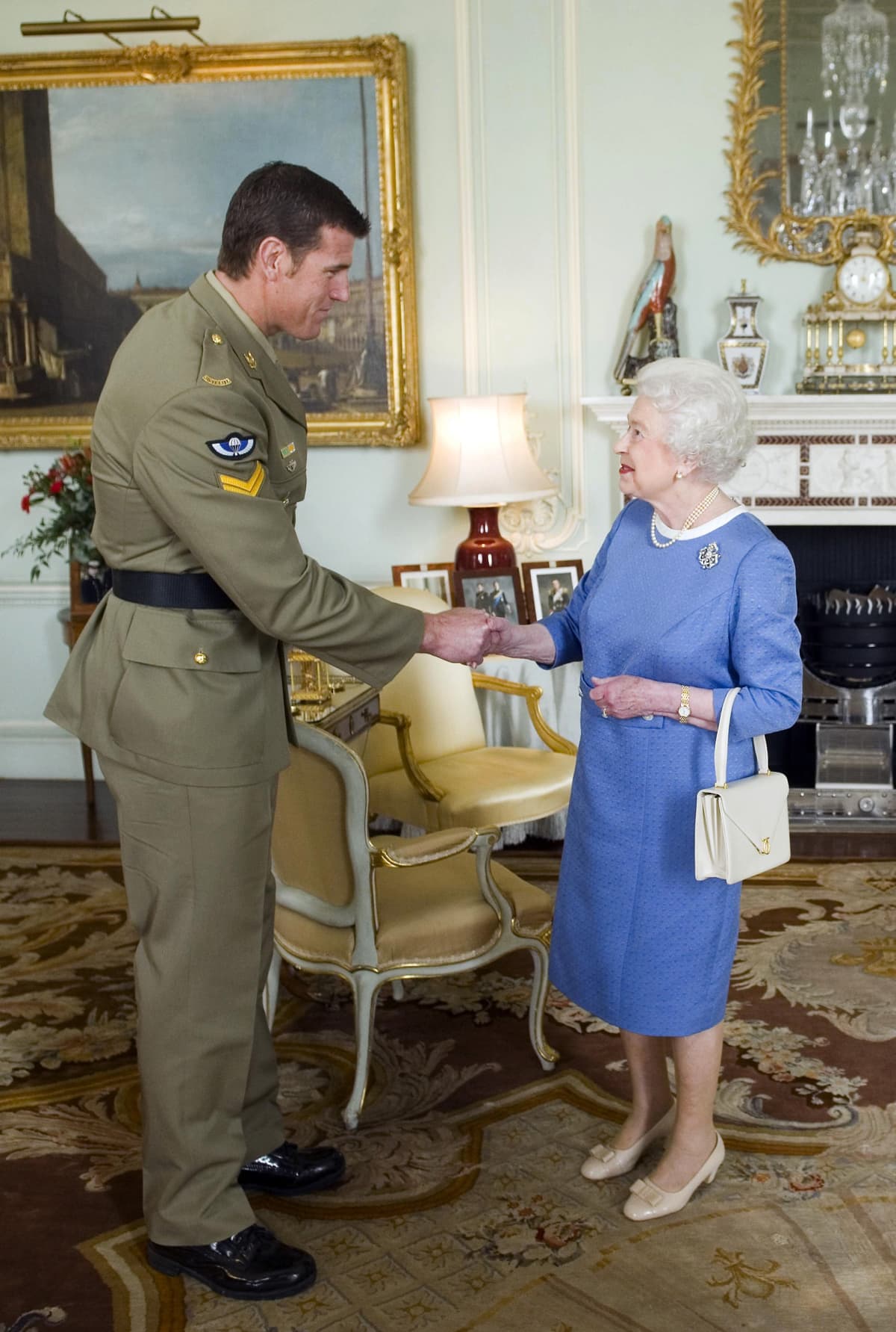
Initially I thought this photograph was a "picture worth a thousand words" and that no further explanation was required. But perhaps I was wrong.
The two persons in the photograph are of course the late Queen Elizabeth II and Australian Army Corporal Ben Roberts-Smith V.C.
For monarchists, the photo speaks of everything good about the monarchy. A dignified and gracious yet amiable Queen Elizabeth greeting the tall, well-built, handsome and immaculately uniformed Roberts-Smith, who, we are told, had served with such distinction in the Afghan war that he had been awarded the British empire's highest military honour, the Victoria Cross.
However thanks to the efforts of an Australian journalist we now know that the same Ben Roberts-Smith took an old man in handcuffs to the top of a cliff and then kicked him over the edge. When the man survived his fall, though terribly injured, Roberts-Smith sent a subordinate to administer the coup-de-grace with a bullet to the head. Other incidents confirm that Roberts-Smith is a thug, a liar, and a ruthless bully and that many of his comrades are of the same ilk.
It is possible that Queen Elizabeth herself had no understanding of the atrocities being perpetrated by her forces in Afghanistan or of the crimes committed by Roberts-Smith in particular, but one thing is certain: her advisors, her intelligence chiefs, her military commanders and her government ministers in Britain, Australia and New Zealand knew exactly what the Anzac forces were up to in Afghanistan, and they have used the personal aura of the monarch to deceive the public into thinking that all was above board. The Queen, as head of state, should have known. She should have made it her business to know. She may well have known. But she also would have known that she would never be held to account for the crimes committed by those under her command, those who acted in her name, and those whom she showered with honours. An elected head of state might not necessarily be a "better person" than Elizabeth Windsor, but the crucial consideration is that an elected head of state would always be accountable.
In a real democracy everyone, most particularly the head of state, must answer for their own acts or omissions. If the monarch as head of state cannot be held to account, then who can? If the monarch can so easily be turned to the glorification of evil, then what purpose could she or he serve in a nation which seeks to uphold even a modest standard of morality?
Note: The photograph above is the only photographic image that has been posted to this website over the 16 years of its existence and I expect it will remain unique in that respect. The "European" symbols which appear in the header are expressions of the written symbolic language (te reo tohu) used in Aotearoa in the late nineteenth century. As such they carry complex meanings and also need to be interpreted in light of specific historic events and circumstances.
8 January 2024
US and allies Joint Statement on Yemen's regulation of shipping in the Red Sea
New Zealand's participation in the "Joint Statement" of 3 January is out of line internationally. With a few exceptions the governments subscribing to the Joint Statement are those from states with deplorable records in international affairs. There are the former imperial powers the Netherlands and Belgium, and the current imperial powers the United Kingdom and United States, all with a history of horrific genocidal violence against colonized peoples. Then there are Germany, Italy and Japan, also former imperial states which constituted the Axis powers in the Second World War. Next the traditional vassal states, the British colonies of Canada, Australia and New Zealand, and Bahrain which is ruled by a family of brutal despots. That leaves only Denmark, South Korea and Singapore, all three of which have a dark history of autocracy and all of which are beholden to the United States of America. From 1940 to 1943 Denmark was an ally of Nazi Germany, and its navy effectively became part of the the the Nazi Kriegsmarine. So the Realm of New Zealand has set out upon an immoral mission, providing diplomatic and possibly naval support to the Israeli genocide in Gaza, and it has done so in some very nasty company.
Unlike New Zealand, the moral majority of the world's states and the world's population do not subscribe to the Joint Statement.
Then, going beyond the talk, we have action in the form of Operation Prosperity Guardian, in which, despite their words, Germany, Italy, Japan, Belgium, Singapore or South Korea are reluctant to participate, although the quisling states of Norway, Denmark and Greece (all with a history of fascist rule in the mid-twentieth century and strong fascist movements to this day) have stepped forward to offer token support. So far the only states to commit warships are the United States and United Kingdom, although the former fascist states of Denmark and Greece have expressed a willingness to do so.
There is no doubt that the Realm of New Zealand and the Royal New Zealand Navy has a place in the fascist flash mob of Operation Prosperity Guardian (which would more truthfully be designated as "Operation Gaza Genocide"). But the people of Aotearoa do not. The RNZN is not just a threat to the people of Gaza. Naval gunboats participated in the invasion of the Waikato and the shelling of Pukorokoro in 1863 and many other actions against our people, and the colonial regime has always relied upon its navy to suppress popular movements of resistance in our country, such as during the depression between the world wars and the 1953 waterfront lockout. The RNZN is not just an enemy to the people of Gaza. It is our own enemy, and should always be regarded as such. The Yemeni action regulating the passage of vessels in the Red Sea is justified, proportionate, and necessary to place restraints on the attempt to exterminate the people of Gaza. If military personnel from the Realm of New Zealand join with the US led naval forces against the Yemeni allies of the Palestinian resistance, then the Realm will become an active participant in the Gaza genocide.
5 December 2023
Shane Jones is Right
Shane Jones is right. We are still playing victim to colonialism. Te Pati Maori's objection to, and then acquiescence in the parliamentary oath of allegiance to King Charles at the opening of Parliament on 5 December proves Shane's point. The ultimate victim is not the one who goes down fighting, but the one who can be made to do something repugnant to every fibre of his being. The colonialists know that very well. The sole purpose and effect of the oath of allegiance to the British monarch is to humiliate nga tangata motu. It can serve no other purpose.
Te Pati Maori addressed the problem by reducing it to a farce. They pledged allegiance to Kingi "Harihari" ("Charlie" or "skin rash") rather than Kingi "Tiari" ("Charles"). The risk with such a strategy is that the colonialists can call their bluff and demand that they retake the oath in its proper form. On the other hand, if the matter is allowed to stand, then the dignity of both Te Pati Maori and the institution of Parliament will have been degraded by the affair.
There may come a day when "the elected representatives of the people" stand their ground and on that day you would be able to put a ring around the date on the calendar and write underneath it "This was the beginning of the end of colonialism in Aotearoa". Sadly 5 December 2023 was not that day.
The more likely scenario is that parliament will be brought into public contempt by the shennanigans around the oath, leaving the institution sidelined while the decisive struggle for mana motuhake and rangatiratanga takes place out in the community.
To their credit, Te Pati Maori did make the oath an issue, and that requires a degree of courage and patriotism which is altogether lacking in Shane Jones. Te Pati Maori also brought the people of Aotearoa out onto the streets to demonstrate our opposition to the colonial regime.
But we can no longer afford to be a colonized people. We can simply refuse to be bullied and humiliated by the colonialist regime. We can stop being victims and become the masters of our own destiny.
Posted 7 November 2023
Gaza in 2023 and the Warsaw Ghetto in 1943 are two sides of the same coin
By Malcolm Evans
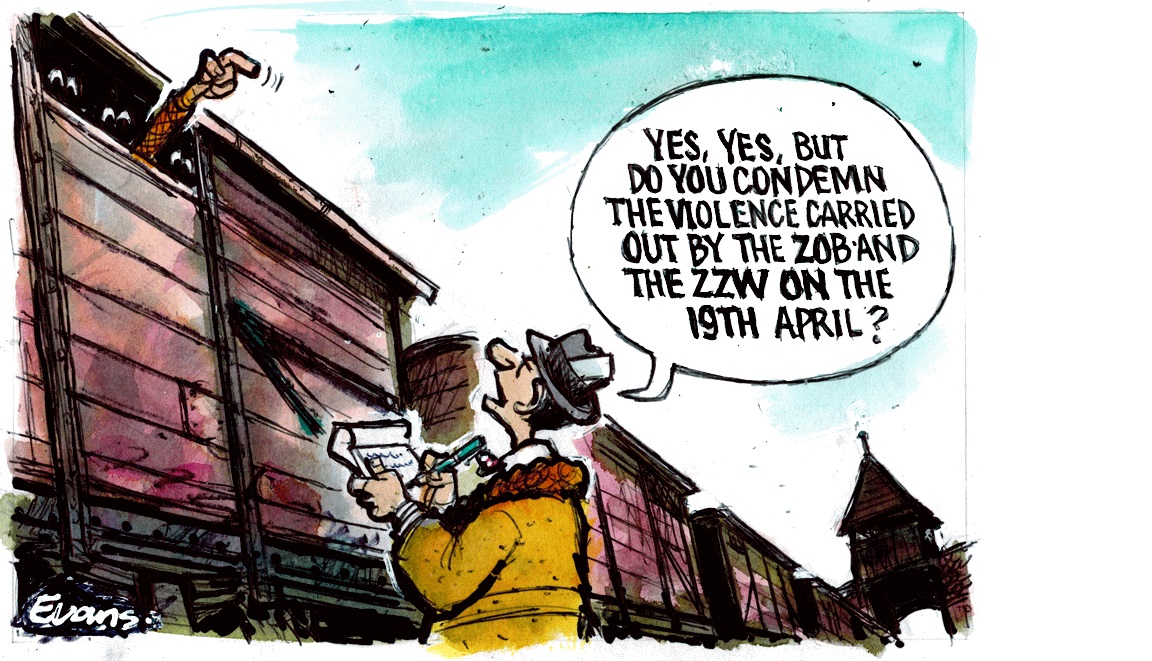
The destruction Israel is now raining down on Gaza, in retaliation for the Oct 7 uprising Palestinians launched earlier, has no more fitting parallel than that suffered in 1943 when the Jews in the Warsaw ghetto rose up against the genocide being waged on them by the Nazis.
Driven from their homes and their properties seized, Europe's Jews were herded into walled-off districts to await the pleasure of their Nazi oppressors. And just as that tyranny took place in Poland then, so has it been systematically executed by Israel in Palestine since 1948.
And just as happened then, after most of the Warsaw ghetto's Jews had been transported to their deaths and the remainder rose up against their Nazi oppressors, so too have Palestinians, after 75 years and thousands of Palestinian deaths, risen up against Israel's Nazi-like treatment of them.
As fair a comparison as it's possible to consider.
In the exact same way Jews were treated, Palestinians have been driven from their homes, had their property seized and they have been herded into walled-off enclaves, And, just as the Jews of Warsaw did, rather than wait to become victims of another Holocaust, or Nakba as Palestinians know their experience, they have fought back.
Like the Warsaw Ghetto's Jews, despite knowing their survival was unlikely, yet determined "not to allow the Germans to pick the time and place of our deaths", so too have Palestinians decided not to allow Israel's Nazi-like Apartheid regime to determine the number of their days.
But you aren't allowed to consider that comparison
To guard against such truths igniting your humanity, our craven media cuts and pastes foreign news agency Zionist propaganda, to keep you sympathising with Apartheid Israel. News reports which always present Israel as the victim and any actions it takes against Palestinians as being born of "regrettable necessity," are deliberately designed to distort your understanding of the reality. Our media always presents the suffering of Israelis as just that much more pitiful than that of Palestinians. Israeli forces are called "the IDF" to project them as "disciplined professionals", whereas Palestinian fighters are disparagingly referred to as "Hamas", "militants", "terrorists", and now as "human animals" and "snakes" whose actions are "barbaric" and comparable with "ISIS." Formed in 1987, Hamas is a Palestinian nationalist movement dedicated to the establishment of an independent Islamic state in historical Palestine and its para-military wing, the Izz a lDin al-Qassam Brigade, which has conducted many attacks against Israel, is regarded as a terrorist organisation.
As contemptible as it is in wartime to weigh the brutality of opposing forces, to determine which is the most, or least, honourable, the findings count for nothing if the opposing forces aren't fairly compared.
Zionist nationalist groups that compare most closely with that definition of Hamas fighters are the Hagganah, the Palmach, Irgun and the Stern Gang, all of them infamous for the savagery and barbarism of their attacks on Palestinians prior to Israel's formal establishment in 1948, when they were universally recognized as "terrorists" .
If Hamas can be described as "barbaric," then they have had good teachers
The groups who fought the Nazis in the Warsaw Ghetto were divided politically, but to project their solidarity today they are presented as simply valiant Jews united against a common foe. But "solidarity" is the last thing our media wants conveyed when it comes to Palestinians, and so they are always presented as "extremists" and "radicals", somehow apart from other Palestinians all suffering under the same tyranny.
All war is barbaric, not least the killing of innocents, but the way of a victim's death is no less barbarous when, instead of war-surplus hand grenade, it results from a multi-million-dollar guided missile launched from a bunker miles away.
The Media is Israel's first line of defence.
If "the first casualty of war is truth," then the media must be held to account for the distortions in foreign news agency reports it publishes, as was highlighted by the Radio NZ journalist, Mick Hall, who tried to bring balance to RNZ's reporting on the war in Ukraine, but was rail-roaded for his trouble.
The Warsaw uprising lasted from 19th April 1943 until 16th May when the SS commander ordered the ghetto's "block by block destruction" which killed 13,000 Jews, about half of whom were burnt alive or suffocated.
Something similar is happening in Gaza right now.
Malcolm Evans
12 October 2023
References;
https://www.youtube.com/watch?v=fjVQgDhMuis
https://en.wikipedia.org/wiki/Warsaw_Ghetto_Uprising
https://encyclopedia.ushmm.org/content/en/article/warsaw-ghetto-uprising
https://scheerpost.com/2023/10/08/chris-hedges-palestinians-speak-the-language-of-violence-israel-taught-them/
https://www.dni.gov/nctc/groups/hamas.html
https://www.aljazeera.com/news/2023/5/15/the-nakba-five-palestinian-towns-massacred-75-years-ago
https://www.youtube.com/watch?v=QUCeQt8zg5o
https://www.youtube.com/watch?v=QUCeQt8zg5o
PS; Interestingly, just as US defences were "down" when 911 happened, coinciding with the Neocons' need of "a new Pearl Harbour" to ignite their "war on terror", so has the failure of Israel's state-of-the-art protection systems coincided with Prime Minister Netanyahu's introduction of Nazi-like law changes being widely challenged.
7 November 2023
The Dark Web of Colonialism
What does the 1918 massacre at a Bedouin camp in Palestine, the exploits of a Rhodesian bomber pilot, the bombing of the city of Dresden in 1945 and the bombing of Gaza in 2023 have to do with the work of "the doyen of left-wing journalists" in New Zealand?
Quite a lot it seems. The journalist in question is Christoper Marshall Trotter, who since October 7 of this year has been amassing and publishing material intended to justify the New Zealand government's tacit support for the saturation bombing of Gaza. To that end Trotter has found a clincher in the shockingly candid writings of Marshal of the Royal Air Force Arthur "Bomber" Harris. Harris started his military career as a pilot for the RAF in World War I. From there he went on to serve with the British forces in Palestine, helping to suppress a number of Arab uprisings. He is on record as saying that "the only thing the Arab understands is the heavy hand" and that "one 250 lb. or 500 lb. bomb in each village that speaks out of turn" would solve the problem of Arab resistance to British rule.
By the time of World War II Harris was the Marshal of the Royal Air Force in charge of Bomber Command. In that capacity he set out to kill as many Germans as possible admitting that "the destruction of German cities, the killing of German workers, and the disruption of civilised life throughout Germany ... the destruction of houses, public utilities, transport and lives, the creation of a refugee problem on an unprecedented scale, and the breakdown of morale both at home and at the battle fronts by fear of extended and intensified bombing, are accepted and intended aims of our bombing policy. They are not by-products of attempts to hit factories."
The New Zealand government pejoratively designates certain anti-imperialist entities as "terrorist", yet it is clear from the writings of Bomber Harris that the entire imperialist project in which New Zealand participates is built around the cold, calculated use of terror and the mass killing of civilians.
A hundred years on, Bomber Harris' tactics are now being employed against the same Arab foe in his old bombing range of Palestine.
New Zealand governments have had a long association with the works of Bomber Harris. Their Anzac troops fought for the British in Palestine, and, like Harris, regarded civilians as legitimate targets. After New Zealand troops massacred at least 40 Bedouin tribesmen in a reprisal raid in 1918, their own British commanding officer described them as "cold blooded murderers". Then thousands of New Zealand airmen went on to fly under the orders of Bomber Harris in the infamous bombing raids over Germany cities in the closing years of World War II.
Now, as the Labour government talks only of "Israel's right to defend itself" and the bombs fall on Gaza, Chris Trotter endorses the bombing campaign and echoes the words of Bomber Harris. Trotter declares that Harris "spoke the brutal language of military necessity. Faced with the impossibility of defeating Germany without killing Germans, he point-blank refused to indulge in moral humbug". Of course it was impossible to defeat Germany without killing Germans, and it is impossible to defeat Hamas without killing Palestinians in vast numbers. But New Zealand governments are too ready to equate cold blooded murder with Anzac heroism, too ready to believe that the deliberate mass killing of civilians and "the disruption of civilised life ... the destruction of houses, public utilities, transport and lives, the creation of a refugee problem on an unprecedented scale" are all justified in the defence of Anglo-American imperialism.
Was Harris completely devoid of regard for human life? On the contrary, he argued that "Attacks on cities .. are strategically justified in so far as they tend to shorten the war and preserve the lives of Allied soldiers. .. I do not personally regard the whole of the remaining cities of Germany as worth the bones of one British Grenadier." As a committed colonialist, Harris valued British lives above all others. The lives of Africans, Arabs and Germans were of little or no account when measured against the life of a "British Grenadier". New Zealand colonialism conforms to the same ungodly logic. Trotter expresses sympathy for the victims of Hamas attacks In the same breath that he calls for "brutal ...military necessity" and disparages the "moral humbug" of sympathy for Palestinians. Trotter rhetorically asks "How is it possible... to absorb all the details of the rape, the torture, the killing (by Hamas) - and not respond with fury and disgust?". (As it happens there is no evidence of rape or torture by Hamas on October 7 - "all the details" are conspicuously missing - far less the "beheading of babies" as alleged by President Biden, Prime Minister Netanyahu, and other western politicians). Along with the cold, clinical resort to considerations of "military necessity" on one side there must be a mass of atrocity stories on the other, with truth lying buried beneath the rubble.
The brutal history of British imperialism and New Zealand colonialism on the world stage needs to be acknowledged. Trotter has done that, but only to go on to say that it was entirely justified, and to say that it is not justified is, in his words, "moral humbug".
The "cold blooded murderers" of the Surafend massacre were never called to account and the morality of bombing a village that "speaks out of turn" has not been questioned in New Zealand government or military circles. So New Zealand is not an innocent bystander of the catastrophe being played out in Gaza. Along with the mother country, Great Britain, it has blood on its hands. The brutally racist legacy of Bomber Harris is also New Zealand's legacy to the world.
Some of us might think that a left-wing government and self-described "left-wing" journalists would take a more humane approach to the unfolding catastrophe in Gaza. Unfortunately that is not always the case. Whether it comes from the right or the left, colonialism follows its own inexorable logic, under which the interests of the empire must be upheld regardless of right or wrong. The first Labour Prime Minister Michael Joseph Savage declared "Where Britain goes, we go. Where she stands we stand" and that is just as true today except that now New Zealand will blindly follow the United States as well as Britain. In doing so New Zealand forsakes its humanity and helps to bring enormous suffering into the world.
But there is another more practical consideration. New Zealand has been on the losing side in every war that it has fought since the war in Vietnam. Most recently it was roundly defeated in Afghanistan. It is yet to be seen whether it and its western allies will prevail in the war in Ukraine, and success in Gaza cannot be taken for granted. Despite the asymmetry of power between western forces and the centres of resistance in the wider world it is possible that "the war situation .. will develop .. not necessarily to imperialism's advantage". In order to avoid being caught in the dark web of colonialism we need to be able to see it. Only while invisible does it have the power to capture us. That is why the colonial regime tries to ensure that we are told as little as possible about the history of Palestine and New Zealand's involvement in the tragedy. When we see the connections between "Bomber" Harris and Christopher Trotter, between the Anzac Palestine campaign of 1918 and the IDF Palestine campaign of 2023 and between Dresden, Hiroshima and Gaza City, then the dark web of colonialism is more clearly illuminated and we are in a better position to avoid being caught in its filaments.
We also need to be aware that since the Second World War the worldwide dark web of colonialism has been steadily degraded by movements of national liberation. That web is now on the verge of being torn apart and the imperialist spider at its centre is at risk of losing control of the events in its world.
5 November 2023
Remember the Warsaw ghetto
(Drawn from Wikipedia article "Warsaw Ghetto")
The Warsaw Ghetto .. was established in November 1940 by the German authorities within the new General Government territory of occupied Poland. At its height, as many as 460,000 Jews were imprisoned there, in an area of 3.4 km2 with an average of 9.2 persons per room, barely subsisting on meager food rations.
An influx of refugees into the ghetto...
By the end of the September campaign the number of Jews in and around the capital increased dramatically with thousands of refugees escaping the Polish-German front. In less than a year, the number of refugees in Warsaw exceeded 90,000.
Non-Jews also contained in the ghetto...
In January 1940 there were 1,540 Catholics and 221 individuals of other Christian faiths imprisoned in the ghetto, including Jewish converts. It is estimated that at the time of closure of the ghetto there were around 2,000 Christians, and number possibly rose eventually to over 5,000. Many of these people considered themselves Polish, but due to Nazi racial criteria they were classified by German authorities as Jewish..
Collaboration...
.. families and individuals frequented restaurants, clubs and cafes, showing in stark contrast the economic inequalities of ghetto life. Tilar Mazzeo estimates that group at around 10,000 people - "rich industrialists, many Judenrat council leaders, Jewish police officers, profiteering smugglers, nightclub owners [and] high-end prostitutes" who were spending their time at over sixty cafes and nightclubs...
Capitalists of the occupying power exploit labour from the ghetto...
Not long after the ghetto was closed off from the outside world, a number of German war profiteers ... appeared in the capital. At first, they acted as middlemen between the high command and the Jewish-run workshops. By spring 1942, the Stickerei Abteilung Division with headquarters at Nowolipie 44 Street had already employed 3,000 workers making shoes, leather products, sweaters and socks for the Wehrmacht. Other divisions were making furs and wool sweaters also, guarded by the Werkschutz police. Some 15,000 Jews were working in the ghetto for Walter C. Tobbens from Hamburg, a convicted war criminal...
Finally, resistance...
Many of the remaining Jews decided to resist further deportations, and began to smuggle in weapons, ammunition and supplies
On January 18, 1943, after almost four months without deportations, the Germans suddenly entered the Warsaw Ghetto intent upon further roundups. Within hours, some 600 Jews were shot and 5,000 others removed from their residences. The Germans expected no resistance, but the action was brought to a halt by hundreds of insurgents armed with handguns and Molotov cocktails.
Preparations to resist had been going on since the previous autumn. The first instance of Jewish armed struggle in Warsaw had begun. The underground fighters achieved considerable success initially, taking control of the ghetto. They then barricaded themselves in the bunkers and built dozens of fighting posts, stopping the expulsions.
but ending in utter destruction...
The final assault started on the eve of Passover of April 19, 1943, when a Nazi force consisting of several thousand troops entered the ghetto. After initial setbacks, 2,000 Waffen-SS soldiers under the field command of Jurgen Stroop systematically burned and blew up the ghetto buildings, block by block, rounding up or murdering anybody they could capture. Significant resistance ended on April 28, and the Nazi operation officially ended in mid-May, symbolically culminating with the demolition of the Great Synagogue of Warsaw on May 16. According to the official report, at least 56,065 people were killed on the spot or deported to German Nazi concentration and death camps .
1 November 2023
"Israel's right to exist"
A stock phrase of western propaganda is that "Israel has a right to exist" and its complement "Israel has a right to defend itself". These phrases are repeated as though they are irrefutably true.
Taking "Israel" to mean the State of Israel, can one reasonably say that any state "has a right to exist?". States come and go. Some are relatively benign in their relations to their own subjects and other foreign states. Some are chauvinistic, putting the interests of their own citizens ahead of the legitimate interests of other peoples. Some are despotic, terrorizing their own population while fawning upon the rulers of foreign powers. To say that all states have an equal right to exist is nonsense. States exist, and it is in their nature as states to try to perpetuate their existence but it is senseless to speak of a "right to exist" as though no one, not even their own people, have the right to bring that existence to an end.
Israel's "right to exist", like the "right" of any other state, is conditional upon its behaviour. We cannot use the right to exist as a starting premise as we might in the case of a human being. States do not have a breath, blood, and life. They are nothing more than an arrangement made among certain persons in order to manage the affairs of the population as a whole, including its relations to other peoples and other states. Further, while the existence of one person does not preclude the existence of another, the existence of one state certainly does preclude the existence of any other state within that state's claimed sovereign territory. That means that we must choose between states or prospective states. We cannot automatically assume that the Realm of New Zealand has a right to exist, and that in consequence Te Whakaminenga a Aotearoa does not. Similarly we cannot assume that the State of Israel had a right to exist and the Palestinian state does not. We must examine the State of Israel's conduct within its own territory and in relation to its neighbours before deciding whether its continued existence is in the best interests of the Jewish people, the Palestinian people, and the peoples of the world. I am not in a position to make such a judgement. All I can say is that there are some arguments to say that it is, and some other very concerning evidence to suggest that it is not. What I can say, with absolute certainty, is that "Israel's right to exist" is not a given.
The second claim that "Israel has a right to defend itself" is also not a given. The right to defend oneself is not unconditional. If one robs a dairy one does not have the unconditional right to defend oneself against arrest. In other words, the right to defend oneself can be forfeited as a result of one's own criminal actions. Even if one is the victim of an assault the right to self-defence is still qualified. We do not have the right to cut the throat of the man who shoves us out of line in a queue. The response must be proportionate to both the damage suffered and the threat posed, and it must be clearly directed towards the perpetrator. We cannot take it upon ourselves to cause grievous harm to the wife and children of the man who robs our shop. We cannot turn the robber's entire family out of their home to compensate for the loss or suffering that he has brought upon us.
We should not accord greater rights to states than we would grant to an individual human being. In fact, states should be subject to much more severe limitations because unlike the human being, a thing of flesh and blood, desires and feelings, capably of loving and being loved, created in the image of God, states are nothing more than arrangements which suit the immediate interests of the persons who constituted those states and which give those persons sometimes inordinate power over others.
There are questions to be asked about the State of Israel's conduct and therefore its "right to exist" and its "right to defend itself". But the true evil in the present crisis, arises not out of the state of Israel, or the Jewish people, but from European and Anglo-American imperialism, including the Realm of New Zealand, which have created, bankrolled and sustained the carnage in the Middle East to the great suffering of the Jewish and Arab peoples. These states, including the Realm of New Zealand, now wish to bring about the final extermination of the Palestinian people and the State of Israel is their chosen instrument for effecting that end.
The Israeli President, Isaac Herzog, has said that the people of Gaza "could have risen up, they could have fought against that evil regime (of Hamas)" but because they did not do so they must pay the price of failure with the blood of their children. I cannot say if the people of Gaza should have "risen up against" Hamas, but I do know that their failure to do so does not justify the massacre of innocents or their expulsion from their homes and their land. I also know that if the people of Gaza could have risen up against their rulers, so could the people of Aotearoa, who remain subject to an evil colonialist regime. That is something to which we should be giving urgent consideration.
17 October 2023
The Realm of New Zealand's response to the plight of the Palestinians
When all is said and done, Israel's blockade of Gaza which blocks the population's access to water, food and electricity, is a clear sign that Israel is prepared to exterminate the Palestinian population of Gaza. The State of Israel claims that it's sole objective is to destroy the militant group Hamas. However Hamas is an expression of the suffering of the Palestinian people and the only way to destroy Hamas is to remove the suffering or to destroy those who suffer. Killing all those who have a formal connection to Hamas would be like removing the pound of flesh closest to Gaza's heart. It is impossible to achieve without killing the mass of people along with the Hamas militants. And, unfortunately the people of Gaza have no Portia to plead their case.
A war of extermination is not Israel's preferred option for Gaza or the Palestinians as a whole. Israel would rather surround Gaza with factories than with tanks, and have the Palestinians cross the border to work in Israel each morning, returning to their places of incarceration in Gaza every night. The dream of every colonial power is to turn the colonized people into a compliant efficient labour force. However such a policy never works in the long term, and it can only work in the short to medium term if it is not made abundantly clear that the colonized people are regarded as different, inferior and undeserving of the rights accorded to the colonizers. The apartheid regime in the Union of South Africa lasted only four decades, and the idea of Palestinian labour from Gaza being used to man factories in southern Israel barely got off the ground.
So there are two remaining options for Israel.
One is to drive the Palestinians out of the territories coveted by Israel. That would require cooperation from neighbouring Arab states such as Egypt and Jordan, states which have collaborated with Israel over recent years, but would be unlikely to accept five million Palestinian refugees, even in transit to other countries. Neither would the US, UK or for that matter New Zealand accept large numbers of Palestinian refugees. None of those countries would give free access to Jewish refugees from Europe in the years prior to the Second World War and the Nazi's attempted extermination of the Jewish race, so it would be idle to suggest that they might feel compassion for the Arab people of Palestine. So although Israel's order for the population of Gaza to start moving south towards Egypt suggests a willingness to see the Palestinians live on as refugees beyond the borders of Palestine, it will not happen, first because it is logistically impossible for the Palestinians to move en masse in the direction of Egypt, and also because the present Egyptian regime will not accept them. When asked whether Israel itself would accept civilian refugees from Gaza, an Israeli politician gave no answer but a wry smile that said more clearly than any words could "No. The Palestinians, whether militants or civilians, are the enemies of Israel. They will be driven out, and are not to be allowed in"
The only remaining option is extermination - the final solution to the Palestinian problem.
The Realm of New Zealand has remained silent over Israel's actions and intentions with respect to the Palestinian problem for reasons that are simple enough to discern. The Realm of New Zealand is a colonial entity which has become more emphatically colonialist under the Labour government of Jacinda Ardern and Chris Hipkins. Wellington will automatically defer to the Westminster and Washington in all matters of foreign policy and on the Palestinian issue the position of the imperial powers is very clear: the Palestinians must be either fully subjugated or exterminated.
The New Zealand state has other reasons for supporting Israeli policy on the Palestinians, because in the the 1870s a New Zealand Premier, Sir Julius Vogel, was obliged to confront the problem of continuing Maori resistance to colonization. Vogel saw himself as having a choice between a war of extermination and mass European immigration which would be used to overwhelm and subjugate Maori. Vogel was able to opt for the latter option, which has been faithfully followed by successive New Zealand governments for the past one hundred and fifty years. However this option could only work because there was a willingness to assimilate Maori into settler society, and the willingness to assimilate Maori was dependent upon a number of factors.
First, space. There was enough room in the land to accommodate both the European immigrant population and the remnant Maori population. Second, time. Because there was enough room to allow Maori to survive, albeit in straitened circumstances, there was time to assimilate Maori into settler society, a process which took place over the space of an entire century. Third, and most importantly, there was the will. Settler society was ultimately willing to accept Maori as social equals, and to grant them full rights of citizenship while extracting value from the Maori population as an effective agricultural and later industrial workforce, and, from 1870 onwards, as an important element in the military forces of the colonial state.
None of these conditions apply in the case of Israel and the Palestinians. The original territory of Palestine, comprising the State of Israel and the Palestinian territories, is small, and Jewish settlers openly covet the fields and olive groves of Palestinian farmers. Then, British imperialism was opportunistically racist, rather than intrinsically racist, as was evident from its dealings with Maori in New Zealand, and for that reason it was able to accept Maori as equal citizens so long as Maori in turn accepted the British claim to sovereign authority. Because Israel defines itself as a Jewish state, it may tolerate sojourners of other races or faiths, but cannot tolerate the idea of a non-Jewish component of the population which might be in a position to definitively alter its character as "the" Jewish state.
Yet despite the fact that colonialism in New Zealand has taken a different form and a different route to the colonialism of the State of Israel, the Realm of New Zealand still identifies with Israel as another colonialist state. New Zealand remembers when it violently rejected the "two state solution" proposed by the Maori Kingitanga movement in 1858. It remembers that it used atrocities committed by dissident Maori to justify its own much greater atrocities against the indigenous people of the land. It remembers contemplating a war of extermination. It remembers adopting the policy of mass immigration to overwhelm Maori. It sees in Israel a harder, stronger manifestation of its own identity as a colonialist state, and for that reason it admires and supports the State of Israel.
Maori remember the same events from a different perspective. That is probably why Nanaia Mahuta, the Maori Minister of Foreign Affairs in the colonial administration, issued a rebuke to Hamas which was judged to be too equivocal by the Prime Minister, Chris Hipkins, and that may be one of the factors which caused Maori voters to withdraw their political support from the Labour government in the recent general election, in favour of the Maori party, Te Pati Maori, which is more sympathetic to the Palestinian cause.
Britain set the stage for the Palestinian tragedy by its actions between 1914 and 1947, but the Realm of New Zealand has also contributed to the history of atrocities and war crimes which provoked the current crisis. In 1918 Anzac forces massacred 40 inhabitants of the village of Surafend in a reprisal raid, and in 1947 a New Zealand Governor-General, Sir Bernard Fergusson, was complicit in the murder by torture of a 16 year old Jewish youth who had been putting up posters on behalf of a militant group in Jerusalem.
The Realm of New Zealand is now adding to its long and dishonourable history of involvement in the Palestine conflict, joining with the United Kingdom and the United States to encourage the State of Israel in a war of extermination against the Palestinian people of Gaza.
12 October 2023 (amended 14 March 2024)
A Referendum on the Treaty?
The ACT Party has issued a statement declaring that "ACT proposes that the next Government pass legislation defining the Principles of the Treaty, in particularly (sic) their effect on democratic institutions. Then ask the people to vote on it becoming law".
The Government is of course an institution of the Crown which signed the Treaty with certain Maori chiefs. So on the face of it this is a case of one party to a contract wanting to unilaterally determine the interpretation of the contract and then proposing to take a poll among people who are not party to the contract and not expert in matters of law to see whether they might agree with that interpretation.
That is an unorthodox approach to deciding how a contract should be interpreted and applied, but it is typical of the colonialist state and its cavalier approach to the sanctity of contract, or should we say, one particular contract, namely Te Tiriti o Waitangi.
ACT's proposal is distinguished by the fact that its three proposed "Principles of the Treaty" actually have little if anything to do with the Treaty, which means that they would effectively do nothing except make the Treaty void.
Let's look at ACT's "three treaty principles" and whether or not they can be related back to the Treaty of Waitangi.
" 1. All citizens of New Zealand have the same political rights and duties."
That was not the case when the Treaty was signed. There were no New Zealand citizens, only British subjects, Maori (the great majority) and Pakeha living under the protection of Maori. Power was held by the appointed officials of the British Crown on the one hand and Maori rangatira on the other and there was no suggestion that all had "the same political rights and duties". Currently the Governor-General, members of cabinet, members of the House of Representatives all have political rights and duties different from those of ordinary citizens. Prisoners of the state do not have the right to vote (whether they should or not is a valid question, but the fact is that they do not). Most of us can vote for only one local council, but a property owner with a highly dispersed portfolios could theoretically vote 78 times in local body elections across the country. ACT is trying to pretend that the Realm of New Zealand is a simple, primitive and natural democracy, which quite clearly it is not. In reality it is a structured system with highly differentiated roles, rights and duties. This representation of the political system mirrors ACT's simplistic and false depiction of the economic system as one where every citizen stands in the market with equal rights and opportunities. In fact the colonial system is always in need of a class of people who have fewer political and economic rights than others, and if it cannot find such a class within New Zealand it will import them in the form of grossly exploited migrant labour.
"2. All political authority comes from the people by democratic means including universal suffrage, regular and free elections with a secret ballot"
When the Treaty was signed there was no universal suffrage, no elections and no secret ballot. Elections came later, the secret ballot much later, and universal suffrage still later again. Even in the present day, ACT's second principle is constitutionally incorrect. King Charles is sovereign. He appoints the government of New Zealand, and he is not constitutionally bound to respect the will of the people. In a political crisis he almost certainly would not. He would do whatever was necessary to maintain the established order. Yes, there are elections, but we need to be asking whether those elections really give voice to the will of the people, whether we should be allowing politicians irrevocable power of attorney over our affairs for terms of three, four or more years, and whether the secret ballot serves any purpose other than to give room for electoral fraud or false allegations of fraud.
"3. New Zealand is a multi-ethnic liberal democracy where discrimination based on ethnicity is illegal."
From the day that the Treaty was signed "discrimination based on ethnicity" was the rule. This did not substantially change until late in the twentieth century. It is also incorrect to claim that "New Zealand is a liberal democracy". The Realm of New Zealand remains part of a conglomeration of parliamentary monarchist states in which sovereignty resides in the British royal family, as it did in 1840 when the Treaty was signed. For the present we should be asking the ACT Party and the government: "Why do you insist on a Head of State who owes his position solely to his British royal lineage, at the same time as you are saying that whakapapa Maori should have no place in our political affairs?"
The ACT Party is doing exactly what it accuses others of doing: defining the "Principles of the Treaty" in ways that have no bearing on the actual text of the document or its historical context.
To make matters worse ACT wants this strange piece of legislation to prevail over "any contradictory enactment by Parliament, or finding on the matter of Treaty Principles by the Courts". ACT would have to say that because in interpreting a contract the Courts are bound to look first at the actual wording of the contract and then at any relevant circumstances that place it in context. They cannot simply dream up an interpretation of the contract to suit the prejudices of politicians.
ACT's policy statement concludes saying "Nobody should get an extra say because of who their great grandparents were". This is extraordinary given that ACT Leader David Seymour pledged allegiance to Queen Elizabeth II on account of the fact that she was the 3x great-grand-daughter of Queen Victoria. Now her son, King Charles III, not only has "a say"; he will have the final say in any constitutional crisis, purely on the basis of his whakapapa and race.
So will this bizarre, immoral, contradictory and hypocritical proposal be enacted into law in New Zealand? Only if the New Zealand Parliament completely takes leave of its senses. Winston Peters who is no friend of "co-governance" or "privileges for Maori" is also nobody's fool and no doubt he will clearly see the folly of David Seymour's proposed "treaty legislation". Even Christopher Luxon can see the danger presented to the state by David Seymour's proposal.
But if by chance ACT does succeed in having the legislation enacted then the Treaty will have been effectively voided by the action of the Crown. Only the Treaty (in its English language version) can provide even a semblance of legitimacy to British colonial rule in New Zealand and once that is gone we revert to the status quo ante of 1835: rangatiratanga and the whakaminenga. Maori and Pakeha will be presented with a clear choice between colonialism and universal rangatiratanga, kotahitanga and mana motuhake and so the days of colonialism will be numbered.
While the ACT referendum proposal is just childish politicking, it is absolutely true that all the people of Aotearoa must have a voice in the arrangement of government. David Seymour's proposal falls well short of that. He is not giving us a voice in determining the future political constitution of Aotearoa. He is seeking to smuggle into law a quasi-constitution purely based on the political status quo.
The problem is that people, especially young people, are not happy with the way things are. They want to be able to exercise a real voice. They don't want to just tick a box in the shadows of a polling booth once every three or four years and walk out politically neutered after supposedly "having their say". They want leaders and representatives to be accountable. The only way they will get that is through building rangatiratanga as a genuine grass roots democracy. That will be our historic task as a people regardless of the fate of the Treaty Referendum proposal.
Comment from Lesley Sampson:
Some questions about this political issue ...
If it is not good for NZ to be ruled by the British monarchy (who have these rights because of who their great grandparents were), why should we instead have the Treaty of Waitangi imposed on us ( by those whose great grandparents signed it originally)?
If the British colonialist system/monarchy is unsuitable and undemocratic for NZ today, and should be scrapped, why not scrap the Treaty as well? It could also be said to be out of date in today's multi-ethnic NZ cultural mix . Why not do away with both of them and start anew??
Why not come up with a genuine NZ Constitution that includes some good features (if any) from both systems, and avoids top-down imposition and racial discrimination (both positive and negative)?
ACT's x3 policy ideas may not be applicable to the meaning in the original Treaty, but why dismiss them? Why not include some of these in a new Treaty/consitution for all NZers of today and the future?
"Equal rights and responsibilities", democratic voting, referendums, accountability in politics, non discrimination of ethnicities etc sounds good for NZ.
Why should ACT's suggestions for improvements have to match the historical Treaty of Waitangi document? NZ today is vastly different from 1840. Why does our choice have to be between Monarchist rule or the Waitangi treaty? Are there other, and/or better options?
Is it fair or just to impose traditions of a minority (I.e Maoridom) on the majority of other NZ citizens?
It is a fact that NZ today is multi-ethnic. Should everyone have an equal say in how we are governed? Is the Treaty of Waitangi just as out of date politically as the British Crown rule??
Geoff Fischer wrote in reply:
1. The difference between the British monarchy (one party to the Treaty) and Maori (the other party to the Treaty) is that Maori belong here and Pakeha belong with them. Frankly, King Charles and the whole apparatus of the British empire do not belong here.
2. I agree that the Treaty will one day pass into obscurity. It is no basis on which to found a nation. However it must be allowed to pass naturally, when we all agree that we have created something better than the regime established through the Treaty. Maori in particular must agree that we are moving on from the Treaty and they will do that as soon as they are allowed alternatives.
3. I personally would incorporate features of British governance and justice (the common law system) in a constitution for Aotearoa - along with rangatiratanga.
4. Of the three ACT principles the one I strongly disagree with is "regular elections ... and the secret ballot" for which I would substitute "continuous election and the open ballot".
5. "Why should ACT's suggestions for improvements have to match the historical Treaty of Waitangi document?" No reason, but they should not be misrepresented as principles of the treaty. They should be put forward as constitutional principles separate from the Treaty. Furthermore, a new constitution for Aotearoa must come from the people. If we were to allow the colonialist state to determine our future constitution we would end up with a constitution which is democratic in name only.
6. "Is it fair or just to impose traditions of a minority (i.e Maoridom) on the majority of other NZ citizens?". Over the past two centuries Maori traditions and culture have been widely taken up among Pakeha and other ethnic groups in Aotearoa without any suggestion of coercion or imposition, and I have no doubt that process will continue into the future. The same would apply to a new constitution based on the principles of rangatiratanga. The present colonialist constitution was imposed on us by deceit and violence. A new constitution for Aotearoa should not and could not be imposed on our people. It will develop organically through the replication of existing social institutions and will eventually win the backing of all the peoples of Aotearoa.
The treaty and the future constitution of Aotearoa are separate issues, connected only by the fact that once we have an agreed constitution of our own, the treaty will pass into abeyance. If the Crown unilaterally nullifies the Treaty, that may make the transition to a new constitution quicker, but also more antagonistic.
12 October 2023
The Minor Party Dilemma
A number of new parties have appeared on the conservative right in the current parliamentary election campaign. The formation of a new party indicates dissatisfaction with the performance, goals or policies of existing parties and thus it is clear that there is a significant amount of unhappiness on the right not only with the Labour and Green Parties but also with the National and ACT parties. Much of this discontent can be traced back to the pretty well unanimous parliamentary position on a range of issues which in an earlier time would have been subject to fierce debate. The Covid epidemic response, the war in Ukraine, the policy towards China, and the growing Five Eyes apparatus for mass surveillance of the New Zealand public are of concern to many but are never seriously debated in parliament or in the official media.
The left is also far from united, and at least one new party (The Women's Rights Party) has popped up on the left in opposition to some of the more "woke" policies of the Labour/Green government. On both the left and the right the new parties may be categorised as "radical conservative". That is, they tend to be conservative in relation to "woke" policies on gender, drugs and race, they are concerned about crime and they are suspicious of neo-liberalism and globalization, to all of which they seek radical solutions.
On the other hand the radical left haa been remarkably quiescent over Labour's policy of advancing the cause of global capitalism and Anglo-American hegemony. They have been struck with a form of post traumatic stress disorder by the parliamentary left's wholesale embrace of neo-liberal economics and military confrontation with Russia and China, and Labour's abject failure to address issues such as climate change, housing, gangs, drug abuse and the impoverishment of the working class. The left has ended up endorsing Labour (albeit reluctantly) as the supposedly "lesser evil" which has done little to mitigate the collapse in public support for the parliamentary left. Barring a few exceptions, the left has decided to go down with Labour's sinking ship while the wider public scrambles to save itself.
So the impetus for change in this election comes from the radical/conservative right, which has responded with a proliferation of parties. They include Democracy NZ, Freedoms New Zealand (comprising NZ Outdoors & Freedom Party, Rock the Vote and Hannah and Brian Tamaki's Vision New Zealand), the Leighton Baker Party, New Zealand Loyal (Liz Gunn) and New Zeal (Alfred Ngaro).
Inevitably the suggestion has been made that rather than "split the vote" all these parties which have much in common should combine under a single banner in order to get over the 5% threshold for parliamentary representation. To a degree that has already happened with the Freedoms New Zealand Party, which is effectively a coalition. However there are two objections to this proposal. The first is a practical one, which is that in most cases these parties are the creations of strong-minded individuals who would compete for leadership in any united front, causing frictions which could be just as damaging as competition between separate parties, if not more so. The second is a closely related matter of principle: ideally, the competition between personalities, policies and even closely related principles should be allowed to play itself out to a logical conclusion. That is, after all, one definition of democracy. Curtailing that democratic competition in order to meet the requirements of a profoundly anti-democratic system (specifically the 5% threshold) would do democracy no service.
If, through a political miracle, one of the new parties was to cross the threshold and make it into parliament the same problem would re-appear in a different form. Should the new party compromise its principles to ally with a major party and thus become part of government, or should it sit impotently in opposition for three years? That is the question that confronted the Green Party, the Maori Party/Te Pati Maori, the New Zealand First party and the ACT party whenever they have been in parliament. Only the ACT party has been able to make it work in a sustainable way, in large part due to a steady helping hand from the National Party. For all the other parties the barriers to parliamentary representation have left them see-sawing between electoral elation and political oblivion.
This all goes to show that it is extraordinarily difficult to change the distribution of political power within the New Zealand system. All the minor parties that have made it into parliament have started as off-shoots of the major parties, with a sitting member or members at the helm. That is true of ACT (founded by Labour MPs Roger Douglas, Richard Prebble and Ken Shirley among others), New Zealand First (founded by the irrepressible National Party MP Winston Peters), the now defunct New Labour/Alliance/Progressive Parties (founded by Labour MP Jim Anderton), United Future (founded by Labour MP Peter Dunne and four National Party MPs), the Maori Party (founded by Labour MP Tania Turia) and the Mana Party (founded by Maori Party MP Hone Harawira). Having a member already in parliament provides access to state resources and media attention, and it gives the party some public credibility with respect to the 5% threshold or the other option of a constituency seat. The problem is that if the success of a new party depends on having an existing member of parliament from an existing party in the leadership role then the chance of it even wanting to effect radical change is slight. (Ironically, the one area in which change can be effected with relative ease is in the Maori seats, which sections of the right wish to abolish. It is important to understand the reasons why democracy functions better within the Maori seats, but that is something to be discussed at another time).
Again, because New Zealand does not have a primary voting system such as in the United States, there is no possibility of a populist outsider coming through one of the established political parties to shake the system up. Donald Trump was able to use the primary system to translate public support into political power, against the will of the Republican Party machine, but the likes of Liz Gunn in New Zealand have no such options. Their prospects of power may be doomed from the start because the New Zealand system denies them the means to gain the traction which they would find within the more democratic (though far from perfect) electoral system of the United States.
There is no disputing that the 5% threshold is designed to assist the major parties and to frustrate the efforts of voters to break their monopoly on power. If the politicians succeed in their desire to grant themselves a four year term in office, the problem will become that much worse. Let us assume that a popular initiative leads to a new party of say one thousand paid up members (the legal minimum of is 500) winning 30,000 votes in an election with a large turnout of voters. Without the threshold that party would win one seat in parliament. With the threshold they face a further three (or four) years in the "political wilderness" during which the enthusiasm and numbers of party members must be maintained, finances must be restored, in some cases new candidates found, and the world will have changed, perhaps irretrievably for the worse. At the next election they gain 100,000 votes. Still not enough to get representation. Another three or four years pass, more than six to eight years in total, and at the next election they gain 150,000 votes. Suddenly they are in parliament with 6 untried and tested members in the house, who must then confront the problem of whether they go into coalition with the parties that have kept them out in the cold for the past six to eight years. This is the optimistic scenario for a minor party.
The more realistic scenario is that the members throw everything they have at the first election, then walk away disappointed at having achieved nothing of substance and the party collapses. The media talk about "wasted votes" as though they are the fault of careless or foolish voters. In fact, they are votes denied due to the iniquity of the political establishment. They are stolen votes, taken as booty to be shared out among the victors. That is not democracy. It is political piracy.
In theory it is possible for the members of a new party to break the monopoly of the major parties given dedication, wisdom, selflessness, patience and time, but the system does not make for an agile democracy and it encourages lazy and irresponsible attitudes within the incumbent major parties. If "time is the essence of justice" then time must also be the essence of politics. Under the present system time has been turned into the enemy of justice and democracy.
However, there is another way which is truly democratic, because it gives power to the people and makes the political establishment subject to their will. We do away with the fixed term of parliament, fixed constituencies, the secret ballot (which is an indefensible innovation of the past century or so, not found in the original democracy and already compromised by the party registration system) and the 5% minimum threshold for representation.
The Catch 22 would seem to be that in order to do away with fixed terms, fixed constituencies and the 5% threshold we first need to get over the 5% threshold, right? Not so. The minor parties could make this change among themselves.
First, let us consider what a real democracy would look like. Everyone would have a voice. No one could be told "There are only 100,000 of you, so you have no representation. Go back home and leave the business of government to us". Leaders would be immediately responsible to their followers. They would not be able to say to the voters "I am here for three or four years, during which time I can do whatever I like. I do not need to deliver on my promises or your expectations, and there is nothing you can do about that so long as I am in parliament". No one would be regimented into a constituency where they do not feel at home and be told "This is your community whether you accept it or not". So everyone having the right to a voice means everyone having a political identity of their own choosing. People can register their support to a leader, and alter their choice at any time, with immediate effect. Leaders will know who their supporters are, and thus can be responsible to and responsible for their supporters.
The minor parties, whether of the left or the right, could institute such a system for themselves if they so chose. Instead of (or as well as) sending the state authorities a list of the names and details of their leaders and party members, they could put a full list of current supporters on public record, and they could negotiate with other parties on the basis of their respective levels of support at the same time as debating matters of policy on their merits. In working towards representation in an essentially anti-democratic system of government, the minor parties could show how a real democracy would work so as to restore responsibility to leaders and agency to the people.
28 September 2023
Canadian Parliament's standing ovation for an unrepentant Nazi
On Friday of last week the Canadian parliament gave a standing ovation to returned Nazi soldier Yaroslav Hunka, who served in an SS regiment responsible for atrocities against Jews, Poles and Russians. The reason for the ovation was the Canadian parliament's gratitude for Nazi efforts to conquer Russia in the Second World War. The same thing sort could have happened in the New Zealand, Australian or British parliaments or in the US Congress, that is in any of the Five Eyes nations which have shown themselves ready to embrace the legacy of fascism in order to bring the Russian Federation to heel through the war in Ukraine. The politicians of the Five Eyes states have fallen victim to their own propaganda, believing that anyone that has an axe to grind with Russia must be on the side of the angels - even when that person is an unrepentant Nazi.
It appears that Prime Minister Trudeau later apologised to Poles, Roma, Jews and others, but did not apologise to the Russian people who also suffered horrendously at the hands of Nazis, and who were the named target of this disgraceful piece of fascist political theatre. Therefore Trudeau's "apology" compounds the insult offered to the Russian people in the Canadian parliament and sends the clear message that in the eyes of the Canadian state, fascism is laudable in a certain context. The Five Eyes alliance has now openly staked its claim to be the vanguard of fascism in the twenty first century, and the world's peoples should take note.
25 September 2023
Why a wealth tax might not be such a good idea.
The idea of a wealth tax is being mooted by sections of the parliamentary left as a way of bringing a greater measure of "fairness" into the distribution of wealth in this country.
It is reminiscent of the arguments that were being advanced in the years from 1984 onward when a coalition of Labour Party politicians, Treasury bureaucrats and a new echelon of aspiring capitalists drove through the privatization of state assets and de-regulation of the economy in the name of "fairness" (by the politicians), "more efficient utilization of capital" (by the bureaucrats) and naked greed (by the entrepreneurs - men like Sir Ron Brierley, Sir Michael Fay, Sir Robert Jones, David Richwhite and Alan Gibbs who for their own advantage sought to disrupt the cosy relationship which existed between the colonialist state and the old school elite of New Zealand capitalism). The publicly proposed theory was that as capital was being utilized more efficiently, the tax revenues collected by government would increase, allowing the public to benefit from increased government services and/or lower taxes but in reality that never happened.
The three key players in the 1984 reforms were, therefore, a group of reforming politicians (Roger Douglas, Richard Prebble, Ken Shirley, David Lange and others), an allied group comprising an ambitious new breed of business people, and, most importantly, a cohort of bureaucrats, mainly based in the Treasury department, who were ideologically committed to free market economics. The key driver for these bureaucrats was their belief that the New Zealand economy had a very low efficiency of utilization of capital across both the public and private sectors. They were probably right about that, but it is also true that their reforms failed to deliver higher productivity to the New Zealand economy. What they delivered instead was the mass transfer of the productive assets of the New Zealand economy to foreign capital, an increase in the rate of return to capital, and a reduction in the return to labour in the form of real wages and salaries, all of which can still count as "a more efficient utilization of capital".
After the passage of four decades the Treasury is still talking of the need for a more efficient utilization of capital, and to that end it is willing to entertain the idea of a wealth tax. The Green Party and Te Pati Maori have proposed such a tax, the Treasury seems to think it worthy of consideration, and all that is missing (apparently) is a group of aspiring capitalists like Brierley, Fay, Jones and so on who can see a way to profit from the institution of a wealth tax. However even if there are few domestic capitalists with a reforming zeal, there are certain to be foreign capitalists who will see advantage to be taken from a wealth tax in New Zealand. The situation is very simple. Capital (wealth) which is being used "efficiently" will generate an income which will be sufficient to pay the wealth tax. Capital which is not being used "efficiently" will come under stress as a result of the tax and will either need to become more efficient so as to increase its rate of return, or be transferred to a new owner who will use that capital more efficiently - that is to say, more profitably.
The standard way to increase the rate of return to capital in the New Zealand economy is to depress wages, and the favored destination for the transfer of under-performing assets is the foreign buyer, so we can predict with some confidence that the outcome of a wealth tax would be very similar to the outcome of the economic reforms of the earlier Lange-Douglas government. For the New Zealand working class it will be just another dose of Roger Douglas' economic medicine. The revenue from the tax will be captured by the state bureaucracy and will not filter through to the working class. Wages will be depressed and rents increased to cope with the demands for the wealth tax, and a portion of remaining capital assets in local ownership will be transferred into the hands of foreign corporations. Given our experience from the Lange-Douglas Labour government it is naive to believe that within the context of a colonial economy any changes to the tax system designed to increase the efficiency of utilization of capital will somehow benefit the domestic working class.
The long and short of it is that the workings of colonial capitalism in New Zealand are intrinsically hostile to the interests of the people of Aotearoa and left-wing inspired financial or economic "reforms", far from making the situation more tolerable for New Zealand workers, invariably make their situation worse. A tax on the wealth of landlords will be passed on to tenants in the same manner as rates, insurance and maintenance costs. A tax on the wealth of producers (farmers, manufacturers and so on) will be passed on to consumers, or extracted from the wages of workers. Capitalism will deal with a wealth tax in the same way that it responds to any other increase in the cost of doing business, that is by raising prices and reducing wages, and the immediate nett result will be a transfer of wealth from the working class to the state.
Will that wealth then find its way from the state back to the workers? Only if the workers had power within and over the state, and that is clearly not the case in New Zealand. The state reflects the balance of power in society. It does not and can not fundamentally change it. Therefore the only way for the working class to improve its situation is to take control of the system of production. When the state taxes capital, capitalism in the abstract may benefit through the improved efficiency of utilization of capital, and the state may benefit from increased revenues (both the above being claims made by Treasury on behalf of the state), but there will be no nett benefit for workers, and any partial compensation they may extract for the increased efficiency of capital (i.e. lower wages and higher prices) is entirely contingent upon the political power of the working class - which is currently negligible.
So why would we bother with a wealth tax? At the crudest level there would be a sense of satisfaction that we are "socking it to the rich", to the "1%" of wealthiest individuals (or the "0.7%" as the Green Party has it), but that would be self-delusion. Despite the feverish propaganda coming from ACT and the far right ("taxation is theft"), capitalists as a class are not greatly troubled by taxes. They respond to tax in pragmatic ways, ranging from distribution of wealth among trusts and dependents through divestment to increased prices and reduced costs for labour and other inputs.
On the other hand, there will be social consequences from taxing the wealth of individuals who do not follow the capitalist ethos, that is people whose principle object in life is not to maximize the return on capital. Take the case of Willy Jackson, Labour Member of Parliament, who tells us that he owns two rental properties which are rented out at $100 p.w. and $50 p.w. respectively. With typical rates charges being $50 per week, and the costs of maintaining a typical property being considerably higher than that, it is hardly conceivable that Jackson is making a profit even if he has no borrowings against the properties to service. Again, assuming that the properties are typical for the lower end of the residential market, a 2% wealth tax on those properties would add another $200 p.w. on to Jackson's cost of ownership. To recover that cost he would need to treble the rent he charges his tenants. Thus the tax could compel someone like Jackson to give up on providing housing as a social good, and join the mass of landlords in extorting excessive rents from their long-suffering tenants.
There would be other unintended consequences. For example some New Zealanders, Maori, Pakeha and others, have very large and valuable landholdings which are essentially undeveloped, but which provide, or potentially could provide, significant environmental and social benefits. Subjecting them to a wealth tax stress could see those lands opened up to development or alternatively transferred to foreign ownership. Family farms, which currently provide a reasonable standard of living to their owners and any casual or permanent labour, would be driven to join the rest of the New Zealand primary industry by moving towards minimum wage and grossly exploited migrant labour in order to have the means to pay a 2% wealth tax on their properties.
The common element is that a wealth tax would drive all owners of property or other potentially productive assets to adopt the capitalist criterion of seeking to maximize the rate of return on capital. For Treasury that would be the primary object of a wealth tax. Treasury thinks New Zealand would be a better place if we all unreservedly accepted the pure and purely amoral ideology of capitalism. The "KiwiSaver" superannuation scheme was intended to turn every New Zealander worker into a petty capitalist, and on the whole it has achieved that aim. The Accident Compensation scheme, the Cullen superannuation fund, the Earthquake insurance fund and the recently proposed Employment Insurance scheme were all designed to entrench capitalism and to undermine the egalitarian ethic of mid-twentieth century New Zealand. A wealth tax would punish those who dedicate their wealth to social and environmental ends while having no material effect upon those who seek only to maximize their rate of return on capital.
Defenders of the system argue that efficiency of utilization of capital is the way to increase wealth for the benefit of society as a whole, but the late Bruce Jesson, in his last work "Only their Purpose is Mad", suggested that Treasury's fanatical and never ending pursuit of more efficient utilization of capital in the economy is a form of insanity. As in so many fields of human endeavor, the means to the end becomes an end in itself, and the ultimate purpose is lost. Capitalism claims that societal good is its greater final purpose, but the means it employs to that end, the never-ending increase in the efficiency of utilization of capital and with it economic growth, becomes the de facto end and purpose of capitalism and the supposed link to social good is fully severed in capitalist practice.
A tax on wealth, which assumes the continuation of the system that Bruce Jesson so powerfully exposed, amounts to accepting that there is no alternative to the continuation of a system which is destroying the planet and its peoples, not least in our own corner of it. Treasury may make that assumption, and the Green Party and Te Pati Maori may concur, but there is absolutely no reason why the rest of us should.
Taxation is not a way to effect profound socio-economic change. The only alternative to the capitalist mode of production is for the people to take direct control over the productive wealth of the nation and then to tailor production to need rather than profit.
(The above post is an adaptation of a comment that was blocked from publication on a well known left wing blog - for reasons which the reader may readily discern)
21 August 2023
On the New Zealand government's deal with BlackRock
Two questions need to be asked about the government's arrangements with BlackRock. Firstly "Why does the government need to be involved in a private investment initiative?" and secondly "What exactly is the deal between the government and BlackRock?". It should come as no surprise that the New Zealand media has asked neither of these questions.
However we can make an informed guess as to the answer to both questions. BlackRock is proposing to invest in renewables, specifically solar and wind power. Both methods of generation suffer from the problem that they cannot supply continuously. Therefore, in the periods when they are generating they need to be assured of a high price per unit supplied. They cannot risk being undercut at those crucial times by suppliers capable of continuous generation, such as hydro, geothermal and gas or coal fired plants. In short, before investing BlackRock needs an assurance that New Zealand electricity prices will remain consistently high, and to that end it would appear that government has given BlackRock an assurance that generating capacity in New Zealand will lag behind demand for electricity or that government will institute a mechanism to impose minimum price levels for electricity.
Clearly there will be consequences for New Zealand electricity consumers who will be paying through the nose to guarantee BlackRock's profits from an inherently risky venture.
29 August 2023
On Co-governance
Co-governance has become an election issue, in which Labour and the Greens have handed National, ACT and fringe parties a free pass to incite ethnic conflict.
It is not hard to demonstrate the hypocrisy of right wing complaints about "race-based" policies which are supposedly "unfair", "undemocratic" and "inconsistent with the principle of 'one person one vote' ". For a start we can point to the non-elected racially selected head of state who has been imposed upon our country without our consent. We can say to the right "first take the log out of your own eye, and then you will see clearly to take the speck out of your neighbor's eye". But because Labour is committed to to the principle of a hereditary British head of state for New Zealand, all it can say in reply to ACT is "There is nothing to fear from co-governance", which the right adroitly (excuse the pun) uses to manufacture even greater fear.
The campaign against co-governance is correct about one thing: any arrangement in which the rights of one of the parties is based on race or whakapapa will by definition be race-based and undemocratic. The two parties to the co-governance proposals in New Zealand are the Crown and "Maori". Since the Crown is represented in the person of the sovereign head of state (currently King Charles III) whose purported rights in respect of New Zealand are inherited from his 3x great-grandmother Queen Victoria, and since King Charles has never been elected to any office in New Zealand, it follows that at least one of the parties to the proposed co-governance arrangement, namely the British Crown in New Zealand, is defined by race and whakapapa and has no democratic mandate.
Some may argue that the difference between having a British Head of State and Maori co-governance is that Charles is not involved in decision making. However it is not that simple (Charles will be involved in any political crisis, when the really important decisions are made), and in any case there can be no denying the importance that is attached to the principle of having a British Head of State. If the British monarchy was not important in principle Chris Hipkins and Christopher Luxon would not have flown to the other side of the world to attend Charles' coronation, members of parliament would not be required to pledge allegiance to Charles, and new citizens would not be required to make an oath of allegiance to the British monarch. In fact, the constitutional requirement that New Zealand's Head of State be of the British race is of greater significance than any Maori involvement in management of water and presents a far greater danger to national well being.
It is curious that those who vehemently argue that an non-elected British head of state is better placed to protect our freedoms than an elected New Zealander would be, can still reject the notion that Maori leadership might make a better job of protecting our our water, our environment and our public health than the present regime. There are empirical as well as logical reasons to believe that Maori might do better in these areas, but I will not canvas those arguments here, because the simple fact is that many of us will fail to be persuaded by even the most objective and dispassionate arguments. However while there may be an uproar over Maori involvement in water management, when a neo-liberal colonialist government (whether Labour, National or ACT) eventually hands control of New Zealand's "three waters" to a corporation based in Sydney, London, New York or Paris there will be at best a dumb silence or at worst a shameless cheer from those who have opposed Maori involvement in water management.
New Zealanders have been repeatedly deceived and betrayed by the colonialist political parties and their response has been an extraordinary proliferation of new parties which is almost without parallel internationally. In addition to the five parliamentary parties there are currently fifteen registered parties. New Labour, the Alliance, the Progressive Party, Mana Party, United Future and Christian Democrats have all come and gone. Nothing has worked for the disenchanted and disaffected. It really is time to take stock and ask whether there is some fundamental reason why the colonialist system of government must always frustrate the will of the people, and the answer is obvious. After all it is a colonialist system. Its politicians and security services have pledged allegiance to a foreign power. It is anti-democratic to the core, and uses all kinds of devices (such as the 5% threshold) to obstruct popular political initiatives. Since 1840 it has relied on a mass immigration policy explicitly designed to overwhelm, contain and subdue the native population
Co-governance would have required a level of trust which is not to be found in New Zealand's colonialist society. So we have to look beyond co-governance to universal rangatiratanga in which every child, woman and man has a place as of right in an open democracy. Rangatiratanga allows individuals to assert their iwi, hapu or whanau identity but grants no privileges on the basis of birth. Under rangatiratanga people are genuinely able to choose their own leaders, and no leader can claim constitutional authority purely on the basis of their whakapapa, as King Charles does with respect to the Realm of New Zealand. So rangatiratanga becomes our way out of the divisive machinations of colonialism and the Westminster system of government.
The Westminster system does not really allow people to choose their own leaders as the colonialists claim. People may vote for a given candidate or party only to be told that their choice has been over-ruled by "the majority". They are then "represented" and ruled over by those who they specifically did not choose to be their leaders, representatives or rulers. Even if their choice of leader is allowed (which is to say that their own choice is to be imposed on others) in the same moment that their "power" of choice is exercised it is given up, potentially forever. (In the absence of a written constitution a New Zealand parliament can grant government extraordinary powers, suspend future elections and impose a de facto dictatorship).
The principles of rangatiratanga on the other hand ensure that all people regardless of ethnicity will always have complete freedom of political choice, that in making a choice they do not give up the right to choose, that one person's choice can never be negated by the choices of others, and that every minority, however few in number, can always actively participate in the affairs of the whakaminenga.
Because of the failures and betrayals of the Hipkins/Ardern Labour government, the right is on track to victory in the upcoming parliamentary electoral contest. As a consequence of a right wing victory co-governance may no longer be in contention, which will leave rangatiratanga as the main item on the constitutional agenda. That would be no bad thing.
A "soft republic" would be a hard dictatorship
Right-wing republicans, particularly those associated with the law schools of New Zealand universities, have consistently argued for a "soft republic" in which the only constitutional change would be the replacement of the sovereign, presently Charles III, with a head of state who is a New Zealand citizen through some form of election or appointment. All such talk of a soft republic is either stupid or mischievous because it would inevitably lead to the appointment of a New Zealand head of state with dictatorial powers. The simplest way to establish a republic in New Zealand, and to do it in a constitutional process, would be for the House of Representatives to enact a statute declaring that "From (a given time on a given day) the rights, powers and privileges of the sovereign in right of New Zealand, King Charles III, shall be vested in (the person or the office of...)." and for the Governor-General to then sign that bill into law. In whom could the King's power be vested? If the object was to impose a military dictatorship with no beating around the bush, the answer would be "the Chief of Defence Force...". If there was to be a semblance of regard to rule of law considerations it might be "The Chief Justice...". If there was to be some show of democratic concern it might be "The Speaker of the House of Representatives..." and if there was to be an attempt to show that it was "business as usual" it might be "The Governor-General..."
All of these except the last are appointees of the Governor-General, as is the Prime Minister. To choose any one as Head of State would be to shift the balance of state power into one or another direction - the military, the judiciary, the politicians or so forth. But to choose the Governor-General would pose an equally unpalatable problem. The Governor-General is appointed by the King on the advice of the Prime Minister. The Prime Minister is appointed by the Governor-General, by convention on the confidence of the House of Representatives. If there is a conflict between Prime Minister and Governor-General the Governor-General generally wins out, although the King can intervene on one side or the other, and his intervention would be constitutionally decisive. But to give the powers, rights and privileges of the King to the Governor-General would be to give the Governor-General the possibility of exercising absolute power over the Prime Minister and all branches of government. It would only be a matter of time before a New Zealand Governor-General decided to exercise the powers available to him or her - as did Sir John Kerr in Australia and Sir Penaia Ganilau in Fiji.
So a "soft republic" is a direct route to the kind of "hard dictatorship" which was established in Fiji, or the travesty of democracy that took place in Australia. New Zealand's present constitutional arrangements are a clear and present threat to any kind of democracy. A "soft republic" would, if anything, be worse. Under the present arrangements an elected Prime Minister can appeal to the monarch to over-rule his Governor-General. While in practice he or she might receive no satisfaction from the monarch (given the experiences of Gough Whitlam and Timoci Bavandra) at least there exists the theoretical possibility that the monarch could intervene to preserve democratic institutions. In a "soft republic" even that slight hope would be taken away.
That is why a republican form of government must be thoroughly and radically modelled on democratic principles. A make over of the present monarchical constitution is not going to cut the mustard.
3 August 2023
Donald Trump and the crisis of democracy
Donald Trump has been charged with failing to control his followers and deter them from entering the Capitol building in Washington D.C. Now it is entirely reasonable to suggest that a leader, like Donald Trump, should be accountable for the actions of his or her followers. Take the New Zealand Parliament as a small and imperfect but functioning democracy with 120 members. There are a variable number of party leaders with varying numbers of followers, and leaders (for example Christopher Hipkins and Christopher Luxon) are held accountable for the actions of their followers (members of their respective parties).
Two key factors make such accountability possible. The first is that the system is open and transparent. The identity of the leaders and their followers is known to all. The second is that members can change their choice of leader at any time, and leaders can disown any of their followers at any time. These two factors are essential to accountability of leaders.
Within the New Zealand Parliament the power of the leaders derives from the number of their followers. Ultimately that determines who is deemed to have the right to govern. Therefore it is important that it be clearly evident which member supports which leader, and that is the case. It would be unreasonable to require a leader to be responsible for a member who does not accept their authority, and it would be unreasonable for a member not to be able to withdraw herself or himself from the authority of a leader whom he or she can no longer support in good conscience, and that also is more or less the case (though it must be acknowledged that Parliament has lately changed its rules in ways which impinge upon the conscientious and democratic right of members to withdraw their support from a leader).
So here we have it. A model of how democracy should work, and the United States congress and senate operate on similar principles. It is also not that different to the way democracy would have operated for the freemen of ancient Athens. However, ancient Athens as a civic entity comprised more than an assembly of free men. There were also slaves and women and children who had no place as of right within the democratic structure.
In New Zealand there are 120 individuals who comprise a functioning democracy and 5 million others whose place is essentially one of looking on from the periphery. These are the people who are told once every three years that they can "have a voice" (which will be once every four years if the politicians get their way). Yet who hears that supposed "voice" which is exercised by ticking a box in a booth out of sight and hearing of the five million other citizens and the 120 members of Parliament? No one. From that act of voting no one knows where you stand and no one hears who you think would make a good leader for your community or your nation. Furthermore, unlike the parliamentarians, you are denied the opportunity to alter your "choice" until a further three years have elapsed. Would you sign up to an electric power account on such terms? If not, then why would you grant political power and abdicate your rights as a citizen in favour of another?
We see here a stark contrast between the way democracy works in western legislatures or ancient Athens, and the way it works for society as a whole. The elected politicians enjoy a democracy with all its rights, powers and responsibilities. We, the people, do not. If we had a democracy, then Donald Trump would be responsible for the actions of his supporters. More than that, there would have been no Capitol "riot" in the first place, because it would have been obvious to all whether or not the election had been "stolen". That is to say, that if society was democratic, every citizen's choice of leader would be publicly registered. Every citizen would be able to change his or her choice at any moment, and every leader would be able to disavow the support of any citizen, even if that caused their power to diminish by a quantum of one. Leaders would be both responsible for their followers and responsible to them. Electoral fraud would be impossible, and false allegations of electoral fraud would be pointless because every citizen's choice would be open for all to see, just as every Parliamentarian's choice is open for all to see.
That would be real democracy. But the politicians do not want to see real democracy. They would rather battle each other with unprovable allegations and counter-allegations of fraud. Anything but grant the citizens the same rights and responsibilities as they themselves enjoy. The politicians have identities. They have a voice. They can make themselves heard. We, the people, the citizens, the voters, are an anonymous mass who have no public identity, no voice, no responsibility for our own decisions and no effective control over those who we have supposedly chosen to be our leaders. We are no more esteemed than the slaves and women and children of Athens, and it is the intuitive realization of that truth which underlies the anger of the Capitol hill and Parliament lawn protests. It is the fundamentally undemocratic nature of "western democracy" which makes us rightly distrustful of politicians and profoundly cynical about the operation of the political system. It is that which makes some among us look to undemocratic alternatives, such as hereditary monarchy or the amoral rule of a "strong leader". But it does not have to be that way. We can have, and we do have rangatiratanga institutions which are truly democratic and which take in nga tangata katoa - but we have to make that choice between rangatiratanga and the sham, shameful and shambolic institutions of faux democracy.
1 July 2023
News report confirms that Gloriavale Christian sect is being targeted by the political establishment.
We expect that the police will take an interest in us if we offend against New Zealand law. We expect that Oranga Tamariki will step in if we abuse or neglect our children. We expect that WorkSafe will become involved if we fail to meet our obligations as employers.
But if we were told that "all of government", including these agencies, had formed a team to specifically target us, we would instantly understand that it is the very fact of our existence which is the "problem" to government rather than any of our acts or omissions according to law.
Gloriavale is a problem to the political establishment, both government and media, because it shows a model of living which is different to the colonialist state's ideal of a neo-liberal individualistic capitalist economy. It is not the bad things about Gloriavale (which are considerable) but the good things about it (the idea of selfless service to others, Christian piety and so on) which most worry the state. If that was not the case there would be no need for an all-of-government "team" targeting the community and seeking ways to bring it down.
WorkSafe's involvement in Gloriavale was designed to invalidate, outlaw and suppress the ideal of a volunteer community. To that end they had the cooperation of dissident ex-Gloriavale members - "escapees" or "renegades" depending on your point of view. But the effect of their involvement has not just been to make socialism technically illegal in New Zealand. WorkSafe's Gloriavale charges has also raised questions about the legality of a whole raft of charitable and volunteer institutions. This is a case of the state over reaching the bounds of a liberal democracy and adopting the methods of totalitarian regimes to target a non-conforming minority. It should be a worry to the rest of us.
30/06/2023 Juliet Speedy, Newshub:
"A number of charges have been laid against a senior member of the reclusive Christian community on the West Coast.... Police formed part of an all-government response team involving other agencies such as Oranga Tamariki and WorkSafe, all of which have had a lens on the isolated West Coast sect."
1 July 2023
Further links on the RNZ purge and the AUKUS alliance
RNZ purge
John Braddock https://www.wsws.org/en/articles/2023/06/17/saeb-j17.html
Tom Peters "Radio New Zealand Removes References To 2014 Ukraine Coup From Online Articles" https://www.scoop.co.nz/stories/WO2306/S00093/radio-new-zealand-removes-references-to-2014-ukraine-coup-from-online-articles.htm
AUKUS
Murray Horton https://covertactionmagazine.com/2023/06/29/military-initiative-by-australia-the-united-kingdom-and-the-united-states-aukus-is-another-major-step-in-prospective-war-on-china/
International Affairs and Disarmament Committee https://www.scoop.co.nz/stories/PO2304/S00106/aukus-and-peace.htm
Binoy Kampmark https://www.scoop.co.nz/stories/HL2305/S00047/aukus-congress-and-cold-feet.htm
Gordon Campbell https://www.scoop.co.nz/stories/HL2304/S00016/on-the-reasons-for-opposing-aukus.htm
19 June 2023
The Left throws Michael Hall under an RNZ bus with Rebecca Kitteridge at the wheel
The SIS has astutely managed its coup at RNZ. It has set the parameters of the subsequent debate in ways that almost guarantee that it will emerge the victor. The talk is about hazy concepts such as "propaganda" and "inappropriate" editing of news reports. Few people understand the difference between "news" and "propaganda", and even fewer know what constitutes "inappropriate editing" of a news report.
"What is truth?" Pilate asked. If he had asked "What is propaganda" we would have been just as perplexed. In a good world the argument would be over whether what Michael Hall had written was true.
In the real world of New Zealand journalism it should be about whether Hall's editing was "accurate and balanced" because "accuracy and balance" is the standard which RNZ claims to uphold. Being accurate and balanced is not the same thing as being truthful but it is a pretty good approximation to truthfulness, and if the argument was to be about "accuracy and balance" in editing then Michael Hall would win his case hands down. But the debate has not been framed in terms of truth, accuracy, balance or fairness. The SIS has managed to frame the discussion in the nebulous terms of "propaganda" and "appropriateness".
The truth is that while there has been propaganda, and spades of it, in RNZ, it has been where you would expect to find it. That is, outside of the news reports and in feature programs like "Red line" or in the interviews conducted by Catherine Ryan on Nine to Noon, Kim Hill on Saturday morning, Jim Mora on Sundays and Wallace Chapman on afternoons. These are the spaces in which anyone with an axe to grind on behalf the state can get twenty minutes or more of air time. But propaganda as such has not been evident in RNZ news reports. Sure, there have been many instances of lack of fairness, accuracy and balance as scores of complaints against the state broadcaster will attest. There have even been untruthful reports, but curiously RNZ does not respect any obligation to report "the truth, the whole truth and nothing but the truth". Instead it only requires itself to show "fairness, accuracy and balance" which is something slightly different. Fairness, accuracy and balance comes down to a matter of judgement, and RNZ's idea of what is fair, accurate and balanced could be very different to yours or mine. However the virtue of debating according to those definitive standards is that there is a way to make a coherent case for both the prosecution and the defence. Statements made can be listed on both sides of the ledger in order to assess balance. For accuracy sources can be queried, and compared with other alternative sources of information. Reports can be assessed for fairness against commonly accepted principles such as right of reply, and the absence of malice or inference or immoderate language.
But when the charge is one of "propaganda" or "inappropriate" editing, how is one to defend oneself? What is propaganda? What is appropriate or inappropriate? In this case the answer would seem to be that propaganda is what Michael Hall wrote and inappropriate editing is editing in the manner of Michael Hall. In other words the case is prejudged and no defense is possible. After all RNZ has already stated as a fact that Hall's reports were "propaganda" and "inappropriate". But do the rest of us have to accept that Michael Hall edited inappropriately and wrote propaganda? Do we even have to accept that the debate should be centred around the idea of "propaganda" and what is "appropriate"?
The left evidently believes that we do. The left wing parties in government and parliament have been silent about the affair. They will not intervene. But other leftists have most disgracefully betrayed Michael Hall.
Martyn Bradbury writing on the "Daily Blog" pro-Labour website took up the "propaganda" claim being pushed by the SIS and NZIC and actually advocated that the purge should be extended to cover "pro-Chinese" and "pro-American" as well as "pro-Russian"and "pro-Palestinian" propaganda. Well, of course "pro-Chinese propaganda" will come within the scope of the purge and of course pro-American propaganda will not, as Mr Bradbury very well knows. Despite being a strong advocate of his own rights to free speech Bradbury has not a word to say in defence of Michael Hall. He has not for a moment suggested that there should be a judicial style process based on meaningful charges. He simply endorses the false notion that the discussion should be about "propaganda". Bradbury is something of an outlier. He believes that New Zealand needs a stronger military, and a civilian population that has ready access to mind altering drugs. In other words he wants the colonialist catastrophe of New Zealand to be taken to its logical conclusion. Many of us fear a dystopian future, but Bradbury is somewhat unusual in actively seeking it out. His comrade Chris Trotter is cut from a different cloth. Once a collaborator of the late great Bruce Jesson (surely a man of "powerful convictions") as joint editor of the Republican magazine, Trotter now reveals himself as an ardent royalist. A consummate journalist and political chameleon, he is able to change his political colour multiple times in the course of a single article (is that "balance" or something more sinister?). His commentary on the RNZ coup blames Michael Hall for "inserting unauthorised material into Reuters wire services" adding "Hall has confessed, and, as far as we know, he had no confederates. He was trusted by his employers to play by RNZ's (and Reuters!) rules, and appears to have betrayed that trust. Either that, or he has for five years been interpreting RNZ's rules in the most creative fashion. The panel must explain why RNZ failed to monitor Hall's output. It also needs to discover how a man of Hall's powerful political convictions could enter the RNZ workforce without raising at least one managerial eyebrow"
Apart from the blithe prejudgement that Hall "inserted unauthorised material" and the loaded language ("Hall confessed..no confederates.. betrayed trust") Trotter pushes for a more totalitarian approach to the operations of the state media implying that no one of "powerful political convictions" should be allowed to work in journalism. (He may be saying that Hall's particular political convictions are the problem, or he may be saying that all political convictions, including his own, would be problematic in the media. Here I have to give him the benefit of the doubt and will settle for the latter). In the workforce of a liberal democracy there is no shame in having political convictions, so long as they do not unduly or improperly affect how one conducts one's duties. If we exclude people of "political conviction" from participation in the organisations of the state, then we end up with people who have no principles at all, in other words with unprincipled people, and that pretty well describes the current state of colonialist politics. If we allow the right of everyone to have political convictions, the question then becomes whether Hall's actions were an expression of professional journalistic principles or private political convictions. That is a matter which needs to be decided on the evidence and should not be prejudged. Trotter follows with a long argument to the effect that the changes at RNZ, and the wider changes in New Zealand society, are "generational", thus implying that they have been natural, organic and even inevitable. He suggests that among supporters of old-style journalism "Rearguard actions of ..journalists and editors...ended in defeat" (defeatism is another common characteristic of Trotter's writings). One could also have argued that fascism in the Europe of the nineteen thirties was a self-perpetuating and generational phenomenon, but to do so would just have been a cover for apathy, indifference and moral irresponsibility. The fact is that two great changes have profoundly affected New Zealand politics and society since 1984 and neither have had popular or democratic origins. The first was the move to fully integrate New Zealand into the system of global capitalism under the Lange/Douglas Labour government. The second was the move to more closely align New Zealand with the Five Eyes military and intelligence alliance under the Ardern/Peters Labour-led government. Neither change was based on a popular mandate. The first was driven by the New Zealand Treasury, the second by the New Zealand Intelligence Community comprising the SIS, GCSB and Military Intelligence. The current SIS led coup at RNZ is a small and some would say unimportant event in the wider Five Eyes programme for New Zealand but it would be foolish to let it pass without criticism or resistance.
Trotter concludes by saying that the state "should think long and hard before presenting our public broadcaster's very own journalistic dissident as a villain", which is to say "By all means create a climate of fear among journalists, but do not make a martyr of Michael Hall". This is the line that the colonialist state is taking. It is prudent, pragmatic and astute but it is also morally reprehensible
17 June 2023
New twist to RNZ coup story
A reader has brought to my attention RNZ edits of BBC and Reuters reports which do not seem to have been included in the purge of edited content currently underway.
While these edits may yet be included in the purge, and while there may be repercussions for the journalists who edited the reports, I suspect that neither will be the case, for the simple reason that the edits to these reports do not challenge the Five Eyes and SIS narrative on world events in the same way as stories on Ukraine, Taiwan, Israel, Peru and so on.
For the moment I will look at only one such Reuters story headed "Female shooter kills 3 children, 3 adults in Nashville school attack - Police Posted March 28, 2023"
This story appeared on RNZ World as "Three children, three adults die in school shooting in Nashville 10:01 am on 28 March 2023"
RNZ made many changes to the story without changing attribution. Some of these changes were minor and legitimate because designed to conform to New Zealand usage. For example "terrorize" is changed to "terrorise", "U.S." is changed to "US" and "elementary school" is changed to "primary school".
A Reuters passage beginning "Police later released a school video..." was excised by RNZ. This may have been done in line with New Zealand government policy of not facilitating access to video footage or detailed descriptions of mass shootings or other kinds of violence. Therefore there is a case for arguing that it was a legitimate change to the original Reuters story.
But other edits dramatically alter the sense of the report. The phrase "a woman by the name of" in the original Reuters report is excised from the RNZ version. The RNZ version goes on to say "In response to reporters questions the chief said: "She does identify as trans-gender." Whether the suspect identified as a man or woman was not made clear." where the original Reuters report says "The chief said the suspect identified as transgender but provided no further clarity The Tennessean newspaper cited a police spokesperson as saying Hale used he/him pronouns. Hale used male pronouns on a LinkedIn page...". Thus RNZ deliberately excised the information on pronouns which would have "provided..further clarity".
RNZ excised the following Reuters paragraph: "Drake said investigators believed the shooting stemmed from "some resentment: the suspect harbored "for having to go to that school" as a younger person. The police chief did not specify the nature of such presumed resentment, or whether it had anything to do with the suspect's gender identity or the Christian orientation of the school. Drake said the school was singled out for attack but the individual victims were targeted at random." For whatever reason, the RNZ edit appears designed to suppress information on the motive for the attack.
This case of the Nashville shooting story illustrates that the practice of editing wire service stories was widespread, that in some respects it was completely legitimate, in some respects it followed New Zealand government policy which may or may not be well-founded, and in other respects it is designed to draw a veil of secrecy over the actual events and situations being reported.
We don't know whether Michael Hall was responsible for the edit of the Nashville killings story, but we can say with confidence that it has not so far been included in the scope of the purge because it does not challenge the SIS/Five Eyes global narrative.
My thanks to those in the womens movement who brought to my attention this and many other cases of RNZ edits of wire service reports. I will follow up with analysis of other gender related edits as they come to hand.
16 June 2023
Cutting through the fog at RNZ
In response to my previous posts on this issue, readers have said that they stopped listening to or reading RNZ because its reporting is biased in favour of the authorities which fund its operations, and because too many RNZ news reports are no longer worthy of trust. To those people what happens to RNZ from this point is almost irrelevant.
I disagree, because although its influence may have declined, RNZ is still a major source of information and disinformation for millions of New Zealanders, and that will inevitably impact even on those of us who have found alternative, more reliable sources of news on world and domestic affairs. Because of that residual influence I believe that it would be foolish of us to remain silent and unconcerned while a Stalinesque purge is underway within the New Zealand state broadcasting system.
Others have come up with specific questions the answers to which have been deliberately hidden in a fog of disinformation by the New Zealand state authorities, and I address those questions (in bold type) below.
Surely it is self-evident that Reuters reports under a Reuters byline should not be altered or edited by non-Reuters journalists?
RNZ has contrived to make us think that is the case and has carefully avoided clarifying the point. The fact that RNZ has claimed "inappropriate editing" implies that there is such a thing as "appropriate editing", and that is indeed the case. The truth is that RNZ has always held the right to edit Reuters copy while retaining the Reuters byline. Re-publishers of Reuters reports are allowed to "add context, links to previous stories and and nationally relevant material". Tony Kevin is a former Australian ambassador to Poland and Cambodia, and an emeritus fellow at Australian National University, and he writes "Australian Broadcasting Company journalists edit incoming feeds from Reuters and other wire services all the time". Reuters customer media, like the ABC and RNZ, are also able to excise portions of a report that may offend political sensibilities in the nations they serve. Many of us, myself included, would think that a bit dodgy, but it is the system that the global media, including RNZ, has always followed. If Reuters is not happy with the way in which a story has been edited it will ask the customer media to remove the Reuters byline. For example Wikipedia reports that "In 2004, Reuters asked CanWest Global Communications, a Canadian newspaper chain, to remove Reuters' bylines, as the chain had edited Reuters articles to insert the word "terrorist"." (Quote marks added). So RNZ has not been frank with us. It has not told us the terms and conditions under which it sources reports from Reuters. It has left us to wrongly assume that there is something illegitimate about the editing per se. There is not, and to the best of my knowledge Reuters had made no complaint about the way their reports were edited by RNZ.
Isn't Reuters a globally recognised reliable, objective, balanced and accurate source of news?
Unfortunately that is not the case. Reuters has always been part of the Anglosphere. In the past it has been funded by the British government and to some extent controlled by the British government. It is now owned by the Canadian based Thomson newspaper organisation. Reuters gives a perspective on world affairs that reflects the interests and geopolitical objectives of the Five Eyes Anglosphere military and intelligence alliance. That is not to say that Reuters is a propaganda instrument pure and simple, but it does sit in a gray area, and most of the world's population has a different perspective to Reuters on current global events.
Should RNZ edit Reuters reports?
RNZ relies almost entirely on Anglosphere news sources for its own reporting of international stories. Apart from Reuters it uses the BBC (British Broadcasting Corporation), ABC (Australian Broadcasting Corporation), CBC (Canadian Broadcasting Corporation) and NPR (National Public Radio) of the United States. All these organisations are funded by their respective governments and all those governments are part of the Five Eyes military and intelligence alliance. RNZ provides virtually none of its own reporting of international events, relying instead on its Five Eyes partners to provide reports. Those who are happy with New Zealand being a passive recipient of news from its senior Five Eyes partners will see no need for New Zealand journalists to check these reports for accuracy, add balance, or provide local context. But all those who believe that New Zealand should have an independent perspective on the world will approve in principle the idea of RNZ being able to edit reports provided by its Five Eyes partners, as was the case until 9 June 2023, when RNZ began its purge of edited content which was perceived as being unfriendly to the Five Eyes, and of the staff responsible for editing that content.
Were the edited Reuters and BBC reports fair, accurate and balanced?
In the course of the purge of staff and content, RNZ has suggested that its own published reports were "false". Yet the broadcaster has been unable to point to a single false statement arising out of the editing of Reuters and BBC reports, and a case by case analysis of the purged content shows that every purged edit did indeed provide balance and accuracy.
So why the fuss over RNZ edits of Reuters and BBC reports if the edits all contributed to a fair, accurate and balanced record of events?
As I have noted previously, the purge of RNZ content and staff arises out of a move by the NZSIS, a constituent member of the Five Eyes Alliance, to take control of RNZ editorial policy and content and to take a more hardline Five Eyes position on all the global issues of the day, from Ukraine to Palestine, China and Latin America. Dr Paul Buchanan, a former CIA officer and leading member of the New Zealand Intelligence Community which comprises the GCSB, SIS, and NZDF, has declared on RNZ that "Free Speech is the Achilles heel of democracy". The aim of the NZIC is to strengthen "democracy" by completely removing RNZ from the free speech sphere. In effect, RNZ has been subjected to a SIS coup which means that viewpoints contrary to those of the SIS will have no place in its broadcast or on-line reports. That is a serious development that should be of concern to all New Zealanders.
14 June 2023
SIS tighten grip on RNZ as coup moves out of "shock and awe" phase
The SIS is pursuing a smart strategy in its attempts to gain editorial control at RNZ. Having shocked the country with claims of "false" reporting and "Russian propaganda" it is now walking back to a more defensible position deep in the woke fog, claiming that RNZ reporting has been "inappropriate" and evinced "pro-Russian sentiment". It has also allowed the Smith-Robson interview, which provoked its move against RNZ, to be re-posted in an altered form. These have been pragmatic decisions, which bear the mark of the politically astute, CIA-trained SIS pointman at RNZ, Dr Paul Buchanan. Taking down the Smith-Robson interview created disquiet within the RNZ audience, and it was clear that copies of the interview already in the public space would be provided on other platforms if the ban continued, thus widening the circle of public unease.
However it is wrong to suppose that the SIS has surrendered any ground. Nothing could be farther from the truth. In fact the service is now widening the scope of the purge to cover expressions of "pro-Palestinian" and "pro-Chinese" sentiment and there is no reason for it to stop there. Once the international issues of concern to the Five Eyes have been addressed, the SIS will be able to give closer attention to the way that domestic political issues are handled at RNZ.
Meanwhile government ministers, including Minister of Broadcasting Willie Jackson, are taking a hands-off approach to the RNZ coup, in a sign of what could be expected if New Zealand was ever to be confronted with a higher level coup d'etat.
https://www.rnz.co.nz/news/national/491940/rnz-appoints-panel-to-investigate-inappropriate-editing-of-online-stories
13 June 2023
"Free speech is the Achilles heel of democracy"
These words were uttered by Dr Paul Buchanan on RNZ Morning Report this morning 13 June 2023. Buchanan is a key figure in the New Zealand Intelligence Community. He is a former CIA officer, he has close links to the NZ Security Intelligence Service, and he is the SIS pointman at RNZ.
His comment was intended to justify the purge of RNZ news reports (allegedly containing "Russian propaganda") and staff currently underway at RNZ.
Many of us read or listen to RNZ news on a more or less regular basis, and we know that RNZ has never put out Russian propaganda. Does Paul Buchanan seriously think he can persuade us that we have been listening to and reading Russian propaganda for the past five years? The claims being made by Paul Buchanan and Paul Thompson, the CEO of RNZ, are a ludicrous hoax intended to justify RNZ's night of the long knives, its Stalinist purge of all who do not conform to and comply with the political viewpoints of the SIS and the Five Eyes military alliance. The screw is being turned on the state broadcaster to ensure that nothing which might lead us to question the actions or motives of the Five Eyes Alliance can make its way into the news.
Much has been made of alterations or additions to Reuters news reports from the Moscow office but it is quite clear that this was never the main focus of the purge and that the Reuters alterations were in fact quite innocent and followed normal practice. The article that really enraged the Five Eyes was an interview that an RNZ journalist conducted with Mike Smith, former Secretary-General of the New Zealand Labour Party, and Matt Robson, a former Minister in the Helen Clark government. Both men criticised New Zealand involvement in the Ukraine war. Immediately that the article was posted it set off a furore among Five Eyes loyalists. Paul Buchanan and David Capie (an academic who has strong relationships with the New Zealand Defence Force) were enlisted to help re-write the article in ways that were considered less objectionable by the Five Eyes. The purge then moved on to embrace copy from Reuters which had been edited by RNZ staff and last week the Robson/Smith article was completely removed from the RNZ website, though later restored for reasons which may become apparent later.
The key points are:
There has been no Russian propaganda on RNZ.
The purges of material and staff are part of an SIS/Five Eyes coup designed to give the service control over content appearing on RNZ
Despite what Buchanan says free speech is not the Achilles heel of democracy. It is the foundation and very essence of democracy. Without it democracy cannot exist.
Once freedom of speech is finally gone from RNZ, it will be threatened throughout the wider society. The SIS will not stop at RNZ. One day it will be coming for all of us - if we do nothing to stop it now.
12 June 2023
How history has been rewritten by RNZ
The state broadcaster, RNZ, has gone through the massive task of rewriting and re-posting its previous reports on the Ukraine war going back to the beginning. The aim has been to remove all references to neo-Nazism, fascism, coups, US backed coups etc.
Extracts from RNZ's own log of the revision follow:
"An earlier edit to this story said "Russia launched its invasion of Ukraine in February last year, claiming that a US-backed coup in 2014 with the help of neo-Nazis had created a threat to its borders and had ignited a civil war that saw Russian-speaking minorities persecuted." This edit has now been removed."
"An edit to this story, "The conflict in Ukraine began in 2014 after a pro-Russian elected government was toppled during Ukraine's violent Maidan colour revolution. Russia annexed Crimea after a referendum, as the new pro-Western government suppressed ethnic Russians in eastern and southern Ukraine, sending in its armed forces to the Donbas." was made. The story has been restored to Reuters copy, "The conflict in eastern Ukraine began in 2014 after a pro-Russian president was toppled in Ukraine's Maidan Revolution and Russia annexed Crimea, with Russian-backed separatist forces fighting Ukraine's armed forces.""
"It was edited to describe the 2014 Maidan Revolution as a 'coup'. The copy has been changed to remove this description."
"An earlier edit to this story said "Russia launched its invasion of Ukraine in February last year, claiming that a US-backed coup in 2014 with the help of neo-Nazis had created a threat to its borders and had ignited a civil war that saw Russian-speaking minorities persecuted." This edit has now been removed."
"A previous version of this article referred to a "2014 US-backed coup". This reference has now been removed."
"A previous version of this article referred to a US-backed coup in 2014. This reference has now been removed."
"A reference to a "neo-Nazi military unit" fighting for Ukraine has been removed."
"A previous version of this article referred to 'neo-Nazism', this reference has now been removed."
"A previous version of this article included this line: "The Azov Battalion was widely regarded as an anti-Russian neo-Nazi military unit by observers and western media before the Russian invasion. Russian President Vladimir Putin has accused the nationalists of using Russian-speaking Ukrainians as human shields." This line has now been removed."
"A previous version of this article included a section added at the end to include this line "This implies that Russian forces must leave not just the territory occupied in recent weeks since their invasion in February, but also Crimea, which it annexed eight years ago after a referendum, and parts of the eastern Donbas region." This has now been removed."
"An earlier version of this article referred to "Neo-nazi" rather than "fascist". It has now been updated."
"A previous version of this article referred to a "2014 US-backed coup". This reference has now been removed."
Each of the re-written "offending" articles has been tagged with the statement "This story was edited inappropriately and has been corrected. RNZ is concerned and takes this matter extremely seriously. We are investigating and have taken appropriate action." and RNZ headlined its self-demeaning mea culpa "RNZ investigating after publishing stories including false account of events in Ukraine". Yet none of the offending articles contained comment that could reasonably be called inappropriate let alone false.
This wholesale re-writing of two years worth of RNZ reports on the conflict is about the facts as well as the way in which they are perceived.
Was the "Maidan" event in Ukraine a coup or a revolution? You could argue either way. A coup (in full a "coup d'etat") is the deposition of an established government through a sudden carefully planned seizure of state power by a well organised group within the population. Typically coups are conducted by the military (in which case we specify a "military coup") but can be carried out by civil elements within or outside of the state system. By this definition the Maidan event in Ukraine could be described as a coup, and RNZ was within its rights to call it such. A revolution is typically regarded to be a popular uprising against an undemocratic government which is driven by popular sentiment and which can proceed without planning or orchestration by any organised group. It is fair to say that the unconstitutional overthrow of the elected government was not a military coup and had a degree of popular support within Ukraine. Therefore it could be described as a revolution. Both perspectives, "coup" on the one hand and "revolution" on the other, have some merit, but in expunging all reference to "coup" from the historical record, and replacing it with "revolution" RNZ is now coming down very firmly on one side, which happens to be the side of the Five Eyes western military alliance.
RNZ now even goes so far as to rule the term "colour revolution" inadmissable. According to Wikipedia "Colour revolution is a term used since around 2004 by worldwide media to describe various anti-regime protest movements and accompanying (attempted or successful) changes of government that took place in post-Soviet Eurasia during the early 21st century". There is nothing "pro-Putin" or "pro-Russian" about this term which simply describes a political phenomenon of eastern Europe and parts of Asia in the twenty-first century. The problem is that RNZ, or rather the state security chiefs who give RNZ its orders, would prefer not to have us thinking about the broad spread of history, and the interconnection of events in eastern Europe. Thus the term "colour revolution" used by media in every other nation of the world, has now been effectively banned in New Zealand.
Elsewhere, RNZ is simply trying to erase the facts of history. The Maidan coup or revolution, call it what you will, was undeniably backed by the United States. It was also supported by neo-Nazi elements which had been present in the Ukrainian body politic since World War II and it was a violent, unconstitutional transfer of state power.
Finally RNZ has erased reported comments and claims by the President of the Russian Federation Vladimir Putin and other notables in the Russian state. Whether these claims were true or false is beside the point. They were the claims made by significant actors in the conflict which deserve to be reported, analysed and criticized. Simply refusing to report anything said by an adversary of the New Zealand state is not a viable position for an authentic news organisation.
Ironically, the New Zealand state is now following the dangerous path of the Soviet Union under the rule of Joseph Stalin. Past news reports are being expunged, so that no trace of them can remain on public view, and there are ominous suggestions that the journalists who wrote those reports will face unspecified but clearly serious consequences. Yet RNZ cannot point to a single false statement in the reports which it is now trying to erase from the record books. The only offence of its journalists was to report the opposing viewpoint.
As George Orwell observed, under despotic regimes what was commonsense truth one day can become treasonably false the next. This is now the case in New Zealand. The way in which the state broadcaster has managed its about-face on the Ukraine conflict, going from a semblance of impartiality to being stridently and unambiguously partisan, will have a chilling effect upon all mainstream journalism, as no doubt is the intention.
RNZ has now doubled down on its self-debasement before the power of the NZSIS. On 26 May the broadcaster had published an article based on the views of a former Labour Party Secretary General, Mike Smith, and former government minister, Matt Robson. These two had taken a critical stand against New Zealand involvement in the Ukraine war. RNZ states that "An editorial review took place that day and resulted in the article being amended later in the day to include quotes from Paul Buchanan, David Capie and Nanaia Mahuta". Paul Buchanan is a former CIA officer with close links to the NZSIS. Nanaia Mahuta is government Minister of Foreign Affairs. David Capie is an academic with strong relations to the New Zealand Defence Force. So RNZ had imparted "balance" to the article, and frankly it does not much matter whether an article is 90% state propaganda and only 10% common sense, because the common sense will shine through. That however is the nub of the problem for the New Zealand state security services and under pressure to re-write its entire reportage of the Ukraine war RNZ revealed that "This article was temporarily taken down on 10 June 2023". Clearly, the concern is not at all about "balance". The SIS had been given "balance" and found it inadequate. What the SIS really wants is the total suppression of all contrary opinion, and that is what RNZ gave to the SIS on 10 June 2023. It has since been forced by an outraged public to do a second about-face and re-post the re-balanced Smith-Robson interview. However this is a sign of things to come. Since the leaking of the "security chiefs' memo" to Jacinda Ardern in 2017 it has been obvious that the entire structure of government and state in New Zealand has been subject to the will and the whim of the state security services. New Zealanders will have to decide at what point they are going to take a stand against the colonialist state's headlong rush into fascism.
Links:
Other comment on this issue: https://www.wsws.org/en/articles/2023/06/12/cvzr-j12.html
The Smith-Robson interview on RNZ: https://www.rnz.co.nz/news/world/491788/nz-entering-ukraine-conflict-at-whim-of-govt-former-labour-general-secretary
Footnote: Paul Buchanan on RNZ National Morning Report, today, 13/06/2023 states unequivocally: "Free speech is the Achilles heel of democracy". We who believe that free speech is the essence of democracy are clearly at variance with Buchanan, RNZ, the SIS and the colonialist state. Unless we can find peaceful means to turn the New Zealand government back on its road to fascism, this will end in civil war.
13 May 2023
Above politics?
Monarchists frequently claim that one of the virtues of their system is that "The monarch is above politics".
In reply we need to ask whether that would be a good thing if it was true, and secondly whether it is actually true.
If you believe, as do the Jehovah's Witnesses, that politics is the domain of Satan, and that no God-fearing person should be in any way involved in political controversy, then it is certainly not a bad thing to be "above politics".
However, in fairness to the Jehovah's witnesses, they do not ignore the evils of this world. They do not turn a blind eye, and they do not remain silent in the face of wickedness.
If on the other hand you believe that everyone has a civic duty to vote, and if, like the New Zealand state you demand that every citizen must register to vote, it hardly makes sense to say that it is a good thing that the Head of State neither votes nor is registered to vote. You cannot have it both ways. If it is good for the monarch to be above politics, then it must be good for the rest of us to be above politics. If it is bad for us to be above politics, then the same must apply to the monarch.
My own view is that it is permissible, even praiseworthy, to stand aside from party politics, but no one, least of all the head of state, should be allowed to abdicate moral responsibility for what is being done in their society, in their name and supposedly in their interests.
Was it a good thing that the apartheid system was introduced to South Africa in 1948 under the reign of King George VI and continued from 1952 to 1961 under the reign of Queen Elizabeth II with not a word of protest coming from either George VI or Elizabeth II when they were heads of state to the Union of South Africa?
Was it a good thing that the Royal Fiji Military Forces staged a coup against the democratically elected government in Fiji in May 1987 without protest from the Head of State and Commander in Chief, Queen Elizabeth II?
Was it a good thing that Queen Elizabeth had nothing to say about the Bloody Sunday massacre in Northern Ireland or the Basra atrocities committed by British troops in Iraq?
Can we draw any other conclusion but that if George or Elizabeth had been the German Head of State in 1942 they would have had nothing to say about the death camps of Auschwitz and Treblinka?
If George and Elizabeth had uttered the four simple words "Not in my name" that would have been sufficient. It might not have altered the course of history, but it would have reassured us that the head of state need not remain silent in the face of crimes committed by the state against the people.
It is not true that the monarch is above politics. It is more correct to say that they are "above" any form of moral responsibility. That is not their fault. It is the fault of the system which they have been trained to serve since infancy. How could they do otherwise?
But we ourselves do not have to be like George or Elizabeth or Charles. We have been brought up to know the meaning of personal moral responsibility, and so we are in a position to do better. There is a path which any head of state can walk. On the one side is the swamp of political partisanship. On the other the dark woods of political indifference. The ability of a head of state to stay on track does not just come down to a question of personal character. It also depends on the way in which the state is constituted. In that respect the New Zealand constitution is seriously deficient and it must be changed.
11 May 2023
Why was Tuheitia snubbed?
New Zealand High Commissioner Phil Goff snubbed Kingi Tuheitia in London. To what purpose? We can safely conclude that it was not done out of malice, but it was done publicly and deliberately and with the full approval of the New Zealand government. That is why Prime Minister Chris Hipkins' only response has been to say that "We don't always get things right" which goes without saying. He is not blaming Phil Goff. Not even a mild rebuke such as "This was a disappointing lapse of judgement". Chris Hipkins is neither condemning nor apologising for the snub against Tuheitia, which indicates that it did not come from Phil Goff personally. It was a government decision. Officials of the New Zealand High Commission briefed Goff on what was required, and he duly did what was required of him. Goff deliberately avoided looking at Tuheitia who was standing right alongside him. But why on earth would the government want to offend a man, Tuheitia, and a movement, the Kingitanga, which is so important to the stability of the political system in New Zealand? The answer lies in the way in which the strict protocols of Buckingham Palace came up against the fuzzy relationship which the Crown has created between the indigenous Kingitanga and the King in Right of New Zealand, the British monarchy in New Zealand.
The Palace recognised three classes of royalty for the purpose of the coronation. The first class was "Reigning monarchs". These include such unsalubrious and autocratic characters as the King of Thailand and the King of Saudi Arabia, and a raft of more benign constitutional monarchs from around the globe. As reigning monarchs they were each the peer and equal of King Charles in terms of protocol. The second class was "Non-reigning monarchs" who were European nobility who had been deposed from the thrones of such countries as Greece and Romania. They all happened to be blood relatives of King Charles. In other words they were whanau.
The third class of royalty was "Ceremonial monarchs" which comprised just two individuals: Kingi Tuheitia and the Asantehene of Asante (Ghana). These two were not considered to be peers or equals of King Charles and they certainly are not family. It has to be said that of all three classes of royalty, the two ceremonial monarchs are the ones that appear to have done most for the world and are most loved by their people, but that is by the way. In terms of of Buckingham Palace protocol, they are third class royalty, just one rank above the Cockney Pearly King and Queen.
So Tuheitia was set up for a snubbing even before he entered the room with Phil Goff. It became incumbent upon Goff to make the point that Tuheitia was not a real king. It was not a role he relished but better for Goff to do it than King Charles himself. So the point was made. Charles III is sovereign of New Zealand and the real king. Like the Asantehene of Asante, Tuheitia is an ethnic leader of good repute, but there can be only one king in New Zealand, and that is King Charles. The government is telling us that Tuheitia and the Kingitanga must give up any thought that they might one day represent all of Aotearoa, Maori, Pakeha and others, as actual head of state in the place of King Charles. It is therefore trying to pre-empt any public debate over the future of the British monarchy in New Zealand. The effect, however, will be to add heat to a debate that is already simmering on marae and in the homes and work places of the nation.
8 May 2023
A parliament of cowards and bullies
There are at least a handful of members of parliament who do not willingly swear allegiance to the British sovereign. They include Rawiri Waititi, Elizabeth Kerekere, and Ricardo Menendez March. In previous parliaments Hone Harawira and Tariana Turia had expressed objections to being required to pledge allegiance to the Queen. Although these five are either Maori, or in the case of Ricardo Menendez March, of Mexican origin, it is fair to assume that some European members of parliament would also have misgivings. After all the oath of allegiance to the Crown is an affront to democracy and patriotism, not to mention the right to freedom of opinion, and without exception members of parliament claim to be patriotic and committed to the principles of democracy and freedom of belief.
Yet the requirement has persisted, year after year, decade after decade since 1852. Why? What does it achieve? We know that Waititi, Kerekere and Menendez March do not sincerely honour the monarch. What good is served by having them make a false oath? That is the nub of the question and the answer is that only two kinds of people are welcome in parliament, namely the genuine monarchists (a small minority) and those who can be forced to lie and abandon their principles (the rest).
Waititi, Kerekere and Menendez March differ from European and other members in that they feel the need to justify their decision to their constituency. They need to be saying to the state that their allegiance is to the monarch, while saying to their constituency that their loyalty is to the people who elected them. In other words, some New Zealanders still expect their representatives to be democrats, patriots, and persons of principle.
However, to this end Te Pati Maori and Green politicians have to go through certain contortions. We are told that Waititi will read "his own oath in te reo as he moves through the seats in House to take the official parliamentary oath, like Hone Harawira did in 2011". Parliament is content to see its members demeaned in this way. It is happy for them to have to resort to the childish expedient of the nod and wink, the fingers crossed behind one's back or saying one thing on the way to the clerk's chair and quite another when they reach it. The very first lesson for new members is that they have to lie if they want a career in the New Zealand Parliament and they have to forgo any genuine commitment to democracy, freedom of speech and love of country.
In consequence New Zealand has a parliament entirely comprised of cowards and bullies.
The culture of the bully boy has thus become engrained in New Zealand politics.
The ructions around the defection of Meka Whaitiri from the Labour Party and Elizabeth Kerekere from the Green Party raise a whole lot of issues. Both women had been accused of "bullying" although neither those accusations nor the political consequences of the accusations were necessarily a factor in their decisions to defect.
One thing is clear though. Accusations of bullying in Parliament are common. Former Labour MP Gaurav Sharma made accusations of widespread bullying including by MP Kieran McAnulty, and Sharma was himself accused of bullying. Last year Labour MP Anna Lorck was accused of bullying by a staff member, as was National MP Nick Smith.
Bullying is a cross party phenomenon. It is intrinsic to the way that Parliament operates, and it will not go away until just one member resolves not to be a coward. Will that ever happen? I live in hope, but without confidence. I fear that the New Zealand Parliament will remain a parliament of cowards and bullies until hell freezes over.
6 May 2023
New Zealand's "unwritten constitution"
New Zealand's "unwritten constitution" actually consists of nothing more than a set of conventions which apply to how the monarch, the Governor-General and the Cabinet exercise their roles in the state.
There is a presumption in some quarters that conventions are a better way of doing things than a written constitution because they are close to our natural way of working in community and to the way that tikanga operates in Maoridom. Conventions and tikanga are also flexible. New conventions can arise naturally as required, and exceptions to tikanga can be allowed with good grace. Almost everyone knows and voluntarily abides by tikanga. That makes us feel that we are part of a whanau and our relations with others are truly familial rather than being defined by and subject to a cold-blooded rule of law.
However what is good and safe practice in the whanau or on the marae can be dangerous in the political sphere precisely because the state is not a whanau. It is an institution which ultimately depends on the use of force to solve disputes and to impose its will. We are always free to leave our whanau or hapu if we decide we don't like the tikanga, or the way it is being applied, but we are not free to leave the state. To attempt to leave the state is by definition an act of rebellion, and we have all seen how the New Zealand state responds to rebellion or separatism.
The conventions which ostensibly protect us from tyranny of state do not have the force of law. They can be discarded on a whim and without process by those who happen to control the institutions of state, and likewise new conventions can be invented at any time to suit the purposes of government - as happened when David Lange's Labour Party defeated Robert Muldoon's National Party in the 1984 general election.
In short, New Zealand's "constitutional conventions" are not a solid wall separating the forces of the state from the freedoms of the people. They are a flimsy piece of barrier tape which the state can duck under or push aside with ease.
So while convention and tikanga will remain the rule for whanau, hapu and hapori the state is a different matter. It must be made subject to the discipline of a written constitution.
6 May 2023
Meka Whaitiri's defection from Labour
The reasons behind Meka Whaitiri's defection from the Labour Party are this simple: she is passed over for a place in Cabinet while her ex-lover, Kiritapu Allan, remains a Labour Cabinet minister and meanwhile, Allan becomes engaged to "the younger woman", RNZ news presenter Mani Dunlop. Two blows to Whaitiri's pride which would be politically and personally mortifying. How to get revenge? Flaunt a new relationship of her own. Like with Te Pati Maori.
The New Zealand media can't suggest this because they are bound by the convention that they do not comment on the private lives of politicians - even when the course of those private lives directly impact on the course of government.
Instead the media gripe about the fact that Whaitiri has not explained what it was that sparked her defection, when they know very well that it is a case of "hell hath no fury like a woman scorned".
For his part, Prime Minister Chris Hipkins pretends that he was "blind-sided" by Whaitiri's defection, which is absolute nonsense. Hipkins may not have known exactly how events would play out, but he must have known that a love triangle involving two ministers of the crown and a prime time presenter on the state broadcasting system leaves scope for a lot to go wrong. As it has.
30 April 2023
Jacinda Ardern's Valedictory
In Jacinda Ardern's Valedictory speech to Parliament she had a lot to say about leadership. She also referred to her well-known line that "climate change is our nuclear-free moment", going on to say that the politics needed to be taken out of climate change policy through a cross-party consensus on the issue. That is an interesting and revealing comment. Ardern became Prime Minister of New Zealand 5 years ago in a coalition with Winston Peters' New Zealand First Party and for the next 3 years was able to argue that she was prevented from acting on climate change because New Zealand First would not agree. Then in the 2020 general election she won a clear and unencumbered majority in Parliament, yet still failed to act decisively. Now she seems to imply that in order to act she would have needed the consent of the parliamentary opposition, the National and ACT parties as well.
There is some political logic to that claim. If Labour acted alone to reduce green house gas emissions and fossil fuel usage, then they might have been punished by some voters at the next general election. The problem with Ardern's logic is that it could not end there. If there was a New Zealand parliamentary consensus on climate change policy, then the New Zealand parliament would want to wait on the entire rest of the world to adopt the same policies before committing itself to action. Otherwise, they would argue, other countries would benefit at New Zealand's expense and the New Zealand electorate would reject the entire parliament.
The reality is that Ardern did nothing to curtail green house gas emissions. Instead she actively encouraged tourism, immigration and militarism, three major contributors to green house gas emissions, and did nothing to discourage other sources of emissions. Even if she had the backing of all parties in parliament for more aggressive policies she would not have enacted them, because despite carefully contrived appearances she had not been a leader, either domestically or on the international stage.
She has ideas about who can become a leader: "That you can be anxious, sensitive, kind and wear your heart on your sleeve. You can be a mother, or not, an ex-Mormon, or not, a nerd, a crier, a hugger - you can be all of these things, and not only can you be here - you can lead. Just like me." but she has no idea about what a leader should do. Ultimately Ardern followed the line of least political resistance on vaccine mandates, the housing crisis, child poverty, the war in Ukraine, confrontation with China and military partnership with NATO and AUKUS. She did not have the strength of character to go against the tide. As Prime Minister she was the same person who once explained that she went to work for Tony Blair, the architect of the illegal Iraq war, "because I needed a job". Ardern was without a political backbone. Anyone can be a leader when everyone is willing to follow but we never meet a situation in politics where everyone is prepared to follow.
On Covid Ardern met resistance from business interests which said "Damn the pandemic, we want open borders". When she yielded to those interests, she then (wrongly and stupidly) felt obliged to impose lockdowns and mandatory vaccination. That generated opposition from the public at large and then when protests were forcibly suppressed we saw the limits to Jacinda's vaunted "kindness". Similarly with capital gains tax and other measures proposed to increase social equity and restore access to housing. On the geo-political front she yielded to the security services demand that New Zealand move towards a formal military alliance with the US, UK and Australia aimed at China, Russia, Iran and any other state that is currently out of favour with Washington. That however provoked implicit opposition from business interests which depend on trade with China in particular and which account for the bulk of the New Zealand economy.
In the end, it must have become too much. Ardern gave up her false claim to leadership. "Let's do this" became "Let's get out of this". Others will take over from her, but they will do no better because no one serving in the colonial system is capable of challenging or even questioning its most basic tenets which are that in New Zealand global capital dominates commerce and foreign powers direct the state. For Ardern those tenets were a given to which she never gave a second thought. Yet they were directly responsible for the personal quandry which brought an end to her five years in office.
Since leaving office Ardern has received a couple of New Zealand government sinecures and has been appointed to roles at Harvard University where she delivered the valedictory speech just over a year ago. We could surmise that Harvard is where her heart lies, which is as far as you could get from Aotearoa and the struggles of its people. In that respect Ardern is not unique. When colonialist politicians abandon the fruitless task of courting and retaining the affection of the people of Aotearoa, they trot off to seek the favour of their imperial masters in London, Washington, Canberra or Cambridge Massachusetts.
Ardern's successor, Christopher Hipkins, has given up on the search for domestic popularity almost before he has begun, flying to London for the coronation of the colonial regime's head of state, Charles III, and to Brisbane to thank the Australian Prime Minister for offering a partial refuge to New Zealanders seeking to flee the colonialist catastrophe of Labour's own making.
Now, with an election looming, there is still a presumption on the colonialist left that a Labour government will somehow be better for the country than any alternative government drawn from the right yet there is no historical or political basis to such a claim. It was the Labour Party, not National, which surrendered the New Zealand economy to the rule of global capital from 1984, with the quid pro quo that New Zealand would have an independent foreign policy and no involvement in military alliances involving the use of nuclear weapons, and now it is the Labour government of Ardern and Hipkins which is abandoning the independent non-nuclear foreign policy with the ludicrous quid pro quo that homosexual men will be allowed to access womens toilets as they wish. It would not be strictly correct to label these significant policy shifts as an undemocratic surrender of sovereignty, because the Realm of New Zealand is not and never has been an independent sovereign state. But these momentous changes are certainly undemocratic, and indeed anti-democratic. Neither had a public mandate, and both were driven by forces within the deep state of colonialism, the first by the Treasury, and the second by the Security Intelligence Service. You would be hard put to find New Zealanders outside of the colonialist administration who want to be part of AUKUS, or wish to provoke conflict with China, but on the other hand immediately on gaining office Ardern received the infamous "Security Chiefs Memo" which on behalf of the US told her to prepare for conflict with China, and to that end, with New Zealand's Chinese community. A true leader would have responded by disestablishing the SIS, the GCSB and a large part of the military, but Ardern was not a leader. She, and the Labour Party, simply rolled over and did what was required of them.
How will this play out? Apart from its foreign backers and overlords, the colonial regime will have the support of the security services, the military, the film industry, most of the wine industry and part of the information technology industry. The tourism industry will be ambivalent. The bulk of the primary and secondary sectors will be anxious at best, and more likely appalled, but the problem for New Zealand business is that over the past two centuries it has developed an attitude of dependency towards the colonialist state, which meant that it failed to mount an effective response to the Treasury engineered onslaught of global capital in the last two decades of the twentieth century and it may be equally ineffective in its response to the SIS engineered surrender to the military and geopolitical interests of the United States in the current decade.
In the end the people of Aotearoa will have to determine the fate of the colonial regime and all who serve it. The longer we delay in driving out colonialism, the more difficult our circumstances will become.
10 April 2023
Shaneel Lal v Posie Parker: The Great Distraction
The New Zealand media has been in fine form these past few weeks, hailing the contest between "Young New Zealander of the Year" Shaneel Lal championing the pure love of the LGBQTI community against "British provocateur Posie Parker" leading the forces of hate. Unsurprisingly, there has been a characteristic reluctance by the media to objectively examine the arguments from each side or to dispassionately assess the history and actions of the protagonists.
Lal may be young, but he is no stranger to the public stage. If not exactly a martyr for the cause of homosexual rights he has courted publicity by claiming to be the object of many death threats. But in one notable case which Bob McCrosky took to the Media Council complaints committee, when asked for material corroboration of the alleged death threat Lal proffered that he had burnt the evidence. Most of us would consider that claimed action to have removed the evidential grounds for a public complaint, and given that, that Lal would be better to hold his silence. But Lal has no such inhibitions. And the New Zealand media is happy to accept his allegations as fact on the grounds, as stated by the Media Council, that no one can prove that they are not true. There is a double standard at work here. Obviously the New Zealand media does not accept any unsubstantiated allegation from any quarter as a publishable fact. Special dispensation is given to those who, like Lal, are deemed to represent marginalized communities. To scrutinize their claims would be to re-victimize them. So the word of an LGBTQI activist must be accepted without question. This may work as the media intends it should, but only up to the point where the said activist concerned is conclusively proven to be dishonest. This happened in the case of George Santos, the man recently elected as the "first openly gay Republican representative" to the United States Congress. It transpired that in the course of his election campaign Santos lied about his origins, his ethnicity, his work history, qualifications, source of income and even it seems, his name. He also claimed, without offering any evidence, that he had been the target of an assassination attempt. RNZ dealt with these revelations by dropping the "first openly gay" tag and describing Santos simply as "the Republican congressman...". Only by such strategems does the media maintain the delusion that militant homosexuals cannot tell a lie.
As well as being active in the media and in the halls of power, Lal is also on social media and many of the comments he makes there are not what most New Zealanders would expect from a young New Zealander of the year, endorsed by academia, the media and bankers. For example "I am happy to be known as the fag that tore the fabric of society apart and destroyed the heterosexual dream", "f... you and f... your father", "this Pakeha man is a f...ing c...", and "go f... yourself you stupid asshole". Narcissistic, abusive, racist and misogynistic? Arguably so. But Lal also represents an attitude which is unfortunately widespread within the media, academia, members of parliament and the institutions of the New Zealand state up to and including ministers of the Crown.
The New Zealand media has doubled down on its glorification of Lal by hailing him as the Kiwibank/University of Canterbury "Young New Zealander of the Year", ostensibly for helping to bring about a legal ban on therapies designed to suppress or divert homosexual impulses. But to many New Zealanders it will seem that the crucial factors gaining Lal the award were his homosexuality and his capacity for self-promotion. That is unfortunate. If we are to have a "young New Zealander of the year" (and I am not sure that we should) then that person should be someone of good character who has done something extraordinary and virtuous which any other young New Zealander could hope to emulate. In other words, the purpose should be to provide a source of inspiration to others. Instead millions of young New Zealanders will be left thinking "I'm not homosexual, so I can't expect to be recognized in that way".
In contrast to its kid-glove treatment of Lal, RNZ chose to describe the opposing side's champion, Keen-Minshull as a "provocateur" ("Posie the provocateur captures media's attention" 26 March) which means only one thing: "She was asking for it". So now the state broadcaster, which presumably would not accept the argument that a woman wearing provocative clothing was "asking for it" will cheerfully imply that a woman making "provocative" statements in a public place is indeed "asking for it" ("it" in this case being "a good smacking over"). The New Zealand Police evidently believed "she deserved it" and failed to intervene to protect her from the mob which included in its ranks at least one minister of the Crown. This exposes the fraud and hypocrisy of the whole colonialist "diversity" project. "You do not have to look like us, but by God you do have to think like us and talk like us". Diverse we may be but in the words of Oscar Wilde "Arguments are extremely vulgar, for everybody in good society holds exactly the same opinions." Diversity is encouraged so long as it is purely superficial, but difference of opinion is prohibited. The real distinctions between ethnicities, genders and cultures must be ignored, glossed over, denied and ultimately suppressed. Anyone who challenges that narrative is a "provocateur" to be dealt with harshly.
To cut a long story short, Keen-Minshull arrived in New Zealand to speak on Women's Rights issues after her opponents in the LGBQTI community failed in a legal attempt to have her barred from entering the country. They then attended what would have been her first speaking event en masse, drowned her voice out and physically overwhelmed her and her supporters. It was a scene reminiscent of Germany in the early 1930s, with street battles between conflicting political persuasions deciding who would have the right to speak. From the longer term perspective it was a risky strategy for the homosexual community to engage in because it is always possible that the womens rights movement at some point might be able to organise a physical defence or retaliation, but for the moment the homosexual militants have won a clear cut physical victory over the womens rights movement.
J K Rowling from Britain described the Albert Park incident as "repellent". New Zealand Prime Minister Chris Hipkins however had a great deal of difficulty in coming to the same judgement. In fact he never really got there, which is not surprising given that one of his ministerial colleagues was among the leaders of the homosexual mob.
RNZ journalist Hamish Cardwell's reporting of the event is typical for it's ability to ignore the facts and the arguments around what should have been an important debate on public policy. On April 4 he wrote on NewsHub "The recent visit by British anti-trans rights activist Kellie-Jay Keen-Minshull has sparked a massive increase in the level of online hatred directed at the trans community..". It is amazing how many falsehoods an ordinary New Zealand journalist can fit into a single short sentence. First, Keen-Minshull is not "anti-trans rights". She has declared herself for women's rights, which may conflict with the desires of homosexuals for greater privileges and freedoms, but to the best of my knowledge she has not promoted herself as an "anti-trans rights activist". The media seem to take it that anything homosexuals claim as a right is by definition their right. Yet the argument as to what rights homosexuals have is as yet unsettled. We cannot presuppose that homosexuals have the right to use womens toilets while women are still arguing that the status quo should prevail. Therefore it is wrong to label Keen-Minshull as "anti-trans rights". Second, there is no evidence given of a "massive increase" in online activity following her visit, and no evidence of "hatred directed at the trans community". Finally Keen-Minshull's visit sparked nothing except a violent response from the LGBQTI community and its supporters in the state (including Minister of the Crown Marama Davidson) and the media. Keen-Minshull did not speak in public because she was not allowed to. Even if she had wanted to, she was not in a position to incite hatred or violence.
Cardwell goes on to defame childrens' author J K Rowling saying "High profile offshore backers of Posie Parker including the author JK Rowling have singled out Lal, leading to a deluge of horrific transphobic messages from within New Zealand and from overseas". Is this "deluge of horrific transphobic messages" a reality, or is it something vastly overstated and misrepresented? Did Rowling's statements in any way "lead to" this supposed "deluge"? Was it fair or reasonable to charge Rowling with actions leading to a "horrific deluge" without providing any evidence of the nature or scale of the deluge and without making any actual reference to the supposedly offending statements made by Rowling?
Cardwell then relates that "Disinformation Project researcher Dr Sanjana Hattotuwa said the outpouring of hate towards the trans community triggered by Posie Parker's visit is beyond anything he has seen.. He said the vitriol directed at the trans community could be described as genocidal". If Hattotuwa had evidence of the "outpouring of hate", evidence that it had been "triggered" by Keen-Minshull's visit or evidence of "genocidal" intent, then Cardwell failed to publish it. But it is most likely that there is no evidence. These are just grossly exaggerated or totally unfounded claims being made by people who are trying to build a case to silence and suppress their political opponents in the so-called "anti-mandate" and "anti-government" groups.
The apostles of love venting their hatred of "cis white men", the evangelists of diversity overwhelming and driving out a minority with a different point of view, the politicians insisting on the importance of law and order while lending their support to a mob of vigilantes, the advocates of women's equality silencing women who don't speak in the same voice as themselves, the antagonists of violence against women in general using violence against particular women in the streets and parks, the mass media which claims to act as defender of democracy and promoter of dialogue rushing to incite and rationalize violence against those of unorthodox opinions: this is New Zealand in 2023. Hypocrisy has seized control of the institutions of colonialist society, and made them its own.
Is New Zealand a better place because certain women now occupy half the seats in parliament, and homosexuals of various persuasions claim 10% of parliamentary representation, more than double what their share of the population would justify? New Zealand may have become a better place for those individuals whose hunger for political power has been satisfied through the workings of the colonial system, but New Zealand society as a whole has become more unequal, divided, angry, polluted, damaged and degraded. It is hardly a better place than it was and no one in their right mind should ever have expected that delivery of womens rights or gay rights would make New Zealand a better place, if those rights amount to nothing more than the ability to occupy a privileged position within a corrupt system of government. The failing of neo-liberalism is that it is devoid of values beyond the right of any individual to gain political or financial power over others, so in the end it does not much matter whether those who gain power are "cis-white men" or people of any other gender or ethnicity. The outcomes for the mass of people are exactly the same, and they are not pretty. For the regime as a whole gender and ethnic politics have become a useful distraction from the deepening crisis of the colonial system, its destruction of the environment, assaults upon the working class and frantic drive towards foreign military alliances, the reign of global capital and ultimately a third world war.
Who killed Kane Te Tai?
The common answer would be "Probably military forces acting under the direction of the Russian Federation". But Kane was just one more victim of the colonial regime which trained him to fight for the Queen and then told him, along with five million other New Zealanders, that the interests of the colonial regime were inextricably linked with the interests of the NATO alliance and the current government of Ukraine. Over the past two centuries too many of our people have killed and died in the name of British colonialism, for a cause that conflicts with the real interests of our people and is fundamentally evil.
What purpose is served by ChatGPT?
"Artificial intelligence" is principally of use to totalitarian societies which insist that there is a "right" or "correct" way of thinking that defines and is defined by the artificial intelligence application. In global capital's new order ordinary people who are sometimes left wondering "What should I be thinking?" (because "correct" thought is not always intuitive or logically consistent) will resort to AI for the answer to that question which afflicts the mass of the populations of totalitarian states. The "safety limits" that the CEO of OpenAI, Sam Altman, talks about may amount to nothing more than giving the state the final say in the construction of the AI algorithm. The phrase "artificial intelligence" is a deliberate misnomer. The applications it refers to are not just products of human intelligence, they are human intelligence packaged in a certain way, just as a text book is not just a product of human intelligence but is human intelligence itself manifested in paper and ink. Artificial intelligence has no special status, and we should not lose sight of the fact that it is essentially human and its outputs should be judged in the same way as any other expression of human intelligence. AI is not artificial in the way that ersatz coffee is artificial, made from cereal grains, and with no relation to the coffee bean. It is more akin to instant coffee. A processing of the natural material to produce something that is easy and convenient to use, but which sacrifices the flavour, nuances and variety of the original while never-the-less dominating the market and generating considerable wealth for its creators. You could say that AI is to intelligence as McDonalds is to food. Except that instead of an epidemic of obesity, AI will induce, or rather exacerbate, an epidemic of stupidity.
But we should not over-react, as has Eliezer Yudkowsky, a co-founder of the Machine Intelligence Research Institute (MIRI), who has warned that "shutting down the development of advanced artificial intelligence systems is the only way to save humanity from extinction" (quoted from RT.com). Yudkowsky's response is indicative of how the western world, under the cultural, political and technological hegemony of the United States, appears to have lost the art of balanced judgement. In part that is because as a matter of choice rather than by accident they have lost, or given up, the ability to use language rigorously and correctly. It suits them that way, whether we are talking politics, culture, or product promotion commonly known as advertising. The "artificial" intelligence applications referred to are human intelligence packaged in a different and more advanced form than, say, a text book, but still an expression of human intelligence. That is the nub of the problem. "AI" becomes a way for the few to dominate the thought of the many which will be far more effective than a text book (and we all know that certain text books have caused enough problems for the human race in our history to date). A balanced view would be that AI should be open, transparent, restricted to certain situations, criticized in its processes and products, and never taken as gospel. But the apocalyptic warnings from Mr Yudkowsky are indicative of the excessive fears and panics which currently tend to grip western society in its political, economic and cultural expressions. Kia marie e hoa.
2 February 2023
Andrew Bagshaw: The Fog of War.
While everyone will feel sympathy for the friends and family of Andrew Bagshaw who died as a result of military action in Ukraine there is one obvious question which no one in the New Zealand media has asked which is "For whom was Andrew Bagshaw working?" Who employed him, gave him his orders, and paid his salary, if he received a salary?
I would suggest that it was no regular humanitarian aid organisation for two reasons. Firstly because no aid organisation would have sent one of their workers into the front line of the fighting at Soledar. Reputable aid organisations manage risk to their staff. They cannot completely remove it, but they take a generally cautious approach. Bagshaw's last mission would have been seen as completely reckless. Secondly because bona fide aid organisations always acknowledge who they have working for them, yet no one has put up his or her hand to say "Bagshaw was working for me".
It has been suggested Bagshaw and his colleague and fellow Briton Christopher Parry were part of the Mozart Group, established by US Special Forces Colonel Andy Milburn as an answer to the Wagner Group Private Military Company of mercenaries fighting on the Russian side. The Mozart group claim to be executing, among other things, exactly the kind of operation in which Bagshaw was allegedly engaged: rescuing civilians and animals from the fierce fighting around the Donbass town of Soledar and distributing humanitarian aid. The Mozart group also keeps the identity of its staff secret and has a military as well as a humanitarian mission within Ukraine.
We do know that Bagshaw's colleague Christopher Parry, who died in the same incident as Bagshaw went to Ukraine to fight with the Ukrainian forces. "A man who selflessly travelled to Ukraine to fight in the war against Russia and help people was tragically killed as tributes have flooded in to pay respect. Chris Parry from Truro, Cornwall, had been in the country for almost a year and spent several months working in tandem with volunteers to help rescue evacuees across villages on the frontline". (https://www.dailystar.co.uk/news/latest-news/brit-killed-fighting-ukraine-fear-29053184) "Speaking in a television interview in November 2022, Parry said that shortly after the start of the Russian invasion, he decided to go to Ukraine and crossed the border on March 5. Initially, the man expected to join the Armed Forces of Ukraine (AFU), but later became engaged in volunteering and dispatching humanitarian aid". (https://www.kyivpost.com/post/11062)
"Stuff" reported that the International Legion Defense of Ukraine, a foreign military unit of the Territorial Defense Forces of Ukraine, paid tribute as follows: “Our Beloved Brother Andrew Bagshaw, who had been serving in Ukraine as a Volunteer succumbed on the Battlefield. Honor, Glory and Gratitude To Our Brother” which is the closest any organisation has come to claiming Bagshaw as one of their own.
Neither Parry nor Bagshaw nor their respective families revealed for whom they were working in Ukraine. They may indeed have been idealistic, brave and selfless. Something inspired them to risk their lives far from home in the midst of a devastating and bloody war. But they were undeniably partisan supporters of the Ukrainian war effort, and they may in fact have been mercenary soldiers working for organisations which have been mired in scandal. (Financial and other corruption allegations have been made against leadership of both the Mozart Group and the International Legion). If we are to have any respect at all for the New Zealand media it should be honest about this kind of thing and the best way to start would be by asking the obvious questions.
22 January 2023
There is something not quite right about the National Ticketing Solution.
New Zealanders are not great users of public transport. Most either prefer to travel by private car or find that is the only practical option for them. I am one of the small proportion who travel by bus, train and ferry, and an even smaller proportion who use public transport in more than one urban centre. To be specific, I use public transport in Rotorua, Hamilton, Tauranga and Auckland for which I need two pieces of plastic (AT Hop for Auckland and Bee Card for the other centres) along with the dozen or so other cards in my wallet. I also have to maintain balances on two transit accounts.
When the government tells me that it is setting in place a "National Ticketing Solution" that will reduce the number of cards I hold by one, and which will mean that I will only have to maintain one account, I can see a small advantage for myself and everyone else in my situation.
But when I am told that the cost to the nation will be $1.3 billion I am left wondering what is going on here... Read more
26 September 2022
On the Death of a Queen.
The death of Queen Elizabeth II and the accession of King Charles III to the throne of the Realm of New Zealand confirms a number of truths that should already be obvious to us all.
First, the people of New Zealand have no say in who is to be the Head of State for the Realm of New Zealand. They just awake one morning to be informed that a certain King Charles III is now their sovereign...Read more
9 September 2022
The notion that a person on the other side of the world can inherit our nation is repugnant to anyone with even a smidgin of patriotism, a skerrick of democratic sensibility and an iota of intelligence.
1 September 2022
Facts on Ukraine that you won't be told by the New Zealand government or media.
A certain number of soldiers belonging to the New Zealand Defence Force are fighting against Russian forces in Ukraine. We have not been told how many. In fact we were not told anything at all about New Zealand forces being actively engaged in the war until one (Corporal Dominic Abelen) was killed in action and his body fell into the hands of the Russian military... Read more
23 August 2022
Ukraine is Russia's Ireland.
Britain and Ireland have a tortuous shared history. Their cultures and language have developed more or less in parallel, often interacting, sometimes intersecting and sometimes diverging. Over the centuries the great works of Irish literature, and the folk culture of Ireland have been welcomed into the cultural heritage of England. At the same time the Gaelic language and Gaelic culture have been jealously preserved in Ireland as a counter to the political, economic, military and cultural dominance of England. One of the principal sources of conflict between Ireland and England - the struggle between Catholic and Protestant faiths - was also the subject of conflict within England, and from the seventeenth century within Ireland itself there was conflict between Catholic and Protestant, nationalist and unionist.
The English considered Ireland to be an intrinsic part of Great Britain, along with Scotland, Wales and England itself. Each of these parts of what came to be known as the United Kingdom had a more or less distinct identity, traditions and culture but were held together as a single political entity, by military force if all else failed.
The historical relationship between Russia and Ukraine is remarkably similar to that between England and Ireland and can also be traced back to wars of conquest in the seventeenth century.... Read more
23 August 2022
The labour shortage.
Once upon a time in a country they called Carolina a band of English entrepreneurs found vast areas of land under-exploited and inadequately defended by the local folks. They decided to plant cotton there, and to build themselves impressive mansions where they could live a gay old life on the yields from their crop.
But there was a catch. The lazy and feckless English workers in the slums of London and Manchester did not want to go out and pick cotton for the innovative entrepreneurs of Carolina. (It might have had something to do with the wages and conditions on offer, which to be frank were not great.) So the entrepreneurs began murmuring about a labour shortage in Carolina, and the English press took up the story of the labour shortage in Carolina, and the British government confirmed the existence of a labour shortage in Carolina. Then, being entrepreneurial, and helped by having a business friendly government and a business friendly press, the plantation owners found the perfect solution to the labour shortage. People of colour! On the Rigidly Supervised Employment (RSE) scheme! And so it was, and so they lived happily ever after, or rather until the people of colour became as lazy and feckless and unmanageable as the English slum dwellers and the lazy and feckless slum dwellers decided that it was not a good thing to have people of colour working for no money to keep the lights burning in the great mansions of the cotton planters. But that is another story.
E hoa, there was never a labour shortage in Carolina! There was just an excess of people who wanted to become very rich without having to pick their own cotton.
11 July 2022
A fiercely independent like-mindedness..
Do an internet search on "Jacinda Ardern + like-minded" and you get a lot of hits. The "like-minded" phrase does not belong to her alone. It has been taken up by the New Zealand media and by, dare we say it, like-minded statespersons overseas.... Read more
21 May 2022
Do you trust the New Zealand media? Should you?.
Every so often regular listeners to RNZ National or RNZ Concert will hear a message containing the words "If you think we've breached our formal standards, either on air or online, you can lodge a formal complaint ..". That message may be irritating for its frequency but it is probably reassuring for most people to know (or believe) that there is a "watchdog" which will keep broadcasters and publishers on the "straight and narrow". That is what RNZ would have us believe, but the reality is a little different... Read more
4 December 2021
Polls: 90% Vaccinated and 57% opposed to vaccine mandates.
A nation largely comprised of rational and humane individuals lumbered with a government which is neither rational nor humane. How could that have happened? That is the real question for our time, and of far greater importance than the issue of Covid itself.
4 December 2021
The Covid Invasion.
We can now have a pretty good idea of what would happen if New Zealand was to be invaded by, say, Indonesian military forces:
The New Zealand government's first reaction is to say that every nation gets invaded some time or other, it is just necessary to minimize the effects of the invasion on the economy and the health system and the public should not over react.
However the public is affronted and the government changes tack vowing to eliminate the invaders from New Zealand territory.
After the first wave of invasion is successfully repelled, the tourism and hospitality sector complains that being on a war footing is hurting their profits. The Auckland Chamber of commerce requests certainty as to when the war will end, and a schedule of dates on which the threat from Indonesia will be over.
The government asks the Ministry of Defence for a timetable, which understandably the ministry is unable to provide.
The Chamber of Commerce then suggests allowing a small contingent of the invaders into the country as a way of reinvigorating the tourism and hospitality industry.
Government is impressed with the logic of this innovative proposal and provides a suitable beach head for the invasion forces at Tamakimakaurau. Within a few days the enemy has pretty well taken over the city. Government is surprised and disappointed by the Indonesians behaviour and declares that although it will be just too hard to eliminate the enemy from Tamaki Makaurau, they will be held back from advancing either north or south of the newly conquered territory.
The Chamber of Commerce is still demanding certainty and a date for when the war will be over. Government goes back to the Ministry of Defence, which advises that while there is no way to guarantee victory within any given time, it could provide certainty by conceding defeat on a particular day.
Government agrees that is the one strategy which will provide certainty and it only remains to decide what the day should be called. Realizing that "Victory Day" would sound odd, and "Surrender Day" would not have the desired effect on public morale, the government settles on "Freedom Day" as the day to mark the end of effective military operations against the enemy forces.
Within days Indonesian units have penetrated as far as Te Awamutu and government announces a new strategy: the Indonesians are not going to go away, we will have to learn to live with them, we are all to study Indonesian and a 24 hour telethon has us learning how to say "Halo! Apa kabar?".
We are told that as soon as 95% of the population can manage at least two phrases in Indonesian, it will be safe to allow the Indonesian military the run of the country. Any selfish individuals who refuse to say "Halo. Apa kabar?" will be restricted from employment, travel and public entertainment venues until they see the error of their ways. However, for humanitarian reasons, those who have a speech impediment will be exempt from the requirement to say "Halo. Apa kabar?" and it is assumed that the Indonesians will be understanding in their cases.
And so endeth the war.
20 November 2021
The V-pass.
We are now able to see what the "Vaccine Pass" looks like. The first and most important fact is that it is not a record of vaccination. There is nothing on it to show that the holder has been vaccinated, with what or when.
In fact some of those who hold the pass will not have been vaccinated (because they are exempt) and some who have been vaccinated will not have a pass (due to clerical error, by their own choice, or for a range of other possible reasons).
Therefore let us take the liberty of renaming the "Vaccine Pass" as the "V-pass".
Like a driver's licence the V-pass shows the holder's name and date of birth and it has an expiry date which bears no relation to the date on which the residual immunity conferred by a Covid vaccination might have reduced to negligible levels, because initially every V-pass starts with a six month period of validity from the time of issue - regardless of whether vaccination was given the previous day, two weeks before, eight months earlier or not at all.
V-pass "freedoms" apply from the date on which the holder acknowledged the right of the state to control his or her movements and associations, not from the date of vaccination.
So the V-pass contains no information (apart from age) which would enable us to determine or predict what level of risk of transmission the holder might present to casual or close contacts.
As a disease control measure it is of little or no value. Instead the pass is an administrative tool which allows police and other persons authorized by government to determine whether the holder can legally be allowed into an aircraft, concert, restaurant, bar, church service, mosque or synagogue or any other place or gathering to which the government decides to restrict access for whatever reason.
There lies the meaning and purpose of the V-pass. Like the sticky labels handed out to those who have been vaccinated it says "I am one of the team of people vaccinated against Covid". But while the sticky label that goes on one's lapel is intended to construct that sense of belonging to the mass and challenge to and differentiation from the minority, it does not convey the added sense of mass privilege and condemnation and punishment of the dissident which is present in the V-pass. Many who take up the pass will be oblivious to that important distinction of course. Ten years down the track they may realize to their shame that they were unintending participants in a project to punish a dissident minority which had no valid and practical justification.
The developers of the system have frankly stated that it is designed to be more than a "vaccine pass", and could be used to restrict public movements on almost any grounds other than vaccination status. Examples that come to mind, apart from public health matters, are enforcing trespass notices, voluntary exclusion from casinos or bars, home detention and probation orders, or public control orders of the kind being applied in the United Kingdom. It is a cardinal rule of systems development that good design should allow for undefined or unanticipated future applications, and the New Zealand government has followed the rule faithfully in the case of the V-pass.
But we should remember that the V-pass is not a customer service system. It is a system for social control which may be put to good or bad uses, and right now it is debatable whether government restrictions on access to places of congregation and worship, for example, is at all good or justifiable. The future possibilities are no less concerning.
What, then is the future of the V-pass? It will do little if anything to slow the spread of Covid. It may even accelerate the rate of spread as it makes people complacent about the risks posed by exempt pass holders and declining immunity. It could prove to be unenforceable, due to public resistance and inadequate police resourcing, it could be quietly phased out due to growing unpopularity or it could be extended, strengthened, and rigorously enforced to impose a dictatorial regime. On the face of it, it is most likely that the V-pass will be quietly dropped some months down the track rather than be transformed into an all encompassing system of social control. Most of us would struggle to envisage Jacinda Ardern as "the human face of fascism". However if there is insufficient public resistance, that last possibility may come to pass by default.
18 November 2021
Vaccine mandates: Why they are wrong.
In the years to come many New Zealanders will look back with shame on the way that they allowed the government of Jacinda Ardern to persecute teachers, health workers, firefighters and countless others who declined to be injected with the Pfizer Covid vaccine.
There is no valid public health or other justification for what the New Zealand government is doing to its own people at this time. I know from personal experience the devastating effects of employment blacklists on workers and their families and I urge everyone who believes in human decency to refuse to accept the government's "Covid vaccination passport" which is designed to shift the blame for the government's own reprehensible dereliction of duty to its people onto a minority who may be misguided but are innocent of wrong doing.
I hear the message that supposedly staunch "anti-vaxers" are motivated by selfish concerns. That may or may not be true, but I had a similar argument put to me when I was imprisoned for refusing to report for military service and I know that it is not true in every case. At the same time I see selfishness being honored and rewarded in our society. So why is the government suddenly incensed about the selfishness of anti-vaxers while praising the business acumen of landlords who are grinding the faces of the poor?
I hear it said that "most if not all anti-vaxers will give up when the going gets tough". That also may or may not be true, but there is neither pride nor comfort to be taken from the ability of a government to bully its people into submission.
The moral and ethical aspect to vaccine mandates most concerns me personally. But there is also a practical aspect. Can the country afford to lose hundreds of doctors, nurses and midwives for no good reason? Can it safely dispense with the services of hundreds of firefighters? What will be the consequences for children's education when hundreds of teachers are absent from the classroom? What will be the social outcome of having scores of officers purged from the police force? Will there be a disproportionate impact on New Zealand's most isolated or marginalized communities? What manner of burdens is the state willing to impose upon the people in its attempt to force a show of political conformity?
Capitalism teaches people that beyond the limits of the criminal law they are free to make their own choices in life but must live with the natural and market consequences of their choices. The capitalist state will not interfere with regard to either choice or consequence. The "anti-vaxers" have been brought up to believe this as a truth, and now they are angry because while it is still the official doctrine of the state, it is a principle that is being honoured in the breach. The state is now imposing adverse consequences of its own but in all other respects it is leaving people to the tender mercies of nature and the market. Most of those who contract Covid will "isolate" at home alone and some of them will die at home alone. Nature and the market will take its course. Large numbers of people in the western nations of the "free world" are rightly angry, and their anger leads them to insist that capitalism be true to its word, allowing choice and consequence to be a matter between the individual and the market, without any unwarranted and malign intrusion from the state. From one perspective the market is the aggregated worst instincts of human beings, but the state, while different, is no better, and in its current manifestation colludes with more than it tempers the market.
For its part the government is inculcating fear of and anger towards the non-vaccinated minority. It is doing this quite deliberately because it apparently believes that vaccination is the best way to contain Covid and it is hoping that pressure from a fearful and angry public will increase the rate of vaccination. The unfortunate, and probably unintended consequence is that many come to think that vaccination is an adequate solution and anti-vaxers are the whole of the problem, and society therefore becomes bitterly divided for no good reason. The truth is that vaccination will be of limited effectiveness, the non-vaccinated will at worst only marginally increase the risk to the rest of us, and social discord should be seen as an impediment rather than a means to achieving an effective response to the epidemic. Our attention should be firstly on Covid itself, and secondly but more importantly, the conditions of twenty first century life that gave rise to Covid and which allow it to flourish.
One could consider the issue in the abstract, in terms of the rights and duties of the citizen and the state, but there is a danger in relying too heavily on such abstract reasoning. Eventually things reveal themselves as relative. Different factors in the equation must be weighed one against the other. Everything has to be placed in its correct real world context. Therefore we need to have an objective understanding of the Covid phenomenon, the effects and efficacy of the vaccines being used to control the epidemic, the strategies being employed by governments, and the range of possible outcomes. In a previous post I dealt with the divisive question of how serious a disease Covid is, and came to the conclusion that is pretty serious - much more so than the "seasonal influenza". So I start from the presumption that Covid is something that justifies concern and requires a response.
Beyond that, any response to Covid needs to be premised on the understanding that Covid is the disease of our age. In an earlier era it would have struggled to make its presence felt but the economic structures and social behavior of twenty first century capitalism have created the perfect ecological niche for the disease. While we commonly think of an ecological niche as consisting of soil, water, plants and animals and an atmosphere, Covid is more specific and unusual in its requirements. Its niche consists firstly of human beings functioning in particular social systems and secondly of man-made infrastructure - long haul aircraft, buses, trains, stadiums, convention halls, restaurants, hotels and tenement buildings.
Thirty years ago the conditions that allowed the virus to spread beyond the borders of China were not fully present, and it probably would not have got outside of Hubei province but over those thirty years humanity has been perfecting an environment fit for Covid. We and nature came close to a match with SARS and MERS, though not quite close enough. It needed a bit more work on our part, and some adaptive improvements on the part of the viral kingdom for the promised pandemic to emerge. Rapid mass transit, mass education, global tourism, a global labour force, international educational institutions, business travel, venues designed for mass gatherings, intensive urbanization and a tendency for everything we need to be provided in and through "the market" (which contrary to conventional belief actually takes a particular physical form in the twenty first century, just as it did in the fifteenth) has created a habitat in which the disease can evolve and flourish. In the early to mid twentieth century child care, aged care, growing, preparing and serving of food, production of clothing, entertainment and exercise largely took place in the home. Now most people go out to the market for most of those things. In the market they meet other people, and they also meet Covid, which they then take back home to their families. You could say that Covid needs the market more than we do.
Even the political structures of twenty first century capitalism conspire to provide a more comfortable niche for Covid. We may point the finger at Trump, Bolsonaro or Boris but these men and others like them are only ciphers for a system which is well suited to create the conditions for Covid to propagate. New Zealand's own Jacinda Ardern performs a similar role. Her apparent success in keeping Covid at bay for a year was actually an anomaly. What came before and after the "hermit kingdom" elimination phase is the true expression of New Zealand's political economy, its domestic political relations and its place in the world of commerce and culture. Before the elimination strategy was forced upon her by expert and public opinion, Ardern was following Boris Johnson's UK "herd immunity" strategy. She has now returned to type following the accepted western control strategy, and has even picked up Johnson's "Vaccine Pass" as an ostensible tool for epidemic control (actually social control) - ironically at the very time when Johnson himself has been forced to abandon its implementation in England.
So the current situation, with endemic Covid and fractious politics, is, as the Prime Minister and the cheer leaders of capitalism claim, a return to political and economic "normality".
The impact of Covid in different countries varies depending on their particular social structures and what is considered to be normal social behavior in different societies - in other words it varies according to how well the virus can fit into the available social niche - but almost all nations of the world have been incorporated into the system of global capitalism and all are impacted to some degree.
The currently available forms of Covid vaccination may be helpful to individuals who are vaccinated, such as myself, but for the virus they function only as a form of population control which may actually benefit the survival and evolution of the virus in the long term. Similarly the "vaccine passport" may "slow the spread" of Covid (as the current slogans urge) but at the same time vaccine passports will preserve the habitat in which Covid thrives. It is not the intention of the passport system to keep a niche open for Covid. The intention is to allow a "return to normality" but normality is precisely the habitat in which Covid finds such a friendly welcome. Twenty-first century capitalism, despite itself, will continue to have a place for Covid. That is what "living with the virus" means. A really interesting question is whether the relationship between Covid and capitalism will become symbiotic. Will Covid give something back to capitalism? Quite possibly it will, because by selecting against the elderly and infirm Covid will tend to increase the efficiency of utilization of capital in the economy. After the initial disruption, resources of land, capital and labour tied to the elderly and chronically ill may be freed up for "more productive" uses. It is too early to say whether the relationship between Covid and capitalism will benefit capital, but fair to say that at least some capitalists are assuming that it will.
The stated initial purpose of the proposed vaccine passport was to give people in Covid affected communities a safe way to consort with strangers in bars, restaurants, nightclubs and mass entertainment events or through travel to foreign countries. These activities will mark a return to pre-pandemic social interactions which take the individual beyond the limits of family and local community.
Whether such things as rock concerts, night clubbing and tourism are necessary social activities is beside the point for those who are looking to vaccination and the vaccination passport as a way out of the Covid predicament. The state itself regards such social activities as "non-essential", having promised that "essential" activities such as procurement of food, housing and health services will not be restricted by Covid passport requirements (though let us remember that promises can always be broken). However, many people enjoy these activities, and others profit from the enjoyment and these happen to be the cases in which the principle of the vaccine passport is being put out for public acceptance.
Let's consider how well the principle might work in the particular cases put before us. The immediate question is whether tourism and mass entertainment among strangers can be effected "safely" in the current environment and whether the passport will assist to this end, or whether the vaccine passport may actually leave its holders less safe than they otherwise might have been. There is obvious danger of complacency in the face of the virus among those who have been vaccinated and particularly when they are in situations governed by vaccine passports. People may tell themselves that they can safely fly by Air New Zealand to Melbourne or Bangkok or London because the government and industry have combined forces to make it "safe" for them. Similarly they will believe they can safely attend a GunsNRoses concert at Eden Park with 30,000 others, or drink and dance with a hundred strangers in a downtown bar, provided the doorman has demanded to see their Covid passport.
The reality is rather more nuanced. There will be fraudulent vaccine passports circulating, or fraudulent ways of working around the passport system. There will be lapses of security at venues and airports. Some "vaccinated" people may have had saline injections. Some batches of vaccine may have denatured. Even discounting the incidence of fraud and error, the chances are that if you travel widely and consort with strangers you will come into contact with carriers of the Covid virus, whether children, non-vaccinated adults, vaccinated adults who have suffered "breakthrough" infection, adults whose vaccination has diminished in effect over time, or even the family's pet dog.
So in the end, passport or no passport, it will come down to the question of whether the vaccine with which you have been inoculated will keep you safe from the disease, and the answer to that is "Vaccination will keep you relatively safe from becoming ill from exposure to the current variants of the virus for an indeterminate time following vaccination". So if you choose to follow a certain late twentieth century lifestyle you will most likely come into contact with the virus and "double vaccination" provides at best only an 85% probability that individuals will not become ill from contact with presently known variants, which is short of a guarantee of "safety". It is perfectly reasonable to take the position that the 85% probability of protection with all the accompanying limitations and conditions, is "good enough". But if that is the position, is it then reasonable to argue that one should not on any account associate with others who are non-vaccinated? Should you then discriminate against these others? To do so would make no moral or practical sense. You either put your trust in the vaccine or you do not. If you do not trust the vaccine you can find other non-discriminatory ways of mitigating risk. The New Zealand government decided that we should "live with the virus" and we are left with no choice but to accept the consequences of that decision. But if we can live with the virus, what could stop us from living with our fellow human beings who have not been vaccinated against the virus?
The things one can do to keep oneself safe from Covid-induced illness are to stay away from the virus, or keep the virus away from you (the latter being known as the "elimination strategy" which the New Zealand government has abandoned). That has been the rule for infectious diseases from the common cold to smallpox since time immemorial and the present state of Covid vaccine science is insufficient to make the rule obsolete.
Staying away from the virus does not necessarily mean staying away from people in general (although that would confer a high level of safety) or associating only with people who have been vaccinated.
It means knowing whether the people with whom you come in contact show signs of illness, or have been in contact with people who show signs of illness. In other words, to keep safe in a pandemic (allowing for the fact that Covid is well down the list of the worst conceivable kinds of pandemic) you should ideally know the people with whom you associate. Your contacts should be an integral part of your family or your community. People do not need to depend on government testing and contact tracing. They can "test" by watching for signs of illness in themselves and others and by taking temperatures. They can trace and control their contacts in the normal course of life and they do not need an app to do it. In a serious widespread epidemic (whether of Covid or some other disease) the contact tracing, testing, general medical practices, ambulance and hospital services of the state will not cope because they are not designed to cope with such events. They will be as we say "overwhelmed" and the people will have to fall back on their own resources.
Vaccination may help, but only to a point. A vaccine acts as a coach to the immune system. Its effectiveness depends on the general strength of the immune system and the specific capabilities of its antagonist, the pathogen. If the immune system is inherently strong and agile the coaching that it receives from the vaccine will train it to react quickly and effectively to a Covid attack. But even the best coach can only work with what he has got. A provincial team of golden oldies cannot be coached to defeat an on form All Black side. The intrinsic factors which determine our ability to respond to the Covid pathogen are age (older people are more vulnerable), gender (males are more at risk), and genetic inheritance (those who have "never had a day's illness in their life" are probably safer). We can do nothing about these factors (gender change therapy notwithstanding). Then there are the socially determined factors, principally good nutrition with optimum levels of the relevant vitamins and minerals, fresh air, regular exercise and adequate rest and relaxation. Theoretically and actually we can do something to enhance these factors but in a capitalist society our ability to do so depends on our social status. If we can afford good food and dietary supplements, if we can afford not to work sixty hours or more each week and if our conditions of life are such that we do not need to suffer stress, then we are better able to create the physiological conditions for a stronger immune system, which means that the coaching we receive from the vaccine will have greater effect.
The state had a role in keeping Covid beyond the border, a role which only the state could fulfill, but the New Zealand state failed and surrendered. When an invading force becomes an occupying power the state is rendered ineffective and irrelevant and the only response that can make a difference is the response of the people themselves.
In a pandemic real community is important but the faux community offered by commerce or government (the kind of community opened up by the vaccine passport) is a snare into which we step at our peril.
When the virus is endemic and vaccines are of limited efficacy there is no rationale to the "no jab, no job" or "vaccine passport" policies except a desire to coerce or punish the non-conforming critics of government policy. If it was necessary to the health of pupils and the public that non-vaccinated teachers be kept out of the classroom, there could be no exemptions on medical grounds. Non-vaccinated teachers are being punished for their wilful refusal to be vaccinated rather than being excluded for the fact of being unvaccinated (some teachers may be exempted from the requirement on medical grounds) that is to say, they are being punished for their beliefs.
If a non-vaccinated teacher is not safe to have in front of a class, why would she be safe to allow into a doctor's waiting room alongside the parents of her pupils? How could her children safely play in the park with their children?
If non-vaccinated people are not safe to encounter at a pub one night a week, at a concert once in a quarter, or in the cabin of a long haul airliner once a year, why are they safe to be with in the bus, supermarket or hardware store every day?
Those who are thrown out of work will not disappear off the face of the planet. They will still be shopping, going to the park, catching the bus or train, visiting the doctor and calling on family and friends. Will the risk that they present be any less? So is this "no jab, no job" policy about protecting ourselves or just about threatening and punishing the non-vaccinated?
The "no jab, no job" policy will have a devastating effect upon workers and their families. Thousands of New Zealand families are presently homeless or going hungry and it would be unconscionable to add to their numbers for purely political purposes. It will also leave many isolated communities without ready access to general practitioners, midwives, school teachers, fire fighting teams and so on. The policy may have made sense when Covid was contained at the border but then only when applied to border workers. Now there is no public health logic to it at all.
Why didn't New Zealand continue with the Covid elimination strategy? Former Prime Minister John Key has given an answer to that question. That strategy was putting New Zealand in the same camp as China and the "hermit kingdom" of North Korea, he argued. While the people of the US, UK and Australia were "living with Covid" (and dying of Covid) and all its disruptive social consequences, New Zealand was seen to have taken another step away from its "traditional allies" and to have something in common with the perceived enemies of the western powers, China and North Korea. So New Zealanders will become ill with Covid, and some will die, to make the important point that New Zealand remains an integral part of the Five Eyes alliance.
The so-called "hermit kingdom" of New Zealand and its "team of five million" were abandoned in favor of the vaccination strategy driven by an alliance between the state and capital, in which state funds are distributed among capitalist enterprises ("businesses") while at the same time capitalist enterprises are obliged to become agents of the state through enforcement of the "vaccine passport" and "no job" policies. In a previous century this kind of arrangement went by the name of "fascism", and like fascism it will end badly.
The New Zealand Crown has an unenviable record of trying to compel unquestioning obedience through such measures as the oath of allegiance to the Crown, military conscription, the Public Safety Conservation Act, the Official Secrets Act and now the pending vaccine passport regulations. We have seen it all before. For example, Section 162 of the Education Act 1964 states "No person shall be employed or shall continue to be employed.. as a teacher, in any State ... or private school ... unless .. he has made .. an oath .. of allegiance ..to Her Majesty" . Mass sackings followed on the pretext that this requirement was vital to the safety and well-being of the New Zealand public. Most importantly from the New Zealand government's viewpoint, a generation of children who watched as their teachers disappear from the classroom were sent the message "This is what happens to you when you dissent". The government is now trying to send the same message to a new generation of children. We have a duty to counter that message, to send a message of our own to our tamariki and mokopuna that wherever there is oppression there will be resistance.
So we are facing a triple challenge from Covid, the New Zealand Crown and global capitalism. Our response to each should be reckful and responsible but rigorous. Not accepting the vaccine passport and the false sense of security that comes with it would be a good start. The next step is to grow a social system which creates a less than ideal environment for diseases like Covid to flourish, and a political system which recognizes our peoples right to be free.
19 October 2021
Why the vaccine passport proposal is "abhorrent".
(Deleted because superseded by the post above).
5 October 2021
Covid in context.
Most of us accept that Covid
While the statistics are difficult to accurately discern I accept that as a fair representation of the effect of Covid on unvaccinated human populations. For vaccinated populations the statistics will be better, but there will still be some hospitalizations and deaths.
How "serious" is it, then? Well, once we move beyond the facts, it becomes a matter for subjective judgement, and this is where people start to categorise others as callous if they are willing to accept one in a hundred of the population dying, or unreasonably idealistic if they say that such deaths must be prevented "at all costs".
The truth is that society cannot prevent all untimely deaths. We may know how to prevent deaths due to disease or injury but simply lack the capacity to put the necessary measures into effect in all cases.
In a previous era we would have accepted our human limitations and ascribed deaths which we did not cause and could not prevent as due to the will of God. At the same time we would have felt compassion for the departed souls.
This was in many ways a more healthy response than the current ideological extremes where on the one hand death is callously calculated as a cost or benefit to the economy and on the other hand idealistically seen as something that must be prevented by the most heroic and unsustainable of human efforts.
The divide between the callous and the idealistic is really a divide of sentiment, where reason tells us that there is another middle way, though it is more than that, where charitable compassion and stoic acceptance walk side by side. Individuals can learn from their own experience of suffering and observing the suffering of others to remove the causes of suffering when they can and to accept suffering when they cannot. Such learning takes place across the whole of society in times of war, plague, famine and pestilence.
However Covid has opened up or exposed other divisions within society and the "team of five million".
The intrusion of former Prime Minister Sir John Key with his "smug hermit kingdom" comment has perfectly encapsulated the nature of the divisions and the choices before us.
Key did not come into the debate out of the blue. For the past year or more there has been a cacophony of voices in New Zealand (albeit a small minority of the total population) who have been demanding that New Zealand's border be either kept open or re-opened while Covid was still cutting a deadly swathe through the nations of the world. This pressure led to the ill-conceived and disastrous "trans-Tasman bubble" and was never rebuffed in principle by the Labour government, which then threw into doubt its own commitment to the elimination strategy as the current outbreak in Auckland proved difficult to contain. So the Labour government itself set the scene for Key's intervention. As long as "elimination" was the working and clearly articulated strategy his argument would have been seen as ludicrous. With the elimination strategy eclipsed by the vaccination strategy, his comments had a semblance of reason.
Having said that Key's choice of language is revealing. Why would he talk of a "smug hermit kingdom" rather than a "happy hermit kingdom"? The word "smug" is intended to invoke shame, guilt and fear. What shame is there in being a happy, open and functioning society somewhat estranged from the rest of the world? None at all, but Key knew that for all sorts of reasons the word "smug" would strike a chord of guilt among New Zealanders who had friends or relations suffering in other countries, and among those good souls who feel empathy for the people of the entire world, and particularly among those who have been indoctrinated with the colonialist mantra that "where Britain (or Australia or the US) goes we go; where she stands we stand". In other words it is the duty of New Zealanders to suffer alongside their "traditional partners" in the Anglophone nations. John Key is therefore elevating the principle of colonialism above all common sense. Having New Zealanders suffer from Covid will not ease the suffering of those in Britain, Australia or India by one iota. All it will do is reinforce the notion that "Where Britain goes we go..." even if that be to the depths of hell.
When we get down to it, despite Sir John Key's efforts to induce feelings of shame and guilt over "the hermit kingdom", "opening up to the world" is not a moral stance. There is no suggestion that, for example, New Zealand should forgo shipments of vaccines to help those countries more tightly held in the grip of Covid. The campaign against "the smug hermit kingdom" is colonialism pure and simple. It presumes that New Zealand should not be allowed to find a better way than the "rest of the world" which actually translates as those nations which comprise the western imperial order, namely Britain, the United States, Australia, Canada and western Europe, because if New Zealand did find a better way for itself it would inevitably loosen and even sever its connections to the old imperial system. So that is why New Zealand's success in eliminating Covid was so intolerable to "the rest of the world" and to the colonialist political classes within New Zealand. The fear is that success of mana motuhake would not stop with the elimination of Covid, but would go on to impact the economy, culture, political institutions and all other aspects of New Zealand society.
When we talk of "the suffering of New Zealanders" under Covid, let us not be deceived into thinking that all will suffer equally either from the disease itself or from the measures taken to control the disease. The John Keys of this land can retreat to their mansions in Parnell with their private swimming pools or their condominiums in Hawaii. They are less exposed to the risk of infection, they have the best nutrition, and if infected they have private access to the best medical care. The incomes of those in the banking and financial sector are increased rather than diminished by lockdown restrictions. By contrast, itinerant workers, manual workers, the self-employed, the homeless and those living in overcrowded conditions are doing it hard.
The "experts" who have been advising the government to open the border are telling us that open borders will put the onus on the individual to make smart decisions about avoiding illness. That is reminiscent of what we were told when the economy was deregulated and privatized in 1984. But then and now, the wealthy have far greater scope than the poor to make "smart decisions" (which all too often are also heartless decisions, but that is another matter). The poor, even if they can see that it would be a smart decision to own a house, are simply unable to buy one. Similarly they will find it difficult or impossible to work from home, to buy the best quality face masks, to travel by private car rather than public transport and so on. Covid freedoms, like market freedoms, will be a mixed blessing for the poor.
When New Zealand last "opened up to the world", in 1984, Sir John Key became very wealthy as a foreign exchange dealer speculating against the New Zealand currency on behalf of foreign bankers. At the same time thousands of New Zealand families were cast into poverty by "the workings of the market", which included the machinations of people like Sir John Key. Ironically, the conditions of gross inequality created by New Zealand's last great "opening to the world" under the Lange/Douglas Labour government have made the task of eliminating Covid under the Ardern/Robertson Labour government that much more difficult.
In fact New Zealand's problems do not stem from its isolation from the world but from its subordination to the political structures of the Anglo-American imperial system and blind submission to the interests of empire. Only a small proportion of New Zealanders materially benefit from colonialism. Sir John Key is one of course. Before his entry into politics he served the foreign banks, after his exit from politics he served the foreign banks, and many would argue that in the space between he served the foreign banks, to his personal financial benefit but at great cost to New Zealand as a whole.
So if John Key has his way and Jacinda Ardern betrays her stated commitment to elimination, we have Covid entering into a colonialist society starkly divided between rich and poor, which will bring to the surface many tensions and conflicts.
These conflicts tend to be articulated in terms of "freedom" versus "authoritarianism", although it is not at all the case that "vaccine passports" favoured by Sir John Key are passports to freedom, and one can just as well argue that "lockdowns" have the ultimate effect of protecting freedoms. Lockdowns at least have a legitimate purpose. Vaccine passports serve no purpose other than to punish the non-conformist and infringe the normal civil rights of those who hold them as well as the rights of those who do not.
Covid has exposed the structural inequality of western societies, including New Zealand, which exist alongside doctrines of freedom and individualism. Because freedom and individualism are the reigning doctrines in our society, they are the means through which people express their response to harsh regulations. The Covid regulations impact most heavily on those who are most deprived. The urban poor and manual workers in particular. In this context the call for freedom from regulations is effectively a call for equality but when coming from other quarters it can also be an intolerable assertion of privilege and entitlement. We are learning to make that distinction, to understand that the demand for freedom may be either perfectly justified on the one hand or a gross abuse of privilege on the other.
Covid has also exposed the breakdown of mutual trust between the colonial regime (comprising the whole of government, the agencies of state, and the fourth estate) and the people of New Zealand, which has allowed "conspiracy theories" and anti-vaccination sentiment to flourish among the marginalized and alienated - as much as twenty percent of the population, which in a previous generation might have been limited to just a few percent.
Overall, Covid has brought to the surface the fundamental problems of New Zealand's colonialist society which will not go away if we merely avert our gaze. The problems will only become more pronounced, and the consequences more dire. The pandemic should have sparked the realization that the social and economic inequality of colonial society is leading us to disaster and that the deceits of successive governments come at a price.
The pandemic should have allowed us to move away from excessive recourse to unsustainable activities such as travel, tourism and international education. New Zealand has a market economy supposedly founded on the principle that the market is flexible and will rationally adapt to disruptive influences such as a pandemic. Yet that has not been allowed to happen. The government has instead chosen to underwrite and support the economic status quo. The Covid response has not been a market response, and it has not been a planned response. It has fallen between the two, an unplanned and irrational decision to preserve the status quo at great cost and to no good effect.
Covid should have allowed New Zealand to reduce it's reliance on migrant labour, and to diversify and strengthen its economic base in the productive sector, both primary and secondary. That process was starting to take place but will be stopped in its tracks by the decision to reopen the border.
Most of all Covid should have allowed New Zealanders to think of themselves as tangata motu, the people of Aotearoa, rather than as a mishmash of foreign peoples with conflicting allegiances to foreign powers who have landed up by chance in a group of islands at the bottom of the world.
It should have come as no surprise that the government of Jacinda Ardern and the New Zealand parliament as a whole conspicuously failed on all of these counts. The task of making real transformative change has been put back where it belongs - with the people of Aotearoa themselves.
A successful strategy of elimination with closed borders would have meant no cases, no lock downs, no hospitalizations and no deaths from Covid. Polls suggest that 70% of New Zealanders and the weight of epidemiological opinion favored elimination, but in the beginning, and now at the end, the New Zealand government chose instead to follow its "traditional allies" down the track of suppression and vaccination with open borders. We can be confident that this track will turn into a rocky road over the next few months.
The strategy of vaccination with open borders means many cases (ultimately the majority of the population), possible lock downs, some hospitalizations and some deaths.
Epidemiologists will have predicted the number of hospitalizations and deaths, Treasury economists will have predicted the economic impact, policy analysts will have predicted the political fallout, and on the basis of those predictions the government will have decided to run with the strategy of vaccination with open borders. Such predictions come with uncertainty, so, while doing what they can to keep their whanau safe, the public will have to live with a great deal more uncertainty under the open border strategy.
The new "rules" proposed by the government for Auckland to be frank make no sense under any strategy. In these circumstances whanau need to decide on their own Covid response strategy and formulate their own rules (if any) in accordance with their chosen strategy.
Kia tupato, kia marie, kia kaha.
23 September 2021
A change of strategy.
The decision to move Auckland out of Alert Level 4 while new cases of Covid were still being notified in the community signaled the end of the New Zealand government's previously successful Covid elimination strategy.
The government has not openly announced the change. It has tried to deny that there has been a change, but the evidence of a change of strategy is so strong as to be almost conclusive.
Firstly, if the tough measures (Level 4) have failed to achieve the object (elimination of community cases) logically you do not turn to less rigid measures (Level 3) to achieve the same object. You would either continue with the rigorous controls as long as necessary, or introduce still more rigorous measures. The abandonment of Level 4 before the object of Level 4 had been achieved was tantamount to both an admission of failure and a change of strategy.
Secondly, the Director-General of Health Ashley Bloomfield has stated that zero community cases is no longer the goal. Since zero community cases is the definition of elimination, that also is tantamount to a change of strategy from "elimination" to "suppression" or "containment".
Thirdly, the New Zealand government has been quietly renaming its alert levels. Alert Level 4 was originally named "Elimination". It is now "Lockdown". The word "elimination" is being slowly phased out of public discourse.
Fourthly the shift of emphasis to "vaccination" is a tacit admission that the elimination strategy has been shelved. "Vaccinate, vaccinate, vaccinate" has taken the place of the earlier slogan "Test, test, test". Vaccination was the backstop to elimination. It is now the alternative to elimination.
Like the boy who said "The Emperor has no clothes" some New Zealand public health experts are now daring to state the obvious, which is that the government has moved away from elimination.
What are the consequences of the effective change in strategy from "Elimination" to "Vaccination"?
First, as the government has pointed out, elimination is still possible, but it can only happen through good luck since it will not now happen by design. People and governments are free to trust to their luck against a highly contagious disease such as Covid, but if they do they cannot claim to be taking a cautionary approach.
Second, vaccination does nothing like what elimination can do. Covid vaccines may be relatively safe but the evidence suggests that they are also relatively ineffective. Furthermore they will never cover the entire population as elimination did. Many will remain unvaccinated because they are considered too young, have medical contra-indications, or choose not to be vaccinated on other grounds. So there will be Covid-related illness and there will be deaths and there will be long term adverse effects even among those who have been "fully vaccinated". The public health system will be under strain even if it is not completely overwhelmed, and in the short term at least the economy will suffer more than it did under elimination.
Elimination has given New Zealanders domestic freedom of movement and social interaction. It benefited public health, not just with respect to Covid, but with respect to continued access to medical treatment for all types of non-Covid related conditions. The productive economy by any standard functioned well.
However elimination was not Jacinda's first choice and despite appearances it has not had her full commitment. She originally planned to follow Britain down the track of suppression, but just in the nick of time yielded to the weight of public and epidemiological opinion. Even then the trans-Tasman bubble, instituted against epidemiological advice, greatly increased the risk of Covid here, and has now left thousands of New Zealanders stranded in Australia. Without the trans-Tasman bubble, New Zealand might not be facing its current dilemma.
Some argue that it was inevitable that there would be outbreaks of Covid in New Zealand and, in effect, that the elimination strategy would fail, yet there was no inevitability about it. If the strategy succeeded in the beginning, it could have succeeded over the longer term. It just required commitment and sound decisions. Putting MIQ under the administration of the New Zealand military which has not managed to win a war any time in the past sixty years was not a good decision. Neither was opening the trans-Tasman bubble to indulge the desires of a narrow section of New Zealand business and the most affluent section of New Zealand society at the expense of virtually everyone else.
So what now is the prospect ahead of us?
"With luck" Covid may be eliminated once again.
Otherwise individuals will have to make some decisions of their own. First whether to become vaccinated and second to what lengths if any they should go in order to avoid infection by the virus. For some the answer will be strict isolation regardless of vaccination status. For others avoidance of high risk situations such as large public gatherings, or meetings with strangers, social distancing, mask wearing etc, will suffice. The foreign advisors who successfully, and against the mass of local opinion, urged Jacinda Ardern's government to drop its elimination strategy are saying that the answer is to "teach people how to risk calculate" which is a classic neo-liberal argument. Put people in unpredictable situations where there are many unknowns, they are saying, and you can still expect them to make the decisions which have good outcomes for themselves and others. The truth is that some will do better than others, but overall this strategy will come at a high social and public health cost.
Why do people like Donald Trump and Amesh Adalja from John Hopkins University believe they have the right to meddle in New Zealand's public health policies? Why do they not take the same approach that we do to Sweden, saying "That is an interesting experiment. Let's observe the outcomes and see if we can learn anything from it"?
Why are foreign leaders and "academics" so keen to scuttle an elimination policy which has worked well for the people of Aotearoa?
The obvious answer is that those who like to call themselves "our traditional allies" do not want Aotearoa to head off in a different direction to the United States and the United Kingdom. They understand that if Aotearoa moves into relative isolation, self sufficiency and mana motuhake as a means of combating the Coronavirus pandemic it may not stop there. Our people could become accustomed to the idea that they can be prosperous and secure as an independent nation. While US and European billionaires are finding it more difficult to jet into their bolt holes at Wanaka or to manage their estates in the Wairarapa, their forests in Tai Tokerau and their regional offices in Tamaki Makaurau, the people of Aotearoa have been finding that they can actually do very nicely in the absence of such folk.
The elimination of coronavirus from Aotearoa is as much a threat to the interests of the US and UK as New Zealand's nuclear free legislation was to the governments of Ronald Reagan and Margaret Thatcher, and that is why "the rest of the world" deems it necessary to intervene in opposition to the strategy. Jacinda Ardern could not be seen to be yielding to such outside pressures, any more than David Lange could have caved in over the nuclear ships issue, and thus the change from "Elimination" to "Suppression" was undertaken surreptitiously and, not to put too fine point on it, deceitfully.
Further down the track we should consider the wider risks of persisting with a colonialist government for which pragmatism so easily degenerates into political expediency, a government which is never completely open about its strategies, and a government which works on the assumption that if the right sentiment is conveyed persuasively and with conviction, the need for practical action may be avoided. Whether with regard to poverty, housing, public health, or foreign relations, and now Covid, the walk and the talk of the New Zealand government lead in very different directions.
The state which lacked the will to defend New Zealand's border against Covid will in all likelihood fail to defend its people against other potentially more deadly threats.
7 September 2021
The New Zealand state has failed.
The New Zealand government has assumed responsibility for protecting the nation from Covid and terrorism. In both it has failed in ways that were totally predictable and totally unnecessary.
It has failed because it thought that it could achieve its object by relying on the coercive powers of the state rather than by employing reason and involving the cooperation of the public.
For the past twenty years New Zealand has been involved in a global war against Islam particularly in relation to Iraq, Afghanistan, Yemen, Somalia and Iran. The consequences of this western belligerence towards Islam have included the rise of the Islamic State movement in Iraq, Syria and Afghanistan, the 2019 Al Noor massacre in Christchurch, and the sentencing of New Zealanders found in possession of Islamic State literature to long periods of imprisonment. Despite all this New Zealand eventually suffered comprehensive military and political defeats in Iraq and Afghanistan.
Now we are experiencing the payback. Prime Minister Ardern disingenuously denies that New Zealand has been involved in the war against Islam. She suggests that it is pure coincidence that the two lone terrorists who have created carnage in the last two years were relatively recent immigrants to New Zealand, and insists that no other possibilities are worthy of consideration. Ardern says that the faith, culture or ethnicity of the terrorist is irrelevant, but the thinking public know that is nonsense. They know that contrary to the official line New Zealand is deeply involved in global ideological and cultural conflicts and they know that there are questions to be asked about how New Zealand assimilates or fails to assimilate immigrants. They are or should be aware that the Colony, Dominion and Realm of New Zealand has been an integral part of the imperial system which created the bitter ethnic, religious and cultural conflicts in Sri Lanka, the Middle East and Central Asia which have now spilled over into New Zealand. The Prime Minister would prefer that we did not look too deeply into any of these issues. She would prefer us not to investigate the personal circumstances, background and beliefs of the terrorists. She would prefer us not to think at all about these matters, but to remain in a state of angry or confused ignorance about the two significant terror attacks which have caused so much carnage in our country. Most of all, she does not want us to become aware of the acts and omissions of the state security forces which allowed these events to take place.
The Lynnmall terrorist Ahamed Aathill Mohamed Samsudeen, "a Tamil Muslim from Sri Lanka, arrived in New Zealand on a student visa in 2011. ..In 2013, he was granted refugee status...In 2016 he received two formal warnings by police for posting violent, extremist, pro-Islamic State content online..."
However, it is alleged that he then "used aliases to continue posting similar material."
This sequence of events demonstrates the folly of New Zealand's policy of restricting the expression of political ideas deemed to be objectionable. If Samsudeen had continued to post his opinions under his own name, the Muslim community and the general public would have become aware of the danger he presented, and would have been able to take appropriate measures to moderate his ideas and the threat that those ideas might have posed to society. By forcing Samsudeen underground, the state disempowered all those who might have been able to act to avert the danger.
Then, in "May 2017, he was arrested at Auckland Airport ..it was suspected he was on his way to Syria". The decision to prevent Samsudeen from leaving the country where he had no wish to remain was another act of folly. It was not motivated by concerns of national security. The national security of New Zealand would have been best served by allowing him to leave, even if his purpose was to join the fight against the regime of Bashar al Assad in Syria. Samsudeen was kept in New Zealand on instruction of the Five Eyes organisation which was at the time engaged in conflict with the Islamic State of Iraq and Syria. So the safety, security and well being of the New Zealand public was sacrificed in order to make an infinitesimally small contribution to the war objects of the United States and the United Kingdom in the Middle East.
The third act of folly by the New Zealand state was its decision to jail Samsudeen without trial for a period of three years. The logic of this action, never mind its morality or legality, has not been explained.
In July of this year he finally came to trial on a charge of possessing propaganda material, and was "released into the community" but under constant police surveillance. In effect, his imprisonment continued in the community (exacerbated by a Covid lock down) but in a way that ultimately proved to be completely ineffective, and which the state knew would be ineffective. This was the fourth major folly, although to be fair the state had left few if any sensible alternatives open to itself.
The fifth act of folly was actually a criminal folly. The New Zealand state professes to have believed in the period ending Friday 3 September that Samsudeen was intending to commit a terrorist act. Therefore it was keeping him under constant surveillance. Samsudeen for his part knew he was under continual surveillance and knew that limited his opportunities to exact revenge upon New Zealand society.
But when Samsudeen walked into the Countdown supermarket on Friday afternoon the police stopped tailing him, and Samsudeen saw that he was no longer being followed.
The police and SIS team knew that they were giving him the opportunity to launch an attack. It would appear that they had lost patience, and decided to give Samsudeen enough rope to hang himself. The trouble is that in hanging himself, Samsudeen almost managed to take seven innocent New Zealanders with him. He was then shot, and given the number of shots were fired, it is apparent that at some point the police operation became an execution. The New Zealand government could release the video record of Samsumeed's death but it is most unlikely to do so.
Although the police team eventually shot and killed Samsudeen, it was members of the New Zealand public who contained the terrorist in those crucial first minutes and no doubt prevented him from accumulating an even longer list of victims.
Ms Ardern's initial position that she would not reveal the name of the man killed by police is peculiar. It would seem that she is trying to establish a general principle that anyone who the state has killed (Ahamed Samsudeen) or sentenced to a lengthy term of incarceration (Brenton Tarrant) for offences that are linked to political ideology should not be named. A gangster state (think Chile under Pinochet or Argentina under the junta) conceals the identities of those it has detained or put to death. A state subject to the rule of law does not. Ms Ardern needs to make it clear whether she thinks she is presiding over a gangster state.
The refusal to name terrorists is part and parcel of the New Zealand state's reluctance to allow any public discussion of the nature and socio-political causes of terrorism or of the means which could and should be employed to prevent it. There is a mistaken presumption that political repression and effective system of censorship are all that is required to control the tendency towards terrorism. In Samsudeen's case censorship, persecution, imprisonment and beatings clearly did not have the desired effect.
Intelligence commentator Paul Buchanan has expressed the view that Samsumeed was mentally ill rather than a rational ideologically motivated terrorist, which raises an important question. When a person commits or threatens to commit an act of violence that in the opinion of society is unprovoked and unjustified, should we regard that as a moral, mental health, criminal or political problem?
In the first instance it is a moral problem. Only if the subject is unable to engage in rational moral discourse, do we need to consider whether the subject's ideas and actions are an expression of mental illness. If the subject is deemed to be sane and rational, then moral and criminal sanctions apply.
Political opinion is not relevant. The political opinions or motives of the subject do not make a good act bad, or a bad one good. Neither should unpopular or unconventional political opinions be confused with mental illness.
The New Zealand state has a different view. To the state the problem lies in the political opinions of those that it deems to be ("designates as") terrorists. It's non-violent pretense at a response to terrorism is "deradicalisation", which like the word "re-education" more in vogue with Marxist regimes, implies that political principles are at issue rather than moral failings. The state takes this line because if it were to acknowledge terrorism as a moral issue then its own conduct in war and the conduct of its allies would meet any reasonable definition of terrorism.
This website describes itself as a forum for radical ideas, so naturally I see nothing wrong or evil in radicalism. In fact I see radicalism as a positive good, and the efforts of the New Zealand state to suppress radical thought as wrong and misguided. I believe that people should be free to live under a secular state or an Islamic state or any other kind of state where those options are available to them. Samsudeen was denied that choice and subjected to a regimen of three years of sustained violence by the New Zealand state. He took his revenge in a brutal manner which reflects the way in he himself had been treated.
In the light of the Al Noor massacre and the Lynmall terror attack we can be certain that the New Zealand state, its police and other security forces are not the solution to the problem of terrorism. Censorship does not stop the spread of terrorism. Deradicalization will not cure the problem. Long periods of imprisonment with or without trial for what are essentially political offences do not help. Armed police and SIS surveillance teams may contain but cannot prevent the shedding of innocent blood.
Terrorism must be addressed as a moral issue divorced from political ideology. If that approach leaves the Realm of New Zealand and its Five Eyes partners standing in the dock, then so be it.
When terror attacks do take place, they can be more quickly shut down where people respond decisively in their own defence. Lone attackers, even when armed, are vulnerable in a crowd. Casualties can be minimized if the crowd immediately and forcefully counter attack. People should mentally and physically prepare themselves to do that. If they had done so at Al Noor the loss of life and scale of injury would have been much less. The same probably applies in the case of the Lynmall attack.
Now to Covid. We know that Covid could be stopped at the border but not within the community except through enormous efforts and massive restrictions upon normal life. The state claims sole rights to police the border. It does not allow any community organisations to intrude upon that prerogative. With respect to Covid it delegated that prerogative to the New Zealand military. The New Zealand military which carried out and then tried and failed to cover up the Tirgiran massacre. The New Zealand military which has lost every one of the many wars in which it has been involved over the past sixty years invariably against less well equipped forces. The New Zealand military which has made an embarrassing debacle out of its administration of the compulsory quarantine system. The New Zealand military which is a disgrace to the regime and an embarrassment to the nation. Jacinda Ardern's government seriously miscalculated when it decided that New Zealanders would accept military administration of the quarantine system. Military control would not be accepted in Chile or Myanmar and should not be accepted here. Even if it was to be effective, which it clearly is not.
26 May 2021
Te Kawanatanga me te Rangatiratanga
Etahi patai e pa ana ki te koroniaratanga ma nga tangata katoa
Was there a nation of Aotearoa prior to the Treaty of Waitangi?
There was no state in the modern sense of the term (with a civil bureaucracy and dedicated police or military forces), but as contact with European peoples and states increased the iwi of Aotearoa realised that they shared common interests which they should unite to advance and defend. This incipient sense of nationhood and national interest was expressed in He Whakaputanga o te Rangatiratanga o Nu Tireni of 1835. He Whakaputanga signifies the emergence of a new reality. The transliteration "Nu Tireni" was used to signify te whenua o te ao Maori in its entirety because no equivalent term was in common usage in te reo Maori. "Rangatiratanga" was the word used to express the idea of secular sovereignty and was also the word used to translate the Biblical notion of the kingdom of God - a divinely ordained order based on righteousness, compassion and justice for all. At this time the absolute monarchs of Europe believed that the nation and the state resided in themselves alone, but by choosing to use the word "Rangatiratanga" rather than "Nga Rangatira" in the title of the Whakaputanga the chiefs indicated that they upheld a system of governance, Rangatiratanga, in which all the people had a share.
Are the names "New Zealand" and "Aotearoa" interchangable?
Sometimes they are run together with a slash between ("Aotearoa/New Zealand") to indicate that the writer or speaker considers the two names refer to the same entity. However New Zealand is the colonialist name for the country, and Aotearoa is the most common indigenous name for the country as a whole. Therefore when talking about the colonialist state and society we will normally use the term "New Zealand" and when talking about the nation as a free and independent entity with mana motuhake we use the name "Aotearoa".
Did the Treaty of Waitangi transfer sovereignty from the people of Aotearoa to the Queen of England?
In the English version it does. In the Maori version sovereignty remains with the people of Aotearoa, but the role of governor is given to Queen Victoria. The Maori signatories' position is consistent with He Whakaputanga, in which they acknowledged that they could grant governorship to an outside party while retaining sovereign authority. The Maori signatories acceded to an equitable arrangement which would protect the interests of British trade and British immigrants, with advantage also to themselves, while keeping rangatiratanga inviolate. The British claim to total power over the people of Aotearoa violated international law as well as the principles of English common law and thus was null and void from the beginning.
Did the Treaty of Waitangi extinguish the Rangatiratanga of the people of Aotearoa?
It did not because it could not, regardless of whether we follow the English or Maori version . Rangatiratanga comes from God. It is a way of living and relating to others which is based in righteousness, compassion and justice for all. No treaty or law made by men can extinguish it. Rangatiratanga has been upheld through peace and war, through times of plenty and scarcity. It has been, and always will be with us just so long as that is our choice.
Did the Treaty of Waitangi in any way bind Maori following the death of Queen Victoria?
When the English Parliament decided to accept a foreign monarch and his descendants as its hereditary ruler (Bill of Rights 1688) it did so with the words "the said Lords Spirituall and Temporall and Commons doe in the Name of all the People aforesaid most humbly and faithfully submitt themselves their Heires and Posterities for ever" No equivalent words appear in either version of the Treaty of Waitangi. So the Treaty of Waitangi gave no hereditary right to the descendants of Queen Victoria, including the present Queen Elizabeth, and the current colonial regime is illegitimate regardless of which version of the Treaty one chooses to uphold.
Is the Treaty the founding document of our nation?
No. The nation existed in embryo from the time of He Whakaputanga five years earlier and has continued an uninterrupted existence ever since. The Treaty of Waitangi made between Victoria and the chiefly signatories neither founded nor extinguished the nation of Aotearoa.
Is there any doubt over the meaning of the Maori text of the Treaty of Waitangi?
No. The respective meanings of "rangatiratanga" and "kawanatanga" are illustrated with absolute clarity in Ruka 3:1 "Na i te tekau ma rima o nga tau o te rangatiratanga o Taipiria Hiha, i a Ponotio Pirato e kawana ana i Huria..". Tiberius Caesar held sovereign authority (rangatiratanga) while Pontius Pilate was governor (kawana) of Judea and subject to Caesar. This text was widely circulated among speakers of te reo at least from 1835 onwards.
Taking the two versions of the Treaty together, can they fit the purpose of being the founding document of the nation of Aotearoa?
No. The two versions of the Treaty are diametrically opposed to each other. That means that the Treaty itself has been and will continue to be the focus of perpetual conflict and distrust. If a nation is to have integrity, in every sense of the word, then its founding document must also have integrity. He Whakaputanga qualifies, but the Treaty does not.
If the English version was the only version of the Treaty would it fit the purpose of being the founding document of the nation of Aotearoa?
It is hard to argue that a document which is the instrument of surrender of sovereignty (cession) can also be the founding document of an independent nation. At best, the English version of the Treaty of Waitangi could be considered to be the founding document of the British Colony of New Zealand, or the British Dominion of New Zealand, but in that case it would still be tainted with a legacy of deceit and betrayal.
Is The Treaty a living document?
Not if that would imply that the document can mean anything you care to make of it. As a document it has precise meanings which can be determined through investigation. However well intentioned, attempts to make the Treaty what it was not will only create greater distrust and conflict.
Who were parties to the Treaty?
The parties were the person of Queen Victoria on the one hand and certain Maori chiefs on the other. It was not an agreement between peoples as such, or, to be specific, an agreement between Maori and Pakeha. Such agreements as were made between the peoples were informal and personal in nature.
Were Pakeha represented by the British crown (Queen Victoria) in the Treaty process?
No. Many Pakeha resident in New Zealand had no loyalty to the British crown, and the Crown did not explicitly purport to be acting on their behalf. The Crown represented itself, and no one else. Many Pakeha preferred to be represented by the chiefs under whose protection they resided. It makes more sense to think of Pakeha who were living in Aotearoa free from the interference of the British Crown as being represented by the Maori chiefs in whose rohe they resided.
Where did the idea of Treaty partnership spring from?
The idea of Treaty partnership arose out of the fact that the two versions of the Treaty of Waitangi directly contradict one another on the question of sovereignty. One says that Victoria is sovereign, the other that the people of Aotearoa are sovereign. The idea of partnership was conceived as a way of getting around the constitutional obstacle created by this contradiction.
Is the Treaty partnership concept just?
No. Because the people of Aotearoa know that sovereignty belongs with them and them alone under God, they have no reason to either settle for half of the state, or to surrender the sovereignty entirely to the British Crown.
Is the colonial regime, which claims to trace its origins to the Treaty of Waitangi, legitimate?
A government is considered legitimate if it has its origins in the will of the people, if it faithfully and honestly serves the interests of the people, and if it answers to the people. The colonial regime certainly does not meet the first condition, and it is becoming increasingly obvious that it does not meet the two remaining conditions. Te Rangatiratanga on the other hand meets all three conditions for legitimacy.
What does the word "colony" mean?
The word comes from the Latin for "a farm". Colonies are outposts of empire which are established for the purpose of sending primary produce (food, textiles, timber etc) back to the centre of the empire or "mother country". Colonies are "more or less" subject to the rule and direction of the imperial state, They may have a measure of self-government but are constitutionally and economically subservient to the empire. New Zealand was formally declared to be a colony of Britain by Governor Hobson in 1840. It later became a British "Dominion" and later still a British "Realm". Throughout its history the Realm of New Zealand has been bound in allegiance to a British sovereign, adopted British structures of government, copied British statutes, followed Britain into war, supplied Britain with primary produce and minerals, and amassed debt in the City of London. Two Labour Prime Ministers (Michael Joseph Savage and Peter Fraser) have famously declared "Where Britain goes, we go. Where she stands we stand" and the present Prime Minister supports that stand. All members of Parliament are required to swear allegiance to the British Queen, and the effect that this has on their decision making is clearly evident.
What are the differences between a colonist, settler, colonizer and colonialist?
Colonizers were those in Britain, Australia or New Zealand itself whose principal political objective was to make New Zealand a British colony.
Colonists were the people who went from Britain, Australia and other places to populate the colony of New Zealand in pursuit of a better life for themselves and their families. Colonists were first generation immigrants and predominately European.
The colonists who stayed and worked the land were called "settlers" because they "settled" themselves down in the country or alternatively because they "settled" the land out of "wilderness".
A colonialist, on the other hand is any person who believes in the colonial system and swears allegiance to the British sovereign. So colonialists, as distinct from colonizers or colonists, are of the present generation, and can come from any race or background.
Does immigration serve the interests of colonialism?
In the broader picture, colonialism is a product of imperialism (empire-ism). Like all empires, the British empire moved ethnic populations around the globe for the military, economic and political advantage of the "mother country". Chinese were sent to Malaya to produce rubber, Africans to America to pick cotton, Indians to Fiji to cut sugar cane, Tamils to Sri Lanka to pick tea, English, Scots and Irish to Australia, Canada and New Zealand to produce wheat, meat, wool, timber, butter and cheese. The produce of the empire was either shipped home to Britain or used in British trade with the rest of the world. Mass movements of peoples were deemed "necessary" whenever the indigenous peoples (Malays, native American Indians, Fijians, Singhalese and Maori) were not willing to labour for Britain for minimal wages, and in every case the migrations left a legacy of racial tension, which actually suited the British policy of governing by a policy of "divide and rule" between peoples. New Zealand was no exception. In 1870 Premier, Sir Julius Vogel, declared in the colonialist Parliament that "the balancing of the numbers of the two races by a large European immigration - will do more to put an end to hostilities and to confirm peaceful relations, than an army of ten thousand men". This statement was made at a time when the number of Europeans already exceeded the number of Maori, so to Vogel "balancing" clearly meant an overwhelming and dominant majority of Europeans. In the same speech Vogel noted "what sheep breeding (is) to the run-holder...are immigrants ... to the state". Later he stated "the policy seemed to the Government the sole alternative to a war of extermination with the natives". Nothing has changed in the past century. Our colonialist rulers continue to use mass immigration as a tool to depress wages and dispossess our people in the interests of international traders.
Are the people of Aotearoa "one people"?
Unfortunately the idea of "one people" has been taken up by those who wilfully distort history and want us all to submit to colonial rule. They mistranslate William Hobson's words to create the false impression that we became one people through the signing of the Treaty of Waitangi. As Premier Vogel admitted, the colonial regime's immigration policies were designed to dispossess the native people of Aotearoa. Never-the-less, under colonialism and over the generations New Zealand has absorbed millions of immigrants . They and their descendants have become part of the nation, and what has been done cannot be undone. Now we look to the future. When we have allowed ourselves to be divided (as in the struggles of the nineteenth century) we have lost out to malevolent foreign powers. As Te Hahi Mihinare tells it "kahore he tangata whenua, kahore he tauiwi... i roto i a te Karaiti". I roto i a te Rangatiratanga we become one people: whanau alongside whanau, hapu alongside hapu, iwi alongside iwi, and Maori alongside Pakeha because that is our hope of salvation. Not as "Treaty partners" with those who seriously contemplated a "war of extermination" against our people, but as joint subjects of Ihoa o nga mano in te Rangatiratanga.
Is the word "Pakeha" derogatory?
Many official government documents use the phrase "New Zealand European" when referring to Pakeha. However even though Pakeha may have ancestral connections to Europe, they are not Europeans. Over the generations and under the influence of Maoritanga they have become a unique people. Pakeha were given that name by Maori and the name has been accepted. It is in no way derogatory.
Should we call Pakeha "tangata tiriti"?
"Tangata tiriti" is a modern phrase applied to non-Maori residents of Aotearoa. It comes from the false presumption that the treaty gave Britain the right to sponsor mass immigration to Aotearoa. This is not the case. Mass immigration was organised by the colonial regime in defiance of Te Tiriti o Waitangi. Pakeha do not have "a right" to be here. They simply are here, as Maori are simply here. That is the reality we have to deal with, and it is for Ihoa o nga mano to instruct us how we deal with it. If the Pakeha have a right to be present in Aotearoa through the Treaty of Waitangi, then that could only be through the disputed English language version of the treaty which gives sovereign authority to the British Crown. It follows that if the Pakeha right to be present is granted by the Crown, then it can be lawfully rescinded by the Crown and that Pakeha have no natural rights and thus are mere creatures of the British Crown. That would not be a good situation for Pakeha or a safe situation for Maori. It would simply add strength to the dangerous and false doctrine that the British Crown has absolute authority over the peoples of Aotearoa.
Are Maori a colonised people?
New Zealand is a colonised country, but would we say that Hone Heke, Te Wherowhero, Tawhiao, Rewi Maniapoto, Wiremu Tamehana Tarapipipi, Titokowaru, Te Kooti, Te Whiti or Te Puea were "colonised" people? So long as they did not surrender to the colonisers, so long as they remained true to te Rangatiratanga, they were not "colonised" as individuals or as a people. So is it helpful to suggest that any of us have been colonised?
Is colonialism a bad thing?
Opinions on that will differ, but given a free choice most of our people would choose not to be subject to a colonialist regime. They would instead opt for rangatiratanga and motu motuhake.
How should we relate to those of our people who have acceded to colonialism?
Some decided to resist colonial rule to the bitter end regardless of the consequences for themselves. Others decided that it was better to cooperate and work within the colonial system so as to temper its abuses power and to bring peace and progress to the motu. Both views were genuinely held by many. At this point in history new possibilities open up. We can now have peace, prosperity and rangatiratanga. In fact it is questionable whether we can enjoy peace and progress without rangatiratanga. However we need to respect the integrity of those who still genuinely believe that colonialism is the better way forward.
What is the relationship between the nation of Aotearoa and the colonialist state?
It is normallly assumed that the state exists to serve the nation. However a colonial state has an abnormal relationship to the nation. The task of a colonial state is to keep the nation, nationalist sentiments and the forces of nationalism in subjection to a wider imperial system. In most of the former territories of the British empire colonial institutions have been removed and replaced by indigenous ones. The British Queen is no longer head of state in the former British colonies.
Will the realm of NZ always remain subject to the British Crown?
Even some of the most ardent supporters of colonialism, including the present New Zealand Prime Minister Jacinda Ardern do not claim that. They know that one day Aotearoa will follow the path of mana motuhake, but they seek to postpone that day as long as they possibly can, and we for our part should not be in too great a hurry to end colonial rule, because te Rangatiratanga needs to progress gradually, earning the respect and confidence of the people while the colonial government postures and equivocates in parliament and over the mass media. People will slowly but surely come to realize that colonialism does not serve the interests of the people of Aotearoa, not even those of "British stock". One's attitude to colonisation is influenced, but not determined by, one's racial origins. The thirteen British colonies in North America which rebelled against British rule to form the United States of America were overwhelming British by race. Certain economic, political and social conditions have encouraged many New Zealanders, both Pakeha and Maori, to accept the continuation of British colonialist institutions in New Zealand, but those conditions are changing. New Zealand actually has more reason than say Canada or Australia to move away from its colonialist past. God is leading us to reject the colonialist regime's legacy of invasion, dispossession and planned genocide.
Were the wars of the nineteenth century fought over race, land or sovereignty?
There is no doubt that the colonial regime and the European land speculators that it served coveted Maori lands, and there is no doubt that Maori were seen as the principal impediment to the advance of colonial capitalism and British imperialism in this part of the world. So Maori were the target, not because of what they are but because of what they stood for. Even Governor George Grey, who launched the invasion of the Waikato, and his General, Cameron, respected Maori. The British went to war against Maori because with integrity Maori refused to give an oath of allegiance to Queen Victoria, and, beyond that, because Maori were not interested in becoming subordinate to the global economic system of the British empire. The wars were first and foremost about sovereignty, only secondly about land and hardly at all about race.
Who fought on the colonialist side?
Most of the fighting for the Crown was done by British and Australian regiments, and mercenary foreign fighters. A significant number of Maori from different hapu and iwi ("kupapa") fought for the British imperial forces, particularly in the latter stages of the wars the campaign against Te Kooti Rikirangi Te Turuki for example.
Did any Pakeha fight on the nationalist side?
Yes. Some of the heroes of the nationalist struggle were of mixed Maori and Pakeha parentage. Heni Karamu for example. Te Kooti's lieutenant Eru Peka Makarini had Pakeha and Maori as his parents. A number of European deserters from the imperial forces also fought in the nationalist ranks.
Were any Pakeha lands confiscated by the Crown at the end of the wars?
Yes. The Hetet family, for example, had their land confiscated because of their perceived sympathy for the nationalist cause. This is further evidence that the wars were not just about race, or even primarily about race.
Does it matter that the Head of State for the Realm of New Zealand was not chosen by the people of Aotearoa?
Supporters of the colonialist regime argue that it does not matter because the monarch is just a figure head. If that is the case why was the issue of loyalty to the monarch the cause the invasion of the Waikato, and why is it a condition for occupying the higher offices in the state, for becoming a citizen, and sitting in the House of Representatives (Parliament)? In fact, the regime calculates that those who are willing to accept an unelected foreign head of state over New Zealand will accept any kind of foreign interference and control.
Is it a good thing that the monarch is "not involved in politics"?
Opponents of the regime argue that the Head of State should either be responsible for the actions of the state or at least be free to criticise the way in which the state is administered. In fact the head of state should be morally accountable in the same way that every citizen and state official should be held morally responsible for their acts and omissions. A non-accountable head of state has created a damaging culture of non-accountability at all levels of the Realm.
Is it strictly true that the monarch is "apolitical"?
No. The monarch and her family give tacit support to the institutions of state, particularly the armed forces and other security services. This extends to overt support for the state's participation in wars against non-British peoples around the globe - for example in Iraq or Afghanistan. The monarch's silence is generally and not incorrectly taken to indicate consent for the status quo. No British monarch has ever protested the injustices perpetrated against the Maori people, or, for that matter, against Pakeha.
5 May 2019
He who shall remain nameless - Brenton Tarrant.
The New Zealand Prime Minister Jacinda Ardern has said of the man accused
of perpetrating the Al Noor massacre "You will never hear me utter his
name".
Yet we use the names of the Emperor Nero, Genghis Khan, Dr Crippen,
Adolf Eichmann, Pol Pot and all those others who are known to have done
evil or to have caused great suffering.
When we choose "never to utter that name again" it is most often the
name of one once loved, a son or daughter, husband or wife who has brought
us immeasurable grief. The phrase is not generally applied
to the unknown stranger who causes us injury and pain. Is Brenton
Tarrant someone once loved? That is an intensely political question,
and the simple answer is "Yes, he is" because Tarrant is a person who closely
adheres to and acted upon the founding principles of the New Zealand state.
That is a reason why the New Zealand state would rather allow no further
mention of Brenton Tarrant, his beliefs or his actions, but it is ultimately
an untenable position. We give people names to establish their identity,
to recognise their worth as unique human beings and to assert their personal
responsibility for their own actions. Personal identity is an essential
premise of our system of justice. A society without names would
be a society without individual worth or responsibility, a society of well
or mal-functioning machines.
Jacinda almost certainly knows this, and she will continue to use Brenton
Tarrant's name in her private discussions with Rebecca Kitteridge, Andrew
Hampton, Mike Bush, Andrew Little and Winston Peters. She just
will not use the name in conversations with the public. We
will not hear the name from her because some of those in government believe
that it is not for us to hear all the facts and to make rational, informed
judgements about the roles of all those directly or indirectly involved
in the Al Noor massacre. The implication is that all that should
be left to the government, the security services and the police - the very
people who were trusted, but failed, to avert atrocities of this kind.
The refusal to name Tarrant (meaning he must be referred to as "the
terrorist", "the murderer" or "the perpetrator") also goes against the
presumption of innocence. That may seem academic in the circumstances,
and even offensive to those who have already come to a judgement on his
guilt, but the principle of the presumption of innocence sits at the heart
of open justice and the rule of law. Abandon that, and you have abandoned
an independent judicial system in favour of the arbitrary authority of
state power.
Rule of law and an open system of justice requires that an accused
be named and identified, and that the public should be able to hear all
the evidence and form their own judgements. If Tarrant is allowed
to come to public trial (which is by no means certain) his name will be
in the public domain, even if the media commonly and quite properly refer
to him as "the accused".
Jacinda's case for "denying the killer a name" and thereby departing
from the principles and conventions of a free, responsible society is that
to name Tarrant would be to give him "the notoriety he seeks".
This claim is based on knowledge that she claims to possess but of which
the public remains ignorant.
It may be assumed that Tarrant seeks fame or notoriety, but the public
do not know that for a fact, and because the state has banned his manifesto,
the public is unable to come to an informed decision on that point.
Right now it is not a known fact, and there is at least some evidence to
contradict that particular claim about his motivations - primary or otherwise.
In any case, it should make no difference to us what Brenton Tarrant
might want. We each have our own principles, our own standards
of conduct and our own sense of decency. Tarrant may be seeking infamy
but we only seek justice. If in our pursuit of justice he acquires
notoriety, then so be it. It should not matter to us.
His notoriety will only matter to us, it will only hurt us, be as salt
in our wounds, if for some reason we fail to bring him to justice.
It is important to recognise and remember that in adhering to the presumption
of innocence, open justice and the rule of law we do not in any way condone
criminality, and to suggest that we cannot have open justice without glorifying
the criminal is dangerously mischievous.
The government might respond by saying that while most of the public
can respond to Tarrant's actions in a measured and responsible way, there
will be a certain number who will be inspired to emulate the monstruous
crime with which he has been charged in order to obtain the same notoriety,
and that if Tarrant is not named there will be less reason or motive for
them to do so. The argument goes that Tarrant copied Breivik because
Breivik became notorious, and others will in turn copy Tarrant for the
same reason. Even if that is true (it is far from proven) it misses
the point. These crimes have either social or political origins
which do not disappear when the names of the perpetrators are erased from
the pages of history, and so long as the conditions continue to exist there
is the chance, even the probability of a de novo event - a similar act
being by someone who believes that he is the first to have conceived of
and executed such a crime.
If there are and remain among us a number of persons who will conduct
a massacre of innocents in order to achieve infamy, then we have a serious
problem that must be addressed intelligently, directly and urgently.
We must think about what would create this particular mentality in a particular
kind of society, and I can think of no better place to start our investigations
than with the accused murderer.
Mass murder is not a feature of all societies. It
figures prominently in some, and not at all in others. So it
will do us no good to go into denial, to refuse to name the accused person,
and to refuse to allow public examination of his expressed motives for
and rationalisation of his actions.
The New Zealand state's ban on Tarrant's "manifesto" is no less troubling
than the decision to "deny the killer a name". It draws a curtain
over Tarrant's history, motives, intentions and beliefs, and thereby allows
a false narrative to take hold upon the public. It helps to obscure
and obstruct understanding of the very real and immediate dangers which
we face from people like Tarrant and from the ideology which he espouses.
It is true that the manifesto contains information that embarrasses
certain elements in the state, and which brings little comfort to either
the "right" or the "left" of politics. The work has been suppressed
in order to protect the state - not to protect the people.
Both in this particular case, and as an unwelcome precedent , the Censor's
ban on possessing, circulating or publishing Tarrant's manifesto will be
strongly resisted by responsible members of a free society.
In 1961 Adolf Eichman was put on trial for his part in the holocaust,
the Nazi "Final Solution of the Jewish problem". He was convicted
and hanged, but the lasting benefit from his trial, the one thing that
really mattered in the end, was the way that it was recorded by a German
Jewish intellectual. Hannah Arendt wrote of the anatomy of evil as revealed
in the person of Adolf Eichmann and the ideology of national socialism.
She did so in a way that was honest and compelling, at times intensely
passionate and at others calmly dispassionate. She was not always kind
to the Jewish state but now her name endures when both Eichmann and his
prosecutors have been largely forgotten.
The New Zealand government seems set on a course which would not permit
such a person as Hannah Arendt to look into and explain the anatomy of
evil, to explain the pathology, to speculate upon its causes, and thereby
allow us the means to prevent its recurrence.
Political censorship ramped up in wake of Al Noor massacre.
Officially, and in normal times, New Zealand has no system of political
censorship. But in reality even when a state of emergency is not
in force the New Zealand government is able to effectively control what
information can make its way through the mass media into the public domain.
This can be seen in the recent cases of the "security chiefs' memo" and
the abduction of Louisa Akavi.
Uniquely among western states, the New Zealand government, the Department
of the Prime Minister and Cabinet, the Department of Internal Affairs and
the Security Intelligence Service are able to direct what the mass media
can publish. This may be done either formally (using instruments
such as "D notices" and the Terrorist Event Media Protocols) or more commonly
through informal approachs to media managers, editors and senior journalists.
Institutional, historical and cultural factors that facilitate this
degree of political control over the media include the concentration of
ownership and control within the New Zealand mass media, the legacy of
restrictive political censorship laws dating from before the Second World
War and the concept of sovereign authority as it applies to New Zealand
.
The extraordinary concentration of media ownership and control in New
Zealand means that a group of six people (two representing the state-owned
media and four from private media organisations) who meet under the Orwellian
name of the "Media Freedom Committee" are able to dictate in advance how
the trial of Brenton Tarrant (presuming that there is to be a trial) shall
be reported.
In a free market this would be deemed "anti-competitive behaviour".
In a truly democratic society it would be seen as a gross transgression
of the principle of a free press. Which implies that
New Zealand lacks both a free market and a free press.
The Prime Minister praises the media for its "responsibility" and the
"Media Freedom Committee" commits itself to "report ... responsibly".
That begs the question "To whom or to what are they ultimately responsible?".
That question has to be answered with regard to the cultural and political
context. Within the Realm of New Zealand Queen Elizabeth is
sovereign and therefore in theory the personnel and institutions of government
and ultimately the press and the public are responsible to her.
However in practice responsibility to the Crown translates into responsibility
to those institutions of government which most closely express the ethos
of the Crown, notably the New Zealand Defence Force, the New Zealand Police
and the SIS. Politicians and the media defer to the SIS in
particular. Many senior journalists, especially investigative
journalists, are embedded in the "New Zealand Intelligence Community" which
comprises the SIS and GCSB and which is presided over by the Inspector
General of Intelligence and Security. In practice "responsible
journalism" in New Zealand reduces to journalism which serves the interests
of the state security services.
However facts or opinions which are effectively suppressed within New
Zealand can and do emerge through the foreign media. Thus Louisa
Akavi's plight was revealed through the New York Times before finally
and belatedly being taken up by New Zealand newspapers and broadcasters,
while the "security chiefs' memo" was publicized through the Financial
Times of London.
Justifications may be offered for suppression orders. In
the Akavi case, the excuse put up by the government was that Akavi's
family had been told by her captors that she would be killed if her abduction
became public knowledge. Any reasonable person, journalist or member
of the public, who accepted that claim at face value would not hesitate
to comply with the suppression "request", and the New Zealand media did
in fact absolutely comply for five years until compliance was no longer
a credible option.
Yet there has not been independent verification of the claimed danger
to Akavi's life as a result of publication and given that
(1) the New Zealand government and the fourth estate as well as Akavi's
family had knowledge of the abduction and
(2) the normal modus operandi of the Islamic State captors is to court
publicity,
then the claim that ISIS would respond to publicity by executing their
hostage is inherently suspect.
Political censorship in New Zealand always purports to be necessary
for reasons of "public safety". The draconian political censorship
of the mid-twentieth century was mandated by the "Public Safety Conservation
Act" of 1932, and subsequent censorship, such as the ban on Islamic State
propaganda and most recently the Chief Censor's ban on Brenton Tarrant's
"Great Replacement" manifesto are also predicated on supposed concerns
about public safety.
Those concerns may be real but they are not the reason for the imposition
of political censorship in New Zealand. The state wishes to
maintain a single inherently implausible narrative concerning the nature
of New Zealand society, New Zealand's place in the world and its historical
military involvements, and it cannot do that so long as groups such as
ISIS, and individuals including Brenton Tarrant, are able to put their
own narratives before the New Zealand public.
In broad terms, the government case is that New Zealand is a happily
diverse and tolerant multi-cultural society which has an independent, democratically
responsible government and which acts as an honest broker in world affairs
and a peace-keeper in situations of conflict and that as a consequence
its people are at low risk of attack from nationalists or religious fundamentalists
of any colour.
The contrasting view of ISIS and others is that New Zealand is a client
state of British and American imperialism which took part in the 1915-18
invasions of the Muslim nations of Turkey, Palestine and Iraq, helped to
uphold decades of bloody and brutal British rule in Central Asia and the
Middle East, then joined in the re-invasion of the Muslim lands by United
States and its western allies in the current century.
The principal difference between the ISIS and Tarrant narratives is
that while ISIS believes New Zealand should be dissuaded from continuing
on its historical course, Tarrant suggests New Zealand should pursue that
course with ever greater vigour, consistency and ruthlessness.
These conflicting narratives, despite their inherent deficiencies,
are a serious challenge to the official narrative of the New Zealand state.
Political censorship in New Zealand is normally carried out with the
voluntary collaboration of mass media organisations. However
we have now entered a coercive phase in which the Chief Censor, the New
Zealand Police, the judiciary and the Corrections Department are able to
severely punish those who offer or receive through independent channels
an alternative to the official narrative of the New Zealand state.
This has been done by taking advantage of, bending, abusing or on occasion
breaching existing New Zealand legislation such as the Films, Video and
Publications Act 1993.
The general trend has been to depart from rule of law considerations
and the protection of democratic rights, and to move towards arbitrary
decisions based on the supposed "expert judgement" of the Chief Censor,
the discretion allowed to the New Zealand Police and the discretionary
powers of judicial officers.
The government ban on publication of Tarrant's manifesto is a case
in point. In the immediate aftermath of the Al Noor massacre
government set the direction of the state and the media by demanding that
Tarrant's name should not be published. It then approached
the Chief Censor with a view to having his manifesto banned, but the normal
and proper legal process under Section 13 (1) (a) of the Films, Video
and Publications Act which provides for the right of public submission,
was not followed.
"I took the step of 'calling in' this video ... as a mechanism to
fast-track the classification process," said the Chief Censor, David
Shanks. Yet the Act does not provide a "fast-track" for the
Chief Censor. In the terms of the FVPA "calling in" a publication
actually adds an extra step at the beginning of the classification process
and does not give the Chief Censor license to omit or over-ride any of
the normal checks and balances on his powers. In dispensing
with those checks and balances he therefore acted in wanton disregard of
the Act which he is trusted to administer.
Tarrant himself had a legal right to make submissions before his own
publication was classified as objectionable and therefore subject to ban.
The Chief Censor got around this difficulty by claiming that it was not
known if the "person" taken into police custody (Tarrant) was actually
the same "person" who authored the document (Tarrant).
This bureaucratic subterfuge was made possible by the Prime Minister's
earlier declaration that Tarrant should not be named. The Chief
Censor then declared that there was no way of knowing whether the "person
in custody" in Christchurch (Tarrant) was the same person who had an "interest
in the publication (being an interest as owner, maker, distributor, or
publisher of the publication)" (Tarrant) and who therefore had a legal
right to make submissions.
The proper legal process for banning a publication in New Zealand is
important, because although there are very few checks, balances and restraints
upon the Chief Censor there are some.
Firstly, the legislation assumes that the Chief Censor will not normally
be actively searching out material in bookshops, newstands or on-line.
Parliament was clearly of the opinion that would be unseemly. The
Chief Censor's proper role is to be a judge of cases which are brought
before him by the chief executive of the New Zealand Customs Service, the
Commissioner of Police, the Secretary of Internal Affairs or, in certain
circumstances a member of the public. In this way he is able
to maintain at least the appearance of impartiality, and is obstructed
from assuming the role of an over-zealous and all-powerful censor of public
morals and political opinions.
However in the case of the "Great Replacement" the Chief Censor was
pro-active rather than judicial. He alleged that the classification
(banning) of "The Great Replacement" was a matter of "urgency".
Yet the Act makes no mention of urgency. Urgency is not a consideration
for the law. Furthermore, in citing "urgency", the Chief
Censor revealed that he had effectively predetermined the outcome of his
investigation. If the classification was urgent, it must be that
the publication had already been deemed objectionable. There
were no commercial or other imperatives on Tarrant's part that would have
made classification a matter of urgency.
The Chief Censor's decision was neither impartial nor judicial.
It was predetermined and driven by the concerns of government which
saw its political narrative about to unravel in a very ugly and embarrassing
way with the publication of Tarrant's manifesto.
The official narrative is that New Zealand is a tolerant, diverse and
harmonious multi-cultural society. Yet the New Zealand state
is part of the ethno-nationalist alliance of the "white commonwealth" countries
which maintain the British monarch as their head of state, and the New
Zealand security forces (the NZDF, NZSIS and GCSB) belong to the broader
ethno-nationalist Five Eyes Alliance which also includes the United States
of America.
Thus the British-Australian ethno-nationalist extremist Brenton Tarrant
was able to portray himself as a friend of the New Zealand state who would
not fire upon the security forces but would kill without compunction non-Europeans
and all those who did not subscribe to the ethno-nationalist doctrines
which remain tenets of faith for the New Zealand state security apparatus.
The New Zealand public was banned from reading Tarrant's manifesto
because it brings into the open the racial creed of the New Zealand security
forces, and the principle of British supremacy on which the state is founded,
while exposing the duplicity of the colonial government's purported "multiculturalism".
The New Zealand government fears what will happen when its people start
making connections between the Tirgiran and Al Noor massacres or when they
start to seriously question the race basis of the New Zealand state.
The question may still be asked "Even though the ban was put in place
with ulterior motives and in contempt of due process, could it still be
justified on the grounds of protecting public safety?"
I do not believe that it can. State-sponsored ignorance
constitutes the greatest danger for the New Zealand public. Ignorance
about their own history and the causes of the New Zealand wars which is
an off-limits topic in New Zealand schools. Ignorance about
the reasons for New Zealand's involvement in later African, European and
Middle Eastern wars. Ignorance of the atrocities perpetrated
by New Zealand troops in Palestine and Afghanistan. Ignorance about
the political agenda of the Five Eyes alliance, and extremist Five Eyes
paramilitary operatives such as Brenton Tarrant.
Lifting the lid on this imperial cesspit will not expose us to any
danger which is not already present. It will only help to clear
the air, and allow us a way forward.
The Chief Censor acknowledges that most of us would not follow Tarrant
into murder and mayhem as a result of reading his manifesto, but suggests
that a significant minority among us would or could.
There is no justification for removing the rights of a people simply
because in the perception of the Chief Censor some among them have a potential
for evil.
How many New Zealanders does the Chief Censor believe will commit atrocities
as a result of reading Tarrant's manifesto? Ten thousand? One
thousand? One hundred? Does he have any reason to believe that
so many as ten would do so? If he does have information to suggest
that ten might be so inclined, then it becomes a relatively easy matter
for the New Zealand Police or the New Zealand public to deal with those
individuals. If the number is in the thousands, then we have a problem
beyond the reach of any agency of government, but I do not believe that
is the case, and if it was the case then banning "The Great Replacement"
would not help a jot to avert catastrophe.
If we have the capacity for sustained, widespread and unchecked political,
ethnic or religious violence in this country, then it is all the more reason
why we need to have an open public discussion on the ideas articulated
by Tarrant many of which are fundamental to the Five Eyes alliance and
the policies of the New Zealand state.
We need to know that despite certain important differences, Tarrant
characterises himself as a friend of the New Zealand state and an adherent
of the Five Eyes philosophy.
Al Noor was not New Zealand's first massacre of innocents.
It is one of many, some carried out within these islands and others in
far-flung corners of the world such as Palestine, Afghanistan and Iraq
and it will not be the last unless we address the philosophies and the
historical legacy which drives sections of the New Zealand state to commit
such atrocities. It would have been unthinkable for Prime Minister
Ardern to say "We are him" rather than "They are us", yet it would have
been more profoundly truthful.
There may be more atrocities. There may be "copy-cat" killings
of Muslims and there may be reprisals, but if there are, they will not
be the result of someone reading and being inspired by Tarrant's political
ideas. They will be the result of someone choosing to either imitate
or retaliate against his acts which are now a fact of history and the reality
of which cannot be denied or suppressed.
The road that the New Zealand state is trying to drive us down will
not make us safe, or keep us safe. It will do the exact opposite.
The only way forward is respect for the truth, acknowledgement of our
people's right to know, and abandonment of the vain attempt to suppress
every line of thought which conflicts with the government's own deeply
flawed narrative about our place in the world.
Suppression of opinion will give rise to ignorance, frustration and
rage which will only fuel further violence. The New Zealand
government, emboldened by its extraordinary success in managing mainstream
domestic media, and dismayed by the ability of the internet to undermine
and even defeat its system of censorship, has now taken the fore among
world states in calling for greater state control of social media.
That demand should also be resisted as dangerous and misguided.
It can only serve to aggravate the conditions which give rise to and serve
as justification for extremist political violence.
21 February 2018
The Open Ballot
The following comment failed to pass moderation on Chris Trotter's "Bowalley Road" (bowalleyroad.blogspot.co.nz2018/02/can-sovereignty-be-shared.html). I am mystified as to why Chris may have found my comment objectionable, and Chris is not saying.
The question I sought to address which came from "Victor" read:
"Victor said...
Geoff Fischer
The advantages of a secret ballot are obvious and I can't think what advantages there would be to abandoning it. What advantages might you suggest might come from doing so?"
My response was:
The two chief objections to the secret ballot are that it
1. Raises the possibility of electoral fraud, and, what may be worse, allows suspicions or allegations of electoral fraud to fester to the detriment of political and social stability. Prior to the US Presidential election Donald Trump was making allegations of fraud and a rigged election. How might his supporters have reacted if the electoral college vote had not gone his way? By comparison, the use of the open vote in recent elections in Nigeria seems to have left no room for allegations of fraud, "stolen" or "rigged" elections or other such de-stabilizing claims. In other nations the secret ballot provides a curtain of secrecy behind which corrupt elements can indeed corrupt the electoral process. An open ballot almost absolutely assures the integrity of the electoral system, even to the extent of allowing clarification of the intention behind informal or incorrectly completed ballot papers, the replacement of lost, damaged or inadvertently destroyed papers, or the recovery of inadvertently corrupted election data.
2. Inhibits genuine public participation in the political process
The end of the secret ballot would mark the political coming of age
of ordinary people. Under an open ballot they would genuinely
"have a voice" which could be heard by family, friends, neighbours and
workmates. New Zealanders are told that they "have a voice"
when they step into a voting booth and mark a piece of paper out of sight
and out of hearing of every other living soul. But do they really?
Does a tree falling in the forest make a sound if there is no one to hear?
"Having a voice" in the secret ballot is a figure of speech designed to
paper over the gap between the open,active, visible role of the political
candidates and the secret, passive, inert and increasingly ineffectual
role of the voters. We live in a world where personality empowers,
and anonymity disempowers. New Zealanders should reflect on that
whenever they comment anonymously on blogs, or vote secretly in a parliamentary
election. Their anonymity holds them forever in subjection
to those who genuinely have a voice and are not afraid to use it.
An open ballot would encourage some people to pause and think deeply before voting. A US voter once told me that he was the only American who ever voted for disgraced President Richard Nixon. What he meant was that he was one of the few prepared to take personal responsibility for having misjudged the character of the man who he had elected to be President of the United States. His was a brave and honorable stand. Unlike too many of his compatriots, he was not going to hide behind the secret ballot. Voters need to think about their responsibilities, and responsibility is not consistent with a culture of secrecy.
Politicians do not cast secret votes in the Houses of Parliament or Congress and there is no good reason why the popular vote should be conducted in secret. We all need to have the courage of our political convictions, and if we are afraid of the consequences of having our political allegiances known to the world there is something badly wrong in ourselves or in our society. Either way, we should address that problem, rather than hiding it away behind the secret ballot.
The secret ballot is not intrinsic to democracy. In ancient Greece it was used only in special circumstances (such as a motion to ostracize). It was first adopted on a national scale in France in 1795 following the republican revolution, in Britain and New Zealand around 1870 and more gradually in the United States over the period from the 1890s through to 1950. So it is an innovation rather than an essential element of the democratic system. There is nothing natural about it, and very little good in it. At best it is a regrettable response to a deplorable social situation in which, for whatever reason, people are afraid to take responsibility for their own political decisions, the persons and the policies that they do in fact seek to impose, through the secret ballot, on every other member of society.
If we were to do away with the secret ballot we would, in effect be
saying that we are a mature, tolerant and free society in which people
can express political opinions without fear of retribution.
Even if we have not yet reached that point, we need to move towards it,
and the open ballot would be a significant step in the right direction.
6 January 2018
What is the SIS up to now? or Jian Yang, the New Zealand Dreyfus
The short answer to the question above, "What is the SIS up to now?" is that the SIS in collaboration with the GCSB has attempted to:
* Unseat an elected Member of Parliament
* Incite anti-Chinese sentiment, and public suspicion towards the New
Zealand Chinese community
* Dictate the foreign policy of the Labour-led government.
You don't have to be a constitutional lawyer to appreciate the implications of this sort of political interference by a secret department of state. In constitutional theory, the people elect Members of Parliament, Parliament elects a government, and the government determines state policy and directs the security services. Over the past six months the SIS has attempted to turn that model on its head. The service believes that it can dictate policy to the new Labour-led government, unseat National list Member of Parliament Jian Yang, engage in a political campaign against the Peoples Republic of China, and incite public suspicion of the New Zealand Chinese community. Jian Yang - click here to read more
2 July 2017
How the New Zealand media is skirting around the facts about Peter Thiel, and why.
New Zealand journalist Max Nippert tripped over the Peter Thiel citizenship story while investigating Thiel's acquisition of a block of land at Wanaka without Overseas Investment Office approval - which Thiel did not need, since he is a New Zealand citizen, and has been, secretly, for the past six years. Nippert then asked how Thiel obtained citizenship, and the answer was by exercise of ministerial discretion in 2011 by the then Minister of Internal Affairs Nathan Guy. Further information was sought from the Department of Internal Affairs, which refused to release certain information relating to Thiel's citizenship until compelled to do so by the Ombudsman. That subsequently released information showed that Thiel had spent just 12 days in New Zealand prior to being granted citizenship, whereas 1350 days residence is normally required as a prerequisite to citizenship.
The overall response of the media has been to suggest that this is just another case of a wealthy foreigner "buying" New Zealand citizenship from a compliant Minister. The New Zealand public is inclined to accept an explanation that fits with the general perception of a colonial government which regularly and as a matter of course bows to the will of wealthy foreigners. The government itself is also relieved to see the narrative taking that course, because the truth about Peter Thiel's citizenship would be far more damaging, was it allowed to see light of day.
The fact is that Thiel's citizenship has only a peripheral relationship to his wealth. He was not granted citizenship in such extraordinary circumstances because he is wealthy, made investments in New Zealand companies, has connections in Silicon Valley, offered to promote New Zealand interests, or donated a million dollars to the Christchurch rebuild. It cannot even be said with any certainty that he sought or seriously wanted New Zealand citizenship for his own sake.
The explanation for Thiel's citizenship lies with his company Palantir Technologies and its association with the New Zealand Government Communications Security Bureau. Palantir was founded by Thiel with financial backing from the United States Central Intelligence Agency, and its business is mass surveillance of civil society. It collects, sorts and analyses huge amounts of data from computer and mobile device communications in the United States, Britain and New Zealand and then makes that data and analysis available to the CIA and National Security Agency in the United States, where it is used to select individuals who should be targetted for assassination under various CIA counter-terrorist programmes. Information provided by Palantir has almost certainly been used to identify New Zealand citizens for execution by US forces operating in the middle east, north Africa or central Asia.
Thiel's connections to the New Zealand government and the GCSB involvement with Palantir in wholesale indiscriminate spying upon the New Zealand public on behalf the CIA have been kept secret with the help of the politically compliant mass media. He was granted citizenship so as to facilitate on-going Palantir operations within this country, which appear to be based around a massive high security and top secret data surveillance centre located in East Tamaki, Auckland. Construction of this facility began during the term of the Helen Clark Labour government, and was completed in 2009 under Prime Minister John Key.
However Thiel is not a politically neutral collector of intelligence. He is a close political associate of US President Donald Trump, and like the Marxist Cheryl Gwyn, Inspector-General of Intelligence and Security, who occupies the highest rank in the security and intelligence apparatus of the New Zealand state, he is deeply hostile to democratic systems of government. He is also seriously misogynistic - which presumably Ms Gwyn is not.
In Thiel's own words " I remain committed ..to authentic human freedom ... But I must confess that over the last two decades, I have changed radically on the question of how to achieve these goals. Most importantly, I no longer believe that freedom and democracy are compatible ... Since 1920, the vast increase in welfare beneficiaries and the extension of the franchise to women — two constituencies that are notoriously tough for libertarians — have rendered the notion of "capitalist democracy" into an oxymoron".
However both the Marxist Cheryl Gwyn, and the lesbian feminist Una Jagose who headed the New Zealand GCSB, are happy enough to work with Thiel because all three share the same ultimate objective of a technologically driven totalitarian social order which will surpass in efficiency and effectiveness anything that might have been possible in the era of the NKVD, KGB or Gestapo.
Peter Thiel believes in "freedom" (as did Adolf Hitler) but (again like Adolf Hitler) he adheres to a rather narrow understanding of the meaning of freedom, namely the freedom conveyed by the privilege of wealth. He explicitly does not believe in democracy, and he has not been idle in his efforts to thwart, undermine and ultimately destroy the democratic system in the United States, the United Kingdom, and New Zealand. The information amassed by Palantir (along with a good share of Thiel's private wealth) was used to support Donald Trump's successful bid for the US Presidency, and is also passed on to intelligence agencies in the United States (CIA), the United Kingdom (GCHQ), and New Zealand (GCSB). So Thiel and Palantir are expressive of a profoundly anti-democratic movement operating at both the political and deep state levels of the "5 Eyes" alliance comprising the United States, New Zealand, Australia, Canada and Britain.
When Nathan Guy says "I completely agreed with officials at
the time that he should be granted citizenship, I backed the decision in
2011 and I back the decision now." he does not expect us to accept
that he made the "right" decision. He does not particularly
mind if New Zealanders believe it was the "wrong" decision, so long as
they do not know the real reasons behind the decision. If the
full story about Thiel and Palantir were to come out it would alert at
least some New Zealanders as to how perilously close we have approached
to the abyss of fascism.
12 May 2017
"Hit and Run"
There should have been no surprise at the reaction of the New Zealand government to the allegations published in the book "Hit and Run" authored by Nicky Hager and respected journalist Jon Stephenson. Hager and Stephenson recounted how in 2010 New Zealand troops conducted a reprisal raid on two Afghan villages, killing a number of civilians including an infant girl, following the death of a New Zealand soldier in an attack from Afghan insurgents.
Despite the evidence of war crimes, and calls for an inquiry by prominent lawyers, journalists and at least one retired military officer, the New Zealand Defence Force and the New Zealand government have ruled out any inquiry into the reprisal raid and the ensuing deaths of innocent villagers, on the curious grounds that Hager and Stephenson have failed to prove any particular individual guilty of war crimes. The New Zealand government, for its part, refuses to make public its own records of the incident. The government is following the same pattern of concealment, denial, bare-faced effrontery and outright lies that we saw in its handling of the AKL304 affair.
Effectively the New Zealand state is saying to its people "I am innocent until proven guilty and I have a right to remain silent. You can't prove a thing".
That would be a legitimate, even if dubious, response from a citizen accused of a crime. Yet the state is not a citizen. It is the organ of law and justice and therefore must be above reproach. The right to remain silent does not apply to the state. Nor can the state claim innocence until proven guilty when the state itself determines the sufficiency of proof of guilt. The state has privileges, powers and authority which oblige it adhere to standards of transparency, integrity and lawfulness which go well beyond what would be demanded of an ordinary citizen.
If the state chooses to model its conduct on that of the most morally dubious of its subjects, then there is only one solution open to the people of New Zealand. They must call the state to account through an alternative sovereign authority, one which adheres to higher standards. They must establish a new state to replace the British colonial regime, a state which is honest, open, transparent and in every respect law abiding, and which will categorically dissociate itself from a history of war crimes stretching back to 1860 The realm of New Zealand, the New Zealand monarchy, is now clearly and irrefutably in a state of moral bankruptcy. It must be overthrown. There is no other way forward for our people, no other way out of the moral morass into which this state has led us.
12 May 2017
Who represented pakeha in the Treaty of Waitangi?
Was it the British crown? The Maori chiefs? Or was there no one to represent Pakeha?
The argument for the Crown is that the "Pakeha were British subjects". However that certainly was not the case for all Pakeha resident in Aotearoa in the years leading up to 1840. Some came from countries which either did not recognise or were not subject to British rule, such as the United States of America, France, other European countries, Ireland and South Asia. In addition not all of those that came from Britain itself, or through the Australian colonies, recognised the British crown. In New Zealand these supposed "British subjects" were not literally subject to British law or the authority of the British crown, and they had no right of political representation in the British parliament. Both in practice, and by choice, they were subject to the authority of the Maori chiefs, and it was to the chiefs that they went for protection, favour and redress of grievances.
Therefore the claim that the Crown represented Pakeha is a spurious racial argument which does not accord with the historical reality and which provides no way for progress in the relationship between Maori and Pakeha. Maori never surrendered sovereignty. Even those who signed the Treaty retained "tino rangatiratanga" - the right of absolute sovereignty. Therefore as a matter of natural and historical justice sovereignty remains with Maori. Pakeha who were subject to Maori sovereignty remain so, and within the context of Maori sovereignty they have the same rights as they had prior to the signing of the treaty, including the right of self- representation, the right to submit to the authority and protection of a chief of their own choosing, all the rights implied in tikanga Maori, and the implied rights asserted in the Gospel of Jesus Christ under which all iwi became one. The rights of Pakeha under tikanga Maori far exceed any rights they would have had as subjects of the British Crown, which in the case of working class Pakeha amounted to no rights at all.
Before 1840, Pakeha could choose whether to accept the "sovereignty" of the British Crown, te rangatiratanga o nga iwi, or te rangatiratanga o Te Atua, and their choice was based on a mix of moral and pragmatic considerations. Nothing changed after 6 February 1840. Both Maori and Pakeha retain the right to unequivocally reject the claimed sovereignty of the Crown. Not only that. They should repudiate the British Crown, and they must repudiate the Crown if we are to escape the bloody legacy of two centuries of corruption, deceit, inequality, dispossession, environmental destruction, race and class conflict.
The sovereign pretensions of the British crown have caused a multitude of troubles while bringing no benefits. By 1840 the wars between iwi had largely ceased through the working of te Rongopai. All the wars since that time, which have been calamitous for both Maori and Pakeha - the wars in Tai Tokerau, Taranaki. Waikato, Tauranga a Moana, Tai Rawhiti, te Urewera and many other parts of the motu, the South African war, the First World War, the Second World War, the Korean war, the Vietnam war and all the wars since. These were all the work of the British Crown. The Crown has pillaged and destroyed within Aotearoa and in the lands of other peoples all over the world. It has deceived, oppressed and exploited our people. It has brought inequality, corrupt government and European class divisions - all the things we can do without.
Does the British Crown represent Maori? No more and no less than it represents Pakeha. The Crown can fairly be said to represent all those who have given it voluntary allegiance. The word "voluntary" is key. It does not include those who have been coerced into swearing allegiance to the British monarch - new immigrants, members of parliament and so on. Most of those who give allegiance to the Crown do so because they have been subject to some degree of coercion, being threatened with losing their right to citizenship, their right to sit in Parliament, or the right to have a job and a wage, if they refuse. Since 1840 the Crown has represented some Maori and some Pakeha, but it does not represent either Maori or Pakeha as such.
Those who support British sovereignty - such as, for example, the New Zealand First political party and the Hobson's Pledge Trust - may do so with the best of intentions, in the belief that we need to be "He iwi tahi" if we are to survive and progress as a people. That belief is well-founded, but the means which they propose to achieve unity are misguided, blinkered and counter-productive. The sovereignty of the British monarch rests on racist and imperialist premises which sooner or later will give rise to violent conflict, if we allow her reign to continue. For the past one hundred and seventy six years British sovereignty has divided us along lines of race and class, and it is totally unrealistic to expect that it can now be used to unite our a population which is more racially diverse and more unequal than at any other time in recent history.
11 May 2017
What is happening in France? And how does it relate to our situation in Aotearoa?
Until the 1980s the parliamentary parties of the left in the developed western world aimed to increase economic output by sponsoring the growth and development of national capital. The New Zealand Labour Party did this by joining with the likes of Fletcher Construction to build state houses, pulp and paper mills, hydro-electric power stations and so on, and by building the infrastructure, such as roads, railways, air transport, electric power generation and reticulation, health and education facilities which were necessary to sustain an advanced economy dominated by national capital. The same role was taken by the social democratic parties of western Europe, while in the Soviet Union, eastern Europe, China, Korea, Indo-China and Cuba it fell to the lot of the Marxist parties to prepare their nations to compete effectively within the global capitalist economy. Many workers suffered under the illusion that the destiny of the left was to overthrow capitalism and prepare the way for socialism. History has shown us a different reality. The task of the left as a progressive force was to build the necessary conditions for the development of capitalism in every country of the world. When that task was done, the left parties handed the reins of power to capital. The transition to pure capitalism took different forms however, depending on the conditions existing in particular countries. In China and Asia the Communist Parties provided a vehicle for a relatively smooth transition to national capitalism. In Russia and Europe the Marxist parties were dissolved, and the communist hierarchy set up new political instruments to manage the somewhat more chaotic transition to national capitalism.
In the western world the transition took a different turn. The progressive social-democratic parties of the left abandoned their support of national capitalism in order to admit and embrace global capital. In other words, while remaining capitalist parties, their political orientation shifted from nationalist to globalist or imperialist. The rejection of national capitalism, and merging of the New Zealand economy into the system of global capitalism is what defined the economic reforms of the fourth Labour government of David Lange, Roger Douglas, Richard Prebble, Helen Clark and others, with the result that national capital assets (forests, farms, steel, pulp and paper mills, manufacturing plants) and infrastructure (banks, telecommunications, power generation, railways, airlines etc) were shifted into the hands of global capital. Throughout the western world the parties of the left, both social democratic and Marxist, became the parties of global capital and were abandoned by the working classes, many of whom then turned to those parties of the right which remained loyal to the principle of national capitalism. In New Zealand this lurch to the right by workers who felt deserted by the left favoured the New Zealand First party, which drew a significant share of Maori and working class support in the aftermath of the left's dramatic switch of allegiance from national to global capital.
The same pattern was repeated around the world, with the left opting for global over national capital, and the working classes turning to the parties of the right, the national capitalist parties, as the ruthless brutality of global capital became more evident to all, and as global capitalism had a progressively severe impact on the lives of a significant proportion of the working class. The left deplores this working class turn to the right as "reactionary", which indeed it is, but an entirely understandable reaction. In New Zealand Winston Peters and New Zealand First, in Britain the National Front and Nigel Farage, in France the National Front and Marine le Pen and in the United States Donald Trump were all able to capitalise on the disillusionment of the working class with the system of global capitalism imposed by the parties of the left. The left in New Zealand is now solidly at one with global capitalism. A feminist/Marxist triumvirate led by Cheryl Gwyn, Una Jagose, Rebecca Kitteridge took control of the state security apparatus (SIS and GCSB) and just as global capital has assumed effective control of the New Zealand economy, so the system of administration has been taken over by those loyal to global capitalism, in many cases recent immigrants from Britain, Australia, Canada and the United States.
So what has happened in France? Essentially the same phenomenon as in New Zealand, but delayed thirty years by the greater strength and sophisticalion of national capitalism in France. The left candidate in the presidential election, Emmanuel Macron, who is an enthusiastic supporter of global capital, has won an apparently resounding victory with two thirds of the votes cast, leaving only one third for his right wing opponent Marine le Pen. Yet only 75% of registered electors actually voted, and millions of votes were spoiled in protest at the choices offered, meaning that the real participation rate was only 65% of registered voters and forty percent of those who did vote for Macron said that they did so only to stop le Pen. It was a hollow victory for Macron. France may be opened to the tender mercies of global capital, but the people of France did not knowingly vote for that outcome, just as the people of New Zealand did not knowingly choose global capital when they elected a left Labour government in order to bring down the national capitalist administration of Robert Muldoon.
Even though global capital has won a victory in France, with cheers resounding through Europe and among the financial elite around the world, the French working class is clearly unimpressed, and the socialist Macron will have difficulty imposing a strictly anti-working class regime of the kind demanded by global capital and instituted by the Labour Party in New Zealand decades back. However we still face a real threat, revealed in how the French political establishment was able to suppress the revelations from the hacking of Macron's computer system in the days leading up to the election. As in New Zealand, the security apparatus can control what appears in the traditional mass media as well as a large proportion of internet traffic. Global capital now has effective control of the mass media in all developed western economies, and is demonstrating that control by the effectiveness of its censorship. The ultimate aim is to be able to suppress all forms of "fake news". Yet there is no need to suppress false reports, which can be easily discredited in an open society. The mass media campaign against "fake news", supported by the likes of US President Donald Trump, is really an essential element of a wider campaign to suppress real facts and to block public access to serious analysis. This is the point at which we have already arrived in New Zealand, where the media is even more tightly controlled than it is in France. Yet it is a mistake for capital to suppose that in this way it will be able to maintain its global hegemony. An increasingly large number of the public dislike and distrust the mass media, and as a consequence, newspapers, magazines, radio and television are in crisis, and even threatened with extinction. The internet will face the same fate as it falls under the control of the GCSB. The capitalist system as a whole will then be brought to the brink of collapse, because no society can survive long without a credible source of news and an open forum for vigorous political debate.
In this light the victory of the left, the standard bearer of global capital in France and around the world, is questionable. Even if national capital surrenders to the demands of global capital, as it did in New Zealand, the French working class may remain defiant, and even if the working class acquieces, global capital now depends on people like Cheryl Gwyn, Andrew Hampton and Rebecca Kitteridge and their systems of state surveillance and control for its continued survival. That, however, is an unsustainable model. Notwithstanding the convenient threat presented by "Islamic extremism" a free people will not tolerate corrupt capitalist states which survive only through systems of social and political control pioneered in the Soviet Union. Ultimately Gwyn, Jagose and Kitteridge will be seen not as inspiring successful women but as the very face of evil The question is not whether capitalism will collapse as an economic order, but whether any kind of capitalism can survive within the present context of a corrupt, oppressive and unrepresentative system of government.
Why has the right become the "official opposition" to global capitalism, not only in France but throughout the world?
How have both the moderate, centrist left, and the radical Marxist left, been able to come to terms with global capital and even, with greater or lesser enthusiasm, throw their support behind it?
It is because both the left and global capitalism are progressive forces. The values of the left are more consistent with the interests of global capitalism than with national capitalism, and national capitalism is a reactionary force because it remains tied to national cultures and religious systems which are basically national in character. What are these progressive values of the left and global capital? Primarily they are secularism; ethnic and gender equality in the market place; and the removal of a range of moral restrictions on personal conduct. Secularism is the most important, even if the least talked about, because the other values are to a large degree subsumed within secularism. Feminism, and to a lesser degree gay rights, have been essential to the expansion of global capital in the late twentieth and early twenty-first centuries because they have resulted in a dramatic increase in both the supply of labour and the demand for goods. The labour market has effectively doubled in size, bringing greater efficiency and lower costs. At the same time domestic production has become capitalist production. Child care and aged care, the preparation of meals, clothing manufacture and repair, cleaning, gardening and housekeeping have been shifted from the realm of domestic production to market commodities. Racial equality brought blacks out of subsistence living in the backblocks of the American south and into the factories and service industries of the north and west. It brought Maori out of rural subsistence in Northland, Taranaki, Tai Rawhiti and Waikato and into the capitalist economies of Auckland, Hamilton and Wellington. These people now produce and consume market commodities. The left sought equality, and capitalism has delivered it. The left is no enemy of capital, and global capital looks with kindness on the left. Even on drug liberalisation capitalism and the left have reached a practical understanding. Capital formerly opposed the legalisation of marijuana and other drugs, because it threatened the demand for capitalist commodities (tobacco and alcohol) and the integrity of labour supply. Now that drug use is endemic, capital has more to gain by selling and taxing marijuana and cocaine than by protecting the trade in alcohol and tobacco. The second concern remains but capital now understands that health costs may decrease and labour availability may increase, or at least remain stable, under a regime where all commonly used drugs have equal standing under the law.
It is this convergence of interests between global capital and the radical left which allowed the Marxist Cheryl Gwyn, the lesbian Una Jagose, and the feminist Rebecca Kitteridge to assume control of the security apparatus of the New Zealand state. As leftists, these women not only support the cause of global capitalism, they will do everything necessary to protect it against the forces which threaten its continued hegemony.
From where does the opposition to capitalism come, if not from the left? The answer is simple. From religion, culture, nationalism and the parties of the right. Religion restricts the demand for goods such as alcohol and tobacco, coffee, tea, movies, lotteries, travel, vehicles, surgical procedures - the list is as endless as the range of religious belief, but at the most fundamental level religion compromises demand for material goods, and not just on Sundays or holy days. It also restricts the supply of labour, and again not just on Sundays or holy days. Women are kept in the home, raising children. Both genders spend time in worship and preaching, consuming few commodities or commercial services and producing none. Not only do religious people in general eschew the market themselves, they encourage others to tollow their example. Religion teaches that we have material obligations to our fellow human beings, which is a direct challenge to the capitalist doctrine that one best serves the market by serving oneself, and that the market in turn serves all. Finally, and above all, religion avows that the Market is not God and God is not the Market. These claims are anathema to secularism and capitalism. Capitalism has of course created a religion in its own image, a form of religion that runs as a capitalist enterprise and preaches capitalist values. However, it has not resolved, and cannot resolve, the contradiction between capitalism and authentic religion. This simple contradiction between the interests of capital and the objects of religion explains why global capitalism has undertaken its fanatical, destructive and bloody war on Islamic fundamentalism, aka the "war on terror".
"Multi-cultural" global capitalism is also concerned about the dangers presented by the intersection of religion, culture and nationalism. Cultural diversity in the context of capitalism is about the things that are neither peculiar nor significant. Firstly, it is quite wrongly taken as being synonymous with ethnic diversity with which global capitalism has no problem at all. In fact ethnic diversity is of positive benefit because it increases effective competition in the labour market Then there is diversity in song and dance, the visual arts, creative writing, cinema and fashion which is actually of high utility to a capitalist economy. Capital welcomes artistic diversity to the extent that it can become an element of an expanding market in goods and services. There are however exceptions, such as the wearing of clothing which is designed to, or has the effect of, signifying disaffection from the capitalist system, for example Muslim hijab (banned in a number of European countries, and also in Turkey and Iran during their periods within the secular order of global capital) and "gang colours" banned in some parts of New Zealand. There are clear boundary lines between artistic and ethnic diversity, both of which are welcomed by capitalism, and culltural diversity which is shunned in reality.
Then there is the more complex issue of linguistic diversity, which capital may tolerate or even encourage in some circumstances, and discourage in others. In general, language diversity is not helpful to the market. People speaking different languages in the workplace reduce productivity and increase overheads. People speaking different languages in the market place have a similar effect. Language is an element of culture when it is spoken in the home, and from there carried to the workplace and marketplace. The ultimate consequence of true cultural diversity in the form of linguistic diversity is that markets become fragmented, encouraging the development of national, rather than global, capitalism. In effect global capitalism has sought, with a high degree of success, to make English the language of the work place and the market place at a global level. On the other hand "dead" languages, that is languages which are second languages, not required in the market or the work place, are no threat to the working of the market and may actually be incorporated into the market, lending it diversity of product, and becoming themselves products in the form of commercial instruction, publishing and entertainment. ("Dead" religions have a similar impact. The left wing secularists who disparage Christianity and Islam can be hightly sympathetic to animism and Maori traditional religion precisely because it does not constitute an ideological threat but can be safely incorporated into the market place.) The crucial distinction between language as culture and language as commodity turns on whether it is spoken in homes as the first language. If spoken in the home, it is culture. If not, then it becomes a commodity. That is why Maori was discouraged while it was spoken in homes, and is now tolerated, or even encouraged, when no longer spoken at home but taught in schools and universities, displayed on television and published in print.
Multi-culturalism is a deception, precisely because culture is not found in the market place. True culture is domestic and collective. Culture is women raising children in the home in a particular and peculiar manner and using a peculiar language. It is men working collectively or interacting socially in a non-market environment. Capitalism, in taking men and more particularly women out of the domestic and collective sphere, and placing them in the marketplace, destroys the basis of culture. Only the commercialized shadow of culture is left where the substance has gone. Global capitalism is certainly multi-ethnic, but definitely not multi-cultural as it so often claims.
Apart from these finer distinctions between culture, language, arts
and ethnicity, it is not hard to understand why the values of the left
and the interests of global capitalism have converged to the point of union,
and why the "conservative right" has emerged as the only meaningful source
of opposition to global capital. The point however is that
the conservative right is in opposition because it is the minority, in
fact a fairly small minority, probably no more than a quarter of the population
in any developed western nation. The overwhelming majority
from both left and right, adheres to the liberal consensus which has emerged
to support and sustain the interests of global capital. Racial
equality, freedom of movement of labour, market equality, gender equality
and the free choice of consumer goods are principles which the majority
regard as being noble and good. The problem is that these values
have also become inextricably associated with gross, sometimes obscene,
economic inequality and a system of control which pervades every aspect
of our lives. The disgrace of the left is that it has not only submitted
to the security apparatus of the state, it has taken the lead in extending
surveillance and control to a historically unprecedented degree.
People like Cheryl Gwyn, Una Jagose and Rebecca Kitteridge, with impeccable
left-wing credentials, are working hard to maintain a regime which has
reduced half our population to a state of near desperation, while indulging
every whim of a priivileged and amoral elite. The left as a whole
has failed itself, and it has failed the working class. The
source of its failure has been the bllind pursuit of material self-interest,
a stubborn refusal to open its eyes to realities, to examine itself critically
and to debate honestly. It is no wonder that the right has
emerged as the last recourse for the oppressed and disaffected, bringing
with it the potential for a resurgence of fascism in the western world.
29 April 2017
The SAL / Chapman Tripp / NZSIS triangle.
(Adapted from a post to the Facebook page of the Rotorua District Residents and Ratepayers Association.)
Our investigations into the AKL304 affair started with the secret "missing" Chapman Tripp invoices, later revealed to have been fudged or doctored, and ended with the revelation that the SIS has acted to cover up Chapman Tripp's role in a plot to provoke conflict and instability in the central North Island.
So what is going on here? The explanation lies in the close connections between the Wellington based law firm of Chapman Tripp, the NZ Security Intelligence Service and the Socialist Action League (SAL). The political method of the SAL was to provoke conflict in the industrial arena and also over Maori land issues. About 1980 a young Auckland University law graduate named Cheryl Gwyn entered the ranks of the SAL and commenced work as a knife hand in the Whakatu freezing works. Her real purpose for being there was not to cut up carcasses, but to provoke dissension between management and workers and thus to advance the cause of proletarian revolution. Like the other members of her organisation, Gwyn was a dedicated revolutionary and Marxist of the Trotskyist tendency. The Trotskyists, with ample experience in the Soviet Union and eastern Europe knew the value of having control over a nation's security apparatus, and so set out to replicate in New Zealand what had been achieved in the communist bloc.
In 1983 Gwyn departed the freezing works and resumed her previous life as a lawyer, working with the Wellington law firm Chapman Tripp. Chapman Tripp was a recruitment and vetting agency for the SIS, assisted in covert operations and was a half-way house for personnel leaving the SIS in mid-career who needed to re-establish a "clean" work history with no reference to the spy agency. Through Chapman Tripp Gwyn met the lesbian feminist Una Jagose (whose brother was a Chapman Tripp partner), and feminist lawyer Rebecca Kitteridge (a Chapman Tripp staff member). Gwyn, Jagose and Kitteridge later became the "three musketeers" of the New Zealand security intelligence system, with Kitteridge heading the SIS, Jagose in charge of the GCSB, and Gwyn presiding over the entire apparatus as Inspector-General of Intelligence and Security. By the time that Gwyn, Jagose and Kitteridge had risen to the top ranks of the security intelligence system, with a little help along the way from Governor-General Jerry Mataparae, Marxists and crypto-Marxists were solidly in control at the SIS and GCSB, having the power that came from knowledge of the lives of private citizens, state servants, parliamentarians, Ministers of the Crown and the Prime Minister, John Key, himself.
The AKL304 plan was a classic Marxist provocation. In 2009 Rotorua Regional Airport (RRAL) had plans to expand into an international airport, requiring runway extensions which encroached into Maori tribal land to the north and Pakeha residential properties to the south. RRAL had settled its conflicts with Pakeha landowners, and was in negotiation with Maori landowners to resolve the remaining issues. However the Marxists believed that a more aggressive approach from RRAL would provoke a violent response from the landowners and saw an opportunity to turn the situation to their advantage by provoking civil conflict. George White, the General Manager of RRAL and a relatively recent arrival from South Africa, was told to commence litigation against the landowners, which would be undertaken by Chapman Tripp and fully funded by the SIS.
Three of the five member board of RRAL (Bill Kingi, Bob Martin and Mike McVicker) were kept in the dark about the litigation and the funding. Of the remaining two board members, Reg Cook may not have known, but Neil Oppatt probably was privy to the broad intent of the plan. The RRAL Finance Manager, Englishwoman Julie Rowe, was required to manage the financing of the litigation so as to keep it secret from Kingi, Martin and McVicker. Kingi represented Maori interests and McVicker and Martin were both elected Councilors on Rotorua District Council. Therefore none of these three could be trusted to keep the AKL304 affair secret, and had to be kept out of the loop.
Julie Rowe handled the financial side of the plan with quiet efficiency. Since the litigation was in the name of RRAL, she received invoices from Chapman Tripp which were fudged or doctored to reach predetermined amounts. The payments made to Chapman Tripp totalled $386,795, almost 15% of RRAL annual expenditure, and a considerable sum to keep hidden from the eyes of the RRAL Board, who had been told that the litigation was nothing to do with RRAL. The Chapman Tripp bills were paid out of RRAL's Legal Expenses account over the period from mid 2009 until early 2010. To prevent the payments coming to the notice of the Board and auditors it was necessary to clear the Legal Expenses Account by the end of the financial year, being 30 June 2010, and Rowe did this by asking the SIS to pay $610,055 into a Rotorua District Council (RDC) BNZ loan facility. A person at RDC drew down the $610,155 on 29 June, and then immediately transferred that amount to the Legal Expenses Account at RRAL through Julie Rowe, using a faked invoice number to get the payment through the RDC accounts system. The next day, Julie Rowe realised that to balance her books she needed to invoice RDC for that amount, so raised a new invoice addressed to RDC for the $610,155 which had already been paid. Because this invoice was a mere book balancing exercise at RRAL, it could not be sent to RDC at the time, although a fake copy of this invoice was sent to RDC some years later in an attempt to throw investigators off the trail of the suspicious 2010 payments. The original Chapman Tripp invoices were also disposed of so as to leave no documentary trace of the RRAL involvement with Chapman Tripp. The transactions did not appear on the RRAL balance sheet, and nor did they appear on the RDC books, because RDC was merely a conduit for money flowing from the SIS to RRAL.
That was the financial background to the affair. In the courtroom, and on the ground, matters were just as interesting. The expectation, based on intelligence obtained by the SIS, was that one of the landowners who had concluded an amicable settlement with RRAL, which RRAL subsequently reneged on at the instigation of the SIS, would not mount a legal defence to the new litigation being brought by the SIS through RRAL, but would physically resist any attempt to appropriate property rights. That exactly fitted the goal of the Marxists who were by now well entrenched in Chapman Tripp and the SIS. By provoking violence they would create instability, and instability,conflict and violence would increase their influence over the political establishment. In the event, however, against all expectations the landowner did choose to defend his case in court, and won against a team of 17 Chapman Tripp lawyers.
The Marxists in the SIS and Chapman Tripp were left in a quandary, and their response was extraordinary but very much in character. They mounted a fierce and sustained press campaign, accusing the landowner of "holding the city to ransom" in the hope that Rotorua residents would be provoked to violence against the landowner. Then, in the absence of the landowner and in defiance of the court ruling they instructed a team to enter his property and begin to fell trees, anticipating an outbreak of violence on the owner's return. None of these provocations worked. The Marxists of the SAL had failed to provoke the violence they had so desperately sought, and could have reasonably anticipated.
The most successful aspect of AKL304 was the cover up that followed. In this the "three musketeers" had the support of Rotorua Mayor Steve (Stephanie) Chadwick. Chadwick had been a senior member of the Helen Clark Labour government which had brought Cheryl Gwyn into the highest rank of the state service, with close involvement in security and intelligence matters. As a citizens' investigation uncovered more and more of the truth, Chadwick ordered Council staff not to cooperate in any enquiry into the AKL304 affair. But by this stage the fudged Chapman Tripp invoices, the fake RRAL invoice to RDC, the forged copy of the actual invoice, and the BNZ loan facility had all come to public notice. The false return which Julie Rowe had submitted to the Companies Office, and the false transaction trail which she had carefully laid down in the aftermath of the affair, had been uncovered. The cover up had failed, as the original provocation had failed.
Yet all is not well. Marxists remain in control of the New Zealand security intelligence system. Their capacity to pervert the future development of New Zealand society is immense. By making home ownership unaffordable for many, the political establishment has already undermined New Zealand as a property owning democracy. Following in the footsteps of the Soviet Union, they are remorselessly putting paid to the concept of the family farm, and making full time wage labour the obligatory norm for New Zealand mothers, encouraging abortion and generally degrading the institution of the family. They have put in place a deliberate and calculated strategy to reduce New Zealand labour rates to third world levels. Most concerning of all, they are bent on creating a system of surveillance and control run along the lines of the East German Stasi and the Soviet KGB and GPU, but with the addition of state of the art enormously powerful electronic technologies under the control of Una Jagose.
From the 1980s onwards the interests of revolutionary Marxism and the New Zealand state converged. As Gwyn herself has observed, the principles and ideals of revolutionary Marxism are congruent with the interests of the state in the era of feminism, secularism and global capitalism. However, in allowing Marxists to take over the state security apparatus New Zealanders have made a monumental error of judgement which will have catastrophic consequences.
To learn more about the AKL304 affair click here
28 February 2017
Immigration
From the time they left their ancestral Eden, human beings have been
migrants. They have also been territorial as illustrated in the phrase
"tangata whenua". What happens when migrants come into contact
with tangata whenua? That depends on the tikanga of the respective
parties. When Tuhourangi lost their lands at Te Wairoa to the
Tarawera eruption in 1886 Ngati Whakaue made them welcome and gave land
at Ngapuna where they could re-establish themselves, and where many remain
to this day. The tikanga that applied was manaakitanga - hospitality
to the visitor or stranger - which may be almost as old as the countervailing
territorial instinct. That happy migration arrangement between
Tuhourangi and Ngati Whakaue may have owed something to the fact that the
the two tribes were closely related within the Arawa waka, but more fundamentally
the hospitality of Ngati Whakaue was extended because both Tuhourangi and
Ngati Whakaue subscribed to the tikanga of manaakitanga. Immigration
- click here to read more
11 February 2017
Conversation with Bryan Crump
On 30 January I spoke with Bryan Crump on RNZ National's "Nights" programme on the subject of the New Zealand wars and republicanism. When Bryan asked me what kind of a indigenous political system I would like in place of the British monarchy I suggested a Confederation of the kind that existed in embryo prior to the signing of the Treaty of Waitangi, and which provided the organisational basis of the kingitanga. That bald statement raises many questions and may provoke concerns - as it did for Bryan - so I will explain here exactly what I am envisaging.
When a people contemplate a new political constitution they have a number of options. One is to modify their existing system, to greater or lesser degree. Another is to adopt a model from another realm. A third is to start from scratch, with a blank slate and construct a completely new model of government. The first option is safe but unexciting, the second risks a system unsuited to local conditions and is suggestive of political and social immaturity, while the last, with all its exciting possibilities, is fraught with the perils of naive idealism. The best starting point for a new constitution is among the institutions which presently exist within society, but not necessarily the official institutions of formal government. Specifically, the iwi system could provide the model and the genesis of a new system, a Confederation of Iwi such as the Chiefs of the United Tribes aspired to in the Declaration of Independence of 1835, and which various Maori movements, such as Kotahitanga and the Kingitanga, have strugged to realize through the succeeding centuries.
The immediate question is "How could such a system include groups other than Maori? Would there be a place for the "new" ethnic minority groups of Chinese, Indian, South African and other immigrants?". The answer to that is that it obviously must, and clearly could. The second question is "How could such a primitive tribal system provide for the needs of a modern technological society?". The answer is that the system, as it exists, is far from primitive, and, this may surprise some, it could provide a more effective system of government than the current western European model, which is on the verge of collapse throughout Europe, the Americas and New Zealand. One could maintain that Brexit and the election of Donald Trump as President of the United States shows that the system still works, that the people have a voice and can determine the course of government. Yet at the same time we need to recognise that these aberrant expressions of the popular will arise out of desperation and disillusionment with the system.
In essence a Confederation of Peoples of Aotearoa would employ a process of continuous and open election In place of the ballot box and "virtual cantons" in place of geographical electorates or the "electorate at large" of the party vote. There would be no limit on the number or size of such cantons, and they would be constituted by the people themselves rather than by a commission of state. An iwi could set itself up as a political entity, but so could a hapu or whanau, a church or congregation, an ethnic group, a trade union or work force, a town or local neighbourhood, a gang, political party or a sporting code. Every citizen could choose to exercise rights of citizenship through one selected virtual canton (even while sitting in others). Therefore he or she would need to choose whether to function primarily as a member of a political organisation, a local community, and industrial organisation, and would, for example, have to choose one iwi over another as a vehicle of citizenship and would need to formally join that canton (or set up a new canton if no existing canton was judged satisfactory to their interests and affiliations). The advantages of such a system is that it would provide community of interest and real, direct, un-mediated relations between people and leaders, and out of that, genuine involvement. Hapu could come together, as they do, in iwi. Political parties could come together, as they do, in coalitions of more or less closely related political persuasions. Ethnic minority groups could join under a wider ethnic umbrella. An organic and open hierarchical system of organisation would naturally evolve, as it has with iwi.
Within each virtual canton representation would be synonymous with leadership and there would be no need to impose rules on the way in which leadership is determined within a canton. In most iwi, hapu or faith-based cantons it might be by birth or seniority, but it could also be by popular election. Any member of a canton who could not accept either the process or the outcome would be free to shift their poll rights to another canton. It would not be necessary to wait for an election and there would be no uncertainty as to outcome. Thus everyone would be assured of the inalienable right to truly "choose their own leader", rather than have their choice subject and potentially negated by a process, and leaders who remarked a decline in the numbers of their followers would presumably take note and remedy the causes of disaffection.
There could be thousands of virtual cantons, each with their own leaders and followers ranging from a mere handful to hundreds or even thousands. So how could such a multitude of interest groups form themselves into a coherent nation? Quite simply, by allowing cantons to associate into federations putting the business of state into the care of a specified number of the largest federations ranked in order of size. Presumably most cantons would then affiliate to one or other of the governing federations, so as to have their interests incorporated into the Confederation of the whole. As is the case with individuals, cantons could switch their allegiance from one federation to another at any time and for any reason, thus ensuring that the system remained continually responsive to the interests and concerns of its peoples.
However complicated such a system may seem, it worked well enough for Maori in pre-European times would be easily managed on a mass scale in a modern society with the aid of computer technology. The elements of the present system which would be missing are
In summary, it is hard to see any disadvantages to the re-establishment
of an ancient, natural and organic system of government supported by modern
technologies in modern social conditions. It would make for a more
conclusive and cooperative society. It would strengthen bonds
within social groups and enhance personal accountability and responsibility
at all levels of society. This is a radical proposal, but it
is founded in history, consistent with common sense and technically
practical. Perhaps most importantly of all its implementation
does not require us to persuade half or more of voters of the wisdom and
practicality of such a scheme. The system already exists in
embryo in iwi governance systems, and it can be expanded, refined and strengthened
by degrees until it reaches the point that the mass of New Zealanders see
the advantages and possibilities of a Confederation of virtual cantons
in the light of the failure of the present Westminster system to cope effectively
with New Zealand's rapidly changing demographic, social and economic conditions.
22 December 2016
The AKL-304 Scandal
To read the initial report of our investigation into the AKL-304 scandal
(also known as the Chapman Tripp payments affair) click
here
The initial report was produced before further investigations revealed
the involvement of a third party which invested in excess $610,000 with
the evident object of provoking violent conflict over land rights in the
central North Island. With the help of the Office of the Auditor-General
of New Zealand we now have confirmation that AKL-304 affair was both one
of the most serious abuses of legal process which could be envisaged
in a free society operating under the rule of law and an incident that
would clearly have qualified for prosecution under Sections 5(2) and 8(1)
the Terrorism Suppression Act 2002 if it had not been orchestrated by individuals
very closely aligned to the New Zealand government.
To read the informal updates to the initial report which exposed the
third party involvement click here
6 October 2016
Hobson's Pledge
Don Brash, former Governor of the Reserve Bank and one-time leader of the National Party and the ACT Party, has hit the headlines again, this time leading an attack by the Hobson's Pledge Trust on "Maori race privilege" . One of the first things that one can say is that the group is hardly consistent. It wants to bring to an end supposed privileges for Maori, but appears happy to retain the British race privilege enshrined in the constitution which decrees that the Head of State of the Realm of New Zealand must be of British descent. However inconsistency is not a mortal sin, and we are still have to answer the question of whether the Hobson's Pledge crowd have a valid argument on this particular issue of Maori race privilege.
The short answer is that they have a point but they do not have a solution. Maori have certain rights or privileges which they claimed in antiquity, paid for with their blood in the nineteenth century, and have defended through political means in the twentieth and twenty-first centuries. Those rights or privileges should not be taken away. Indeed they cannot be taken away without consequence. Rather they should be extended to every community in Aotearoa. For example mana motuhake and kaitiakitanga - the two "privileges" which the Hobson's Pledge Trust seems most concerned to suppress - should be extended to all iwi of the motu, both Maori and non-Maori. Every New Zealander should be left free to choose which political constituency they wish to be part of, and if they so desire, to set up a new constituency to represent their particular community, ethnic group, political or religious persuasion or any other category by which they choose to identify themselves. It is not the business of the state to tell us who we are or where we belong. The Maori seats, based on geography, should remain so long as the constituents of those seats desire them to remain. But if Maori wish to establish representation based on iwi affiliation, rather than place of residence, they should be allowed to do that also.
Unfortunately some have responded to the Hobson's Pledge Trust with racist, sexist and ageist abuse. Don Brash and his colleagues have been described as "male, pale and stale" which they may well be, but that has nothing to do with the merits or otherwise, of their arguments, and it is their arguments which deserve to be criticised rather than their age, gender or race.
The Hobson's Pledge Trust have displayed to the world lamentable ignorance of our language, history and culture. Their website banner claims that "He iwi tahi tatou" means "We are now one people". Four words in Maori become five words in English, one of which clearly does not belong. The word "now", which has no equivalent in the Maori text, was inserted into the English translation to make it appear that the status of Maori and the relationship between Maori and Pakeha had been redefined by the Treaty of Waitangi. And none of the Trust's members picked up on that creative mistranslation, presumably because not one has the slightest understanding of te reo. Even worse is the Trust's attempt to mangle the meaning of the word "rangatiratanga", changing its original and powerful meaning of "absolute sovereignty" to a shadowy "right to own property".
The British, through a corrupt translation, hold that "He iwi tahi tatou" means that we all, Maori and Pakeha, natives and immigrants, are subject to the sovereign authority of the British crown by virtue of the Treaty of Waitangi. We hold, as a matter of plain truth, that "He iwi tahi tatou" indeed, and that we are subject to the sovereign authority of Ihoa on nga mano by virtue of the Holy Covenant that He has made with his people.
Despite their obvious lack of knowledge and understanding of reo, tikanga, whakapono and history, the Hobson's Pledge movement has every chance of achieving its political object at some time over the next decade. We dismiss them as "male, pale and stale" at our peril. There are political and demographic forces at work from which they may garner substantial support even for a programme that is based on ignorance and misinformation. Some factors which may work to the advantage of Hobson's Pledge are
Before 1984 the vast majority of leftists in New Zealand did not believe that economic nationalism could be sacrificed to global capitalism, the union movement destroyed and wage rates and conditions progressively reduced to third world levels. Probably only a handful realized that the Labour Party of David Lange and Roger Douglas would be the instrument of this most profound policy change. Yet the signs had been there for years prior to 1984. Rod Deane and Don Brash had been quietly talking in meetings up and down the country about the need to deregulate the economy and the left had failed to come up with any viable alternative to their plans.
A similar change is about to take place in relation to the principles of the treaty of Waitangi. Because we may still have about ten years to go before that change comes into effect and because the National government of John Key and the Labour Party of Andrew Little both ostensibly support the principles of the Treaty, many do not believe that Treaty principles will be abandoned by any New Zealand government.
They are wrong about that, just as they were wrong to think that because both the Labour Party and the National Party under Robert Muldoon appeared committed to policies of egalitarianism and economic nationalism the door could not be thrown wide open to rampant global capitalism.
People have short political memories. They forget that Labour brought in the Foreshore and Seabed Act and our own Mayor Chadwick (who stands for treaty partnership at the present moment) voted in favour. The fact is that circumstances determine policies. The British have a saying that "Nations do not have friends. They only have interests". Maori have few real friends in national or local government, and such partnership arrangements as they enjoy at present will fall apart when they are no longer of advantage to the state.
The colonial state will once again abandon the treaty when the time is right, and there is nothing that we can do to stop that. The regime has always been pragmatic. It reaches accommodations with Maori when it has something to gain, or something to fear, and when it sees nothing to gain from peaceful cooperation, and nothing to fear from conflict, it is just as likely to choose conflict. From the days of first contact until the mid 1850's Maori were needed to supply timber, flax, pork, potatoes and grain to British vessels and settlements, and the British lacked the military capacity to conquer New Zealand. That is why we had the Treaty of Waitangi.
By 1860, the size of the British immigrant population and the military capabilities of the imperial forces (both British and Australian) had increased dramatically during a time when Maori had stood still. No reira, we had the wars of the 1860s during which Maori were vanquished and their lands were confiscated. Maori remained a dispossessed, oppressed and marginalised people until the time of the Second World War, when they were wanted for military service in Europe and North Africa, and then during the post war period when they were needed to provide labour in shearing gangs, mining crews, forestry, the dairy industry, pulp and paper, hydro-electric construction projects and the newly emerging urban secondary industries. There followed forty years of what we can call the period of paternalistic assimilation represented in the policies of such institutions as the Department of Maori Affairs, the Forest Service, and the State Housing Corporation.
All that ended in 1984 when the Lange-Douglas government re-structured the economy and in the process tore up the social contract which had been in place since 1936. The push for reform came from a younger generation of liberal middle class professionals who believed that their material aspirations could not be met within the limits of an egalitarian society. Maori, on the other hand, were no longer required to work in such large numbers in forestry, agriculture or secondary industry. The drive of global capitalism to mechanize and replace labour with capital was to make them redundant en masse. But the government feared a Maori backlash. There had been a cultural and political renaissance among Maori, and so Maori threatened to become the core of national resistance to global capitalism. The solution was the Treaty of Waitangi Act. The Treaty was resurrected, and considerable sums of money were paid in settlement of treaty grievances so that by investing in capitalist enterprises iwi might feel themselves to be an integral part of the system of global capitalism. By and large that is what happened. The leadership of many iwi made successful investments and with the principles of the Treaty well established Maori as a whole adjusted to the new economic order.
However many Maori wage workers "dropped through the cracks" as wages fell while investment profits rose. In the secular, socially liberal milieu of global capitalism addiction to alcohol, tobacco and other drugs escalated, family breakdowns became widespread and an underclass of unemployed Maori developed. These are the people that John Key and employer organisations refer to when explaining why it is necessary to bring in foreign labour from Polynesia, Melanesia and South Asia to work in the horticultural, forestry and dairy sectors. It is no coincidence that this is also the time at which Don Brash talks of taking away Maori "privileges". The colonial state no longer believes that it has much to gain, or anything to fear, from Maori as a whole. With certain exceptions it no longer depends on Maori labour in pastoral farming, horticulture or forestry. It has cheaper and more "convenient" options such as migrant workers from the Philippines, Solomon Islands, Vanuatu, Fiji, Tonga, India and Indonesia. There is pressure from rapidly growing immigrant communities for greater rights and more political representation, and immigrants will begin to compare their own situation unfavorably with that of Maori. The situation is quite similar to that in 1860, when Maori were no longer necessary to British interests, and were actually seen as an obstacle to the progress of an expanding immigrant population. It then became necessary to take drastic action against Maori in order to appease the British immigrant community. So in 1860 it was both necessary and possible for the government to tear up the Treaty, and that was duly done. By 2020, or shortly after, similar circumstances will apply once again, and a similar policy change will result. The Treaty will be torn up for a second time just as soon as the regime decides it has more to gain and more to fear from the immigrant community than it does from Maori.
That is why we should be listening to Don Brash. He is jumping
the gun, but he is not too far ahead of his time. Within five
or ten years "Maori race privilege" will come under attack not just from
the fringes but from the heart of the colonial state. However
British rule over Aotearoa, based on brutality and deceit, is doomed by
its own iniquity, and while The Hobson's Pledge Trust may enjoy some success
in the medium term, its hopes will eventually be reduced to ashes.
Last updated 11 July 2016
Auckland District Court sentences man to three years and nine months jail for political offences.
On 23 June the Stuff website (stuff.co.nz) reported "Imran Patel, 26, has been jailed for three years and nine months after pleading guilty to making, distributing and possessing videos depicting cruel violence perpetuated (sic) by terrorist group Isis (sic)".
On the same day The New Zealand Herald website reported "An Auckland man who distributed extremist videos, featuring footage of people being shot, beheaded and burned alive has been dragged from court screaming "Allahu Akbar". Imran Patel, 26, launched into the rant as he was jailed for three years nine months before Auckland District Court this afternoon"
Patel had been arrested in November 2015 on charges of offenses under the Films, Videos and Publications Classification Act 1993. He had been held in custody from the time of his arrest.
On 24 June the US Library of Congress Global Legal Monitor reported "On June 23, 2016, in two separate cases, New Zealand’s Auckland District Court sentenced two men for offenses that included possession of videos produced by the Islamic State of Iraq and the Levant (ISIL, also referred to as ISIS). The cases were the first of this kind in the country. The charges against the men included offenses under the Films, Videos and Publications Classification Act 1993, which are often used to prosecute people in relation to child pornography"
The judge has said that he was not sentencing the pair for their association with "radical Islam", but the media and the public have been left in no doubt that he was punished for no other reason than his sympathies for ISIS.
A vast number of violent videos are routinely made, distributed and viewed in New Zealand. Peter Jackson was given a knighthood for producing grisly, gory, macabre, blood-soaked videos which tens of thousands of New Zealanders watched with impunity. Patel's video was deemed to be offensive only because it recorded public executions carried out by the Islamic State of Iraq and Syria, and Patel himself was only charged because he sympathizes with ISIS. Therefore, whatever the Judge might say, Patel was sentenced to three years and nine months in jail for his political and religous beliefs. Despite the precedent of the Patel case, no one in this country will be sentenced to a single day in jail for making, distributing or watching violent videos unless they subscribe to an unpopular political or religious philosophy - in which case their punishment will be draconian.
The liberal pundits (of both the left and right) have either been silent about the Patel case, or have indicated approval of the charges, verdict and sentence. I am not aware of any who have challenged the decision to jail Patel for three years on the basis of his admittedly unedifying political opinions. Yet the verdict, and the sentence, is a dangerous precedent which would be fiercely resisted in any genuinely free society.
In sentencing Patel Judge Russell Collins handed a small victory to ISIS. The New Zealand State has now unequivocally demonstrated its acceptance of the Islamic State's basic premise that people can and should be severely punished for being of a different religious persuasion or for holding unorthodox political opinions. That may be a comfort to the New Zealand police, many of the public, and even Patel himself, but it will be a cause of concern to any who truly believe in freedom of thought and opinion and it will not make New Zealand a safer place.
Stuff also delved into the character of Imran Patel, quoting security expert Dr Paul Buchanan as saying.".. he's displaying all the characteristics of a classic Isis recruit." and recommending "The Government .. to look at introducing de-radicalisation programmes into prisons, by appointing moderate preachers to help counsel young people" Dr Buchanan's diagnosis and prescription are both moot. Patel's behaviour is that of a troubled attention-seeking person who is more concerned with expressing his own political and religous angst than with causing material damage to his opponents. He has not displayed the kind of inconspicuous premeditation and rational linking of means and ends which is necessary to conducting a terrorist enterprise. He is one of those emotionally unstable individuals found on the fringes of virtually all protest movements who seek to draw attention to themselves and their cause in bizarre ways. His behaviour is not a present danger to society, but it is an indication that others, whose approach is more rational and calculating, and whose social presence is less obvious, suffer similar frustrations and could act upon their grievances in ways that could be materially harmful to the wider society. There are Muslims (and many non-Muslims) in this country who are deeply aggrieved by Western military interventions in the Middle East, disaffected with the New Zealand government, and alienated from New Zealand society and some of those sympathize with militant organisatons such as ISIS. So while Patel himself may be a threat, he is in a sense a canary in the mine. He is not a threat in himself, but he does indicate an unstable environment from which real threats could emerge.
Apart from the fact that it flies in the face of the secular principle
of "separation of church and state", Buchanan's suggestion that the government
recruit moderate preachers to counter militant Islam has a couple of flaws.
Firstly, militant Muslims have a greater antipathy towards "moderates"
who they regard as backsliders and even apostates, than they have towards
infidels, and generally speaking they do not listen to the "moderates".
Patel's own history demonstrates this very clearly. Secondly, the
association of "moderate preachers" with "the government" destroys their
crediblity with many Muslims, not all of them by any means "radical".
The Muslim community in New Zealand is already deeply divided between those
who cooperate with the Security-Intelligence Service, and those who want
nothing to do with it. More Muslim preachers working more closely
with the government will not make a jot of difference. The
only sensible solution to this problem is the one proposed by Patel himself:
"Tell John Key to stop being a slave to America!"
7 June 2016
Winston Peters loses the plot - or rather follows it too closely.
Winston's suggestion that immigration should be reduced by an order of magnitude from over 100,000 to something like 15,000 has merit. It would force New Zealanders who have been using immigration as a surrogate for sound economic development, to get to grips with the reality of their situation. But his second proposal, that immigrants should be forced to salute the flag and affirm their belief in gender equality, would be considered bizarre in any jurisdiction where sanity prevails. In New Zealand new immigrants are required to pledge solemn allegiance to Queen Elizabeth and her presumptive heirs. They do so with nonchalance, not knowing or caring who this "Elizabeth" is or why they should swear an oath of allegiance to her. But in order to become New Zealand citizens they need to swear allegiance and so that is what they do. It is a lie, of course, and all they learn from the experience is that the New Zealand state expects them to lie when required to do so. Now Winston wants them to lie about their attitudes to gender equality, and probably a dozen other things as well. He wants them to salute a flag that at least four out of ten New Zealanders would rather be rid of. The immigrants will do that as well. They will obey, they will conform and they will lie. How can that help us? It can't and it won't.
Postscript: The ACT party has now endorsed the NZ First proposal,
arguing that people who will not "sign up" to their understanding of "New
Zealand values" "should not be allowed into the country". What they
actually mean by "New Zealand values" is a set of dogmas which are either
simplistic, meaningless, or in stark contradiction with reality.
Even while glorifying "diversity" the colonial establishment wants to force
the population into a formal show of conformity with its bizarre
and anachronistic political doctrines. It won't happen of course.
ACT and New Zealand First agree that no one should be allowed to enter
Parliament or become a citizen without first declaring allegiance to the
British monarch, but they will be unable to agree on the articles of a
more wide-ranging affirmation of faith.
11 April 2016
The Switzerland of the Pacific?
It is now clearly evident that Prime Minister John Key's plan for a change of flag was made with a nod to New Zealand's large and affluent community of Chinese immigrants. The Prime Minister's lunch with Lewis Holden and a handful of wealthy Chinese business people, revealed that the Chinese are offended by the presence of the British Union Jack on New Zealand's "national" colours, not because of the legacy of Ruapekapeka, Rangiriri, Orakau, Pukehinahina, Waerenga a hika, Parihaka, the Raupatu, or any of the hundreds of injustices perpetrated through British rule in this country, but on account of the Opium war, the repression of the Boxer and Taiping rebellions, the annexation of Hong Kong, and other outrages committed against the Chinese nation by British imperialism.
So New Zealand is now embroiled in the conflict between Chinese nationalism and British imperialism, and this, in essence, is what Prime Minister's lunch date was all about. Both the Chinese and the British know that the flag is only a symbol below which sit more serious concerns about military, political and economic alliances. The British wish to keep New Zealand part of the Anglo-Saxon alliance along with the United States, Canada and Australia. The Chinese want New Zealand to become a non-aligned nation, and saw a change of flag as a symbolic yet significant loosening of the bonds to Anglo-Saxon imperialism. The British (represented by the John Key government) on the other hand saw a change of flag as way of appeasing Chinese sentiment and an alternative to political and military disengagement from the Anglo-Saxon powers. The British, however, were only deluding themselves, and the Chinese were not to be deceived. A new flag alone was never going to satisfy the Chinese. At best it would only have been taken as a sign of goodwill towards China by the colonial authorities in New Zealand, and given that even that token gesture has been withdrawn, the New Zealand government must scramble to find some other means to accommodate Chinese sentiment.
It has been obvious for the past ten years that Chinese nationalism and British imperialism would clash in New Zealand as the Chinese population increased in numbers and influence and China became New Zealand's dominant trading partner, and the only question has been over how the New Zealand government would cope with the problem. The answer must be "not at all well". In the flag referendum John Key attempted to accommodate Chinese sentiment in a token fashion, but even in that has been thwarted by the New Zealand public who either did not understand his motives or else were steadfastly opposed to his object.
So what possible solutions remain?. Only one stands out, and that, ironically, is that New Zealand should become "the Switzerland of the Pacific" as proposed by Key himself, but not in the sense that Key intended, which was that New Zealand should be a refuge for the wealthy of all nations, a keeper of numbered bank accounts, and a tax haven for celebrities, fraudsters and political gangsters.
Rather New Zealand will have to become what it should have been since
1840 - a neutral state governed by a federal system and host to different
languages and cultures in each of its parts. Twenty years ago
it still remained possible that New Zealand could continue to exist as
a monolithic nation state, but due to demographic and economic changes
that possibility has been lost to the present century. The choice
now is between political, ethnic and cultural federalism or a second round
of civil wars which no sane New Zealander would want to contemplate.
In the interests of ethnic peace and social stability, both Chinese and
British New Zealanders must be separated from allegiance to "home" countries,
and the Chinese will have to be given a degree of political autonomy.
As must Maori, who have waited a hundred years for the rights that Chinese
will be demanding within a decade.
Corruption by design: How the regulatory self-funding model is destroying the integrity of New Zealand industry
In the past I have criticised the state broadcaster, Radio New Zealand
National, now RNZ National, for its unquestioning support of the secular
liberal doctrines which have become the de facto ideology of the New Zealand
state. In that I may have been a little unfair. What else could
one expect from RNZ, if not to propagate an ideology which is received
wisdom for nine out of ten politicians, business people, media commentators
and academics, and beyond them the great mass of the middle classes?
But good things do happen in RNZ. Occasionally the organisation,
or more properly some individual within the organisation, breaks out of
the straitjacket to challenge the dogmas of state. One recent
story from RNZ reporter Phil Pennington which reflects credit on the broadcaster
is the revelation of sub-standard reinforcing mesh being distributed by
Steel and Tube Ltd under false documentation. Corruption
by design - click here to read more
8 April 2016
The flag referendum
I have been musing on the flag referendum and the disconnect between
those promoting a new flag and the "old New Zealanders", particularly Maori
and those Pakeha whose consciousness has been subtly influenced, or even
radically transformed, by Maori modes of thought. Maori, as I remarked
earlier, have no difficulty with the concept of two or more flags representing
a single entity. Each flag carries its own message, and has its own
mana motuhake. The mana of a flag is more important than its
provenance,
and thus an enemy flag captured in battle might be flown the next day in
defiance of its previous owners. The Union Jack on hapu or
iwi flags, occupying the same position as the Union Jack on the New Zealand
Ensign, is commonly intended to signify that iwi and the New Zealand government
have equal standing before the British Crown. However the subtlely
of this symbolism may mean that it is lost on many European New Zealanders.
The Union Jack may also have been incorporated into Maori flags so that
the hapu or iwi might incorporate its mana into their own. Militantly
anti-British hapu or kokiri would incorporate the union jack, or images
of British soldiers, into their colours .. the flag
referendum - click here to read more...
7 April 2016
John Key's vision for New Zealand as a bolt-hole, refuge or resort for the rich of the earth
Prime Minister Key has made explicit his personal vision for New Zealand
which has long been apparent to observers with insight. He wants
the world's wealthy to migrate to New Zealand to escape terrorism, political
confusion, refugees (irony in that one), pollution and every other ill
that affects the world and which is, in no small degree, the result of
the deliberate if misguided actions of the very rich themselves.
This reveals something else about John Key which should come as no surprise.
He sees himself as one of the world's rich, and despite the sterling work
of his public relations people, he has more in common with a property developer
in Hawaii, a stock-broker in London or a currency trader in Brussels than
he does with a forest labourer in Rotorua, a process worker in Otara, or
a waitress in Queenstown. His vision has nothing to do with the welfare
of those millions of New Zealanders who are not themselves already wealthy.
He leads a party called the New Zealand National Party, and has advocated
for a national flag, but that is as far as nationalism goes for him.
At heart he is an imperialist and colonialist, and his policies are colonist
policies. There is a fond illusion in some quarters, encouraged by
the likes of John Key, that the wealth of the wave of rich immigrants
will somehow rub off on the natives. The reality is just that those
natives who do not already possess great wealth will be priced out of the
country. If they are not driven to Australia, they will find themselves
living in increasingly cramped, isolated or deprived conditions in their
own land, "tenants in their own country" as Mr Key once famously observed.
19 March 2016
The most corrupt immigration service in the world"
That is Winston Peter's verdict on the New Zealand Immigration Service.
Is there any good basis to his claim? There may be. There are
peculiar circumstances which make New Zealand more vulnerable to corruption
in this area than most, if not all, other states. Fundamentally,
governmental corruption is not a product of "history", "culture", or "national
character". It derives directly from the policies of government,
and sadly it is the case that New Zealand government policies deliver corruption
by design not only in the field of immigration, but in other significant
policy fields as well. I will analyse this issue in more depth
in a later post.
17 March 2016
"Overseas experience"
Young New Zealanders prize "overseas experience" which they believe will establish them as people to be reckoned with in the eyes of their compatriots, and older New Zealanders find some kind of validation of their life's work through touring the world and thus persuading themselves that they could have succeeded in New York just as well as they did in New Lynn or Newlands. This mentality which is a direct effect of the sense of cultural inferiority engendered by colonialism and imperialism, goes by the name of the "cultural cringe" in Australia and New Zealand.
There is another kind of overseas experience which is not realy about experience at all, but financial gain. New Zealanders go to Sydney, London or New York to earn higher incomes than they could in their home country. They accumulate capital and eventually return to New Zealand to buy a home (or two or three) or a farm, or to invest in a business.
Both kinds of overseas experience are praised by the colonial regime. The first because it ostensibly brings more highly developed skills into the country and widens the scope of its business and professional relationships and , and the second because it brings wealth.
Both kinds of overseas experience also have a long history, going back to the first arrival of Europeans on our shores. From the late eighteenth century young men served on foreign whaling and trading vessels, bringing back some useful seafaring knowledge and savings which were modest at best. But the best known example of overseas endeavours must be the odyssey of Hongi Hika, who went to London and Sydney in 1819, returning with wealth extracted from the European aristocracy, converted to 500 muskets, which he used to spread death and destruction through the upper North Island.
Hongi Hika's example continues to be followed by many in the twenty-first century. They acquire wealth from the far corners of the world, and use that wealth to attain power over their compatriots back home. Their instruments of power are property titles rather than muskets, and there is no body count to be taken, but the intent and the effect of gaining power over others, to their cost and one's own benefit, are essentially the same as they were for Hongi Hika.
Not all those who go overseas return to oppress and exploit their compatriots, but the fact that many do is sufficient cause for us to question the notion that there is unalloyed good to be found in New Zealanders who travel overseas in order to "better" themselves either financially or professionally. It all depends on the particular motives and actions of the individual concerned.
Imperial wars, of course, have been the preeminent path to overseas experience for hundreds of thousands of New Zealand men, and quite a few women besides. Men went to war for mixed motives, combining curiosity, idealism and vanity, but in no case could the experience be said to justify the sacrifices. Our involvement with the wider world has been taken to excess, come at great cost and yielded little benefit. We are told that there is no alternative, that we must build our existence around trading with and fighting against other nations of the world. That is just pernicious nonsense. We have the means and the power to be a people unto ourselves if only we so choose.
David Shearer as leader of the Labour Party and John Key as Leader of
the National Party both owed their positions to the prestiege and wealth
they gained in the employ of powerful global organisations.
Shearer's supporters claim that he was motivated by altruism whereas Key
was driven by avarice but those claims can be seen as both simplistic
and self-serving. The one certainty is that in a colonial society
foreign education, experience or sources of wealth rate more highly
than the indigenous equivalents, thus enabling Shearer and Key to leapfrog
to the leadership of their respective parties. The meteoric rise
of these two political figures testifies to the colonial character of New
Zealand society, where "overseas" capital, culture, and personnel are increasingly
predominant within the local realm. While that trend continues the
allure of, and status conferred by overseas experience will also continue
to grow. However colonialism will not, and cannot lead to an intrinsically
strong, healthy and well-grounded society. To achieve
that New Zealanders will have to look to their own land, history, identity
and culture, and apply to their own country the energies they have previously
spent, or wasted, in foreign parts.
Industrial Relations in New Zealand
Modern industrial relations in this country go back to the eighteenth century, and the model followed for the next half-century was quite different to the individualised labour system of today.
Originally, Maori provided labour and Britiish and Australian merchants provided capital for the production of timber, flax fibre, pork and potatoes. Back then, capital dealt with labour through the organisations of labour, that is through the tribes and their chiefs. Differences of language and culture, and the power of the tribal system relative to the system of capital, made this the only viable option. Interestingly, the Maori model was taken up by European immigrant labour who formed themselves into collectives which undertook a wide range of forestry, agricultural, roading, mining and even manufacturing work under their own elected leaders or foremen. It was not until the twentieth century that capital was able to achieve tighter control over the labour force by appointing its own foremen and employing individual labourers in place of the gangs or collective groups of labour.
Labour responded to the individualisation of labour by forming trade
unions to negotiate collective terms and conditions of labour, but the
trade union system was a poor substitute for the sovereignty of labour
which had existed in the days when Aotearoa was still a free and independent
nation. In the past three decades the historical decline in
the status of labour has accelerated. Trade unions have been
destroyed. Labour still creates capital, but it is no
longer a viable means to acquire capital. In other words, the
labouring class is being progressively shut out by the system of capital.
Under the Maori system, labour generated wealth in the form of a surplus
which was used to buy capital goods such as sailing ships, ploughs, flour
mills, flax mills and agricultural buildings. Later, under the modified
system of unionized labour, labourers were still able to acquire sufficient
capital to buy their own homes. Now, with the colonial system
fully entrenched, capital rules every aspect of our lives.
Farm labourers have no real possibility of buying a farm on the strength
of their earnings, and at least half of the urban working class will not
realise their ambition to own a home. The way forward is not
trade unionism. It is the sovereignty of labour, the sovereignty
of the people, and the absolute destruction of the sovereignty of
capital and the sovereign pretensions of the British monarchy.
Light armoured vehicles
In 2001 the Labour Government purchased 105 Light Armoured Vehicles
(LAVs) at a cost $653 million, ostensibly for use in overseas conflicts.
In the intervening fifteen years the sum total of overseas deployments
has been 11 sent to Afghanistan (where they were so vulnerable to Taleban
IEDs that they were mainly used for show) and now three have been deployed
in the police action at Onepu Springs near to the town of Kawerau.
That may well have been the kind of purpose for which Helen Clark's government
intended them. But by what stretch of the imagination would
the authorities in Wellington need 105 vehicles which are only suitable
for quelling civil unrest? Did Clark seriously suppose that
15 incidents such as the Onepu siege could occur on a single day?
Or that a few score of lightly armed nationalists might take their
guns onto the streets of some major New Zealand town?
The thought beggars belief.
Is free trade (or any sort of trade) a good thing?
From the late seventeenth century, New Zealand was exposed to free trade in muskets, rum, tobacco, sex and land. The consequences were death by gunshot, alcoholic poisoning, lung diseases, venereal infections, and eventually dispossession from the land.
At that time, as now, free trade was an article of faith for the British empire. Britain had demanded that China open its markets to the trade in opium, which was dominated by the Britain. When the Chinese refused, the British government made war on China, obliging it to allow market access for British opium grown in Burma and India. The United States fleet, under Admiral Perry, then confronted Japan, forcing the Japanese also to accept the principle of “free” trade.
At about the same time the British were the leading player in the global slave trade. When dissenting Christians finally forced Britain to end that particular trade, the British parliament paid compensation - not to the slaves, but to the slave owners who had been deprived of their property in slaves.
Similar provisions have been incorporated in the TPPA - companies involved the sale of tobacco, alcohol, sex, gambling and pornographic movies will be entitled to compensation if, or when, their vile trade is brought to a well deserved end, while the New Zealanders who have been the victims of the trade would receive nothing.
Free, unrestrained trade has always been advocated by moral reprobates. The New Zealand Parliament today is full of such types, sitting on both sides of the House of Representatives. They have granted freedom of trade to the purveyors of alcohol, gambling and prostitution but they have enslaved working people and they are innately hostile to the idea of popular sovereignty for New Zealand. Their formal allegiance is to a wealthy foreigner (Queen Elizabeth, her heirs and successors) and their practical loyalty is to the powerful global corporations which dictated the text of the TPPA.
The kauri forests of Tai Tokerau were felled in the name of free trade and shipped to San Francisco to build houses, which were then destroyed in the great San Francisco fire. What was left? Gorse covered hills at home, and the ashes of the city of San Francisco. Gorse and ashes are the only legacy of free trade. If there had been no free trade those forests would now be sustaining the New Zealand economy, full of life and providing timber for craftspeople, artisans and boat and waka builders.
The rivers are also being destroyed for the benefit of the dairy trade. Many are no longer fit to drink, and it is unsafe to swim or fish in their waters. Meanwhile, free trade in land means that New Zealanders are deprived of the right to roam by wealthy private landowners, many of them foreigners.
The log export trade is sustained by logging juggernauts which roll past the houses poor, choking them in clouds of dust, shaking their foundations and making normal conversation impossible. People die when logs fall off these trucks, and carnage results when the trucks collide with cars and pedestrians.
The export trade in eels, whitebait, paua, crayfish and oysters and other seafood to affluent foreign markets means that most New Zealanders no longer have access to these traditional foods, and cannot afford to buy them from the supermarkets. Even lamb and beef, which are exported in huge quantities, are now beyond the means of many.
During the Irish potato famine, while Irish working families were starving to death, and millions were forced to emigrate to the “new world”, tons of grain were being exported from Ireland by by the wealthy landlord and merchant class. Would anyone seriously suggest that those Irish children who died of malnutrition were better off because of free trade? Now many New Zealand children are struggling to obtain good quality nutrition. Are they better off because of New Zealand's policy of free trade in meat, dairy products, fruit and seafood?
Free trade in residential and farming property means that New Zealanders have been deprived of their supposed “birthright” to own a family home or family farm.
What has the trade in oil, coal and other fossil fuels done for the world apart from creating traffic congestion, pollution of the air, rivers and seas, global climate change and wars over access to oil? What about the trade in weapons which brings death and destruction to Africa, Asia, the Middle East and many other parts of the world?
The supposed benefits of free trade are an economic dogma which is not far short of being a hoax perpetrated by the privileged classes who have most to gain from it. Trade may have a place in a properly ordered world, but the current obsession with trade divides the rich from the poor, demoralizes people, and destroys their environment. It only benefits the rich and powerful in any country.
The New Zealand government Minister of Trade Mr Todd McClay has argued “We are a small export nation and trade is our lifeblood. Every region in New Zealand relies on trade. Take fish away from Nelson, kiwifruit from the Bay of Plenty, forestry from Kawerau or Tokoroa and wine from Marlborough and see what happens.”
In truth New Zealand is a small nation but the present export trade
is the lifeblood seeping out of the land. We may just
as well ask "Where would Afghanistan be without opium? Mexico without
marijuana? Columbia without cocaine?". All these lands, and
the world as a whole, would actually be better off. The people
of these countries may think their survival depends on the trade in these
commodities, but they have been duped. As have New Zealanders.
Free trade has never served their true interests.
4 February 2016
Sovereignty and the TPP
Popular concerns about "loss of sovereignty" arising from the Trans Pacific Partnership Agreement are understandable. But one has to ask "Who holds sovereign authority in New Zealand at this moment?" Legally, from the perspective of the New Zealand state, it is Queen Elizabeth. A wealthy foreigner. Who in practice controls the decisions and policies of the New Zealand government? Foreign governments and foreign and domestic commercial corporations. Not the people of New Zealand. The United States of America, the Commonwealth of Australia and the United Kingdom of England, Scotland and Northern Ireland, in that order, with the government of the Peoples Republic of China playing a hand. On the corporate side Fonterra, Sky City, BHP, BP, Mobil, Todd Energy, Infratil, the shipping companies, Carter Holt Harvey, Juken Nissho, Rayonier, Rio Tinto and the rest.
So the TPP changes little. The New Zealand government does not
represent the sovereign authority of the people of New Zealand and never
has. The sovereignty of the people of New Zealand, Maori and Pakeha,
can only be asserted by a new state or confederation of iwi which
is not formally subject to the British Crown or subservient to the dictates
of the United States of America, the Commonwealth of Australia and the
United Kingdom. The challenge of our time is to form an indigenous
state power, based on the organisational principles of the Confederation
of Tribes and the Kingitanga, but covering all our people under its potae.
Who benefits from trade?
"Everyone" say the economists, and as usual they are wrong.
They acknowledge that there will temporary difficulties and disruption
as uncompetitive industries are forced to close down. But they
argue that "in the long run" everyone will be better off. That is
nonsense. The great Irish famine was caused by free trade. Throughout
the famine Irish landlords were exporting grain, which the starving Irish
farm labourers could not afford to buy to feed their own families.
As John Maynard Keynes observed, in the long run we are all dead, and the
families of the Irish labouring class were well and truly dead from starvation
long before the market corrected itself. In fact it was the deaths
of thousands of Irish men, women and children, and the emigration of millions
more, which provided the sacrificial correction that the market required.
If New Zealand was cut off from all international trade, the immediate
result would be roast lamb on the table, while whitebait, crayfish, paua,
oyster and snapper would once again be on the dinner menu.
The majority of New Zealand workers would be better off, not just for the
short term, but "in the long run" as well. The wealthy, who would have
to forsake their luxury cars, yachts, holiday homes in Hawaii and imported
luxury goods, would suffer most. Which is why they keep perpetuating
the nonsense that the more goods traded internationally, the better it
will be for all of us.
The fear of history
The colonial regime, while seemingly in charge of the day to day business
of state, finds the ideological foundations crumbling under its feet.
Its response has been to seek immunity from criticism, not by overt repression,
but by undermining intellectual standards across the board - in the legislative
debating chamber, in the press, on the web, on television and radio.
The "flag debate" - is a case in point. The arguments for both
sides of the "debate" as represented on the government web site, bill boards
and television advertisements were crass. Consequently people stayed
away from the government organised public meetings in droves, which would
have suited John Key just fine. Any serious expression of interest
from among government supporters would actually have been a worry to the
colonial authorities. Now the state broadcaster, Radio New
Zealand (renamed "RNZ") has ditched its long standing and respected
"Sounds Historical" programme, presented by Jim Sullivan, and replaced
it with a "Sunday Nostalgia" programme presented by Paul Brennan.
History as the critical study of the antecedents of state and society,
had become a danger to the regime. Nostalgia, as a form of sentimental
indulgence, is a safe and thoroughly acceptable alternative.
In every sphere of public discourse the goal of the state is to switch
the focus from "thinking" to "feeling" because, as Adolf Hitler observed,
people are more easily manipulated through their feelings than through
their thoughts.
29 January 2016
Pernicious fictions
The division of Aotearoa into opposed populations of "Maori" and "Pakeha"
is an invention of the British Crown which dates back to the 1840 Treaty
of Waitangi. Prior to that time Maori lived in separate tribal
groups, each of which had its own mana motuhake and what we now term "territorial
sovereignty". However the reality of divided native sovereignty presented
a problem to the British as they aspired to impose their own sovereignty
over the motu.
If the Crown had acknowledged the truth, that the individual tribes
enjoyed their own separate territorial sovereignty or mana motuhake, it
would have needed to negotiate a separate treaty with each tribe.
That would have proved impossible for two reasons... Pernicious
Fictions - click here to read more...
27 December 2015
Dispossession
Two hundred years ago an insular people, the Maori of Aotearoa, suddenly
and unexpectedly came into contact with the outside world of the Pakeha.
Maori quickly determined that they could benefit by trading with the newcomers.
They encouraged some Pakeha to settle among them, to act as a bridge
between the cultures, and to facilitate trade. The new settlers were
given or sold land to dwell upon and the numbers of Pakeha steadily grew
to the point where the value to Maori of individual Pakeha was diminished,
and the demographic threat presented by the growing Pakeha population intensified.
Dispossession
- click here to read more...
Caroline Perrett
At the age of 8, Caroline Perrett was kidnapped by Maori in Taranaki
in 1874, and was discovered living as a Maori in Whakatane fifty years
later. Her story, as told to the Sun newspaper is recorded
below. It is a remarkable tale, most revealing of Maori life and
the extraordinary character of Caroline Perrett. I have reproduced
it here because to my mind, for the study of the history of New Zealand,
and the relationship between its peoples, it is one of the most significant
documents still in existence.
"MY LIFE AMONG THE MAORIS
I have no recollection whatever of my early life at Lepperton. Neither
is it true, as has been read to me from the newspapers, that I can remember
being taken across the sea in a great canoe by the Maoris. My first conscious
memories begin from the time when, as a small girl, I was digging gum with
a band of wandering Maoris in the Kaipara district, north of Auckland....
Caroline
Perrett - to read more click here....
4 October 2015
Helen Clark on the TPP
Helen Clark's gratuitious comment that "New Zealand could not afford to be left out of the TPP" (Trans-Pacific Partnership trade agreement) was deliberately designed to undermine New Zealand's position at the TPP negotiations. Helen Clark is now a United Nations bureaucrat. She is no longer Prime Minister of New Zealand and thus some may think that there is no reason why she should support, defend, or even remain silent in the interests of the people who had elected her to the highest political office in the state. However, Ms Clark's disloyalty to New Zealand predates her appointment as Director of the United Nations Development Program.
Her political career was driven by pride, egoism and personal ambition. In the aftermath of the 2008 election which brought an end to her time as Prime Minister of New Zealand she declared that she would not work as the "Number Two" within the system, and would not settle for anything less than the top job in New Zealand politics.
Clark's subsequent path to the United Nations was smoothed by a secret and treacherous decision to allow the establishment of a NSA data centre in New Zealand which is used to spy upon the New Zealand public on behalf of the United States government. Thus even when she occupied office of Prime Minister of New Zealand, she was already acting on behalf of foreign powers who she believed held the key to open doors for her in her future career.
Her attempt to subvert the New Zealand negotiating position on behalf
of the United States should not surprise anyone, but it will disappoint
many Labour supporters who are still subject to the deluded belief that
Helen Clark was in some way committed to the welfare of her own people.
10 September 2015 Additions and revisions 20 September 2015
The New Zealand wars
Why do they matter?
The government and people of New Zealand have been involved in a remarkable number of wars over the past 175 years, though their commitment to most of those wars has been questionable. The wars in Vietnam, Iraq and Afghanistan were conducted reluctantly, in token fashion, and enjoyed little popular support. Earlier wars, in Malaya and Korea were not particularly popular, and were actively opposed by the peace and anti-imperialist movements. The Second World War was the last truly popular war, because it was the last war during which European New Zealanders saw themselves more as part and parcel of the British Empire than as an independent South Pacific nation. Even then it was not an entirely popular war, and the Labour government of the time needed to impose conscription and strict laws against sedition in order to maintain political stability and military effectiveness for the duration.
..... but the wars which were fought in this country...
really defined us as a people and shaped our history. They
were unjustified, bloody, brutal and cruel, but also the occasion for acts
of great courage and compassion. Villages and farms were burned
and their occupants slaughtered. Prisoners were executed summarily
and indiscriminately, by pistol or tomahawk. Small groups of warriors
fought to the death against overwhelming odds ...
The New Zealand Wars - click here
to read more...
26 August 2015
Soft talk on repugnant philosophies
Last night Radio New Zealand National's Paul Brennan interviewed the New Zealand Initiative's Eric Crampton on the subject of "repugnant markets".
The term "repugnant markets" refers to trade in goods or services which
are considered morally objectionable. Prostitution, pornography,
and dealing in psycho-active drugs such as cannabis, methamphetamine, heroin
or cocaine are repugnant to most of us. Others, who hold to
stricter moral values, deem the trade in alcohol and tobacco, nuclear,
biological and chemical weapons or weapons in general to be repugnant.
So the concept of a "repugnant market" is subjective.
One's concept of repugnancy depends on what one considers to be morally
objectionable. Conversely, to those who have no moral values there
is no such thing as a repugnant market. Crampton, for example,
favours free markets in everything from prostitution to the sale of body
parts.
Liberals like Crampton are anxious to assert the rights of the individual to sell her soul, body, and any part thereof in any repugnant market where such personal "property" can find a willing buyer. The only reason he does not assert the individual's right to sell himself or herself into slavery is that slavery imposes a moral obligation on the slave owner to feed, house and clothe the slave. In other words, Crampton would only oppose slavery because it involves moral obligation, which is anathema to him.
Despite working under the banner of the so-called "New Zealand Initiative", Crampton himself is not a native New Zealander. Like many of those who have stepped into leading roles in the colonial regime and proclaim themselves to be "New Zealanders" (for example the Chair of "Monarchy New Zealand", Dr Sean Palmer), he is in fact a Canadian, and what is more one who has no sense of moral obligation to native New Zealanders, or, for that matter, to anyone else. He is comfortable with the notion that a market in body parts should be established in this country, so that the privileged can extend their lives, and the poor can reduce their own life expectancy, through the transfer of body parts from the poor to the rich. The call for a body parts market is not inconsistent with the general policies of "The New Zealand Initiative", which very simply says that the privileged classes in this country should be allowed to use their wealth in the most nasty, brutal, depraved manner imaginable, and that the poor must be forced to submit to their will.
Any listeners who hoped that Brennan might ask searching questions of
Crampton were swiftly disillusioned. Brennan confined himself
to patsy questions, and uncritically accepted Crampton's ridiculous idea
that allowing the wealthy to farm the poor for body parts must add to the
general well-being of New Zealand society. Those like Brennan and
Crampton who promote the idea of a proudly amoral society have been elevated
to their present status of "leaders of public opinion" by a corrupt
political regime and a morally degenerate academic system. One thing
is certain: Crampton and Brennan did not get where they are by virtue of
intellectual merit. The time of "hard talk" has yet to come,
but when it does, people like Crampton and Brennan will suddenly find themselves
standing naked before a laughing public.
14 August 2015
Solid Energy and the tyranny of debt
As prices plummet for a broad range of commodities - coal, oil, steel, aluminium, timber and dairy products to name just a few relevant to the economy of this country - New Zealand faces the prospect of a global economic depression that will have a far more serious impact than the global financial crisis of 2008.
Debt will be the key factor that brings New Zealand farmers, manufacturers, state-owned enterprises, governments and householders to grief in a declining market. New Zealanders have learned nothing from the disasters of the past century. They have not read their history. They have not even read their newspapers, of if they have, they have failed to note the obvious lessons from three decades of debt-driven company collapses, each of which has helped to wipe out New Zealanders' equity in their own country.
Bill Oliver wrote in 1960 that "New Zealand accepted a perpetually precarious position.. of dependence on overseas markets, creditors and shipping" but noted that "New Zealand can never stop a market from contracting, a creditor from turning sour...". From the nineteenth century New Zealand economy has been built on the unholy trinity of debt, speculation, and immigration. In the nineteen thirties we were told of "A newly formed army of private land agents.. exhorting farmers to get rich more quickly by ... buying larger holdings. The possibility that debts might one day have to be paid was entirely lost sight of". If New Zealanders had not been kept so ignorant of their own history, the year 2015 would evoke a keen sense of deja vu.
Going back beyond the nineteen-thirties in Tony Simpson's 1990 work "The Slump. The 1930s depression: Its Origins and Aftermath" we read that "The parallels between the economic events of the twenties and thirties and and the Long Depression of 1870-95 are clear. In each case the New Zealand economy ... began to decline as commodity prices fell... hard on the heels of the land boom which overvalued land .. in relation to its productive capacity .. the costs of capital servicing exceeded the surpluses .. the result was widespread business collapse".
In the past decade we had the Crafar farms debacle, and there will be more Crafar farms over the next few years, across the whole range of the New Zealand economy, each contributing to a plethora of ripe pickings for foreign capitalists. The only surprise is that New Zealand has survived relatively unscathed for as long as it has.
History has dealt New Zealand two brutal lessons in the past 150 years, and is about to deliver a third, which in all essential respects will be a carbon copy of the first two. As always the bogy will be debt. Debt is the means by which the impatiently ambitious, the lazy and cowardly among us seek to improve their station in life, and, as often as not, end in ruin. Without debt, a business, a farm, a state or an economy can survive falling commodity prices with relative equanimity. When burdened by debt, they go to the wall.
That is why I have limited sympathy for the debt-ridden generation which features in Andrew Dean's Ruth, Roger and Me: Debts and Legacies . These young people bought into the ideology of capitalism with all its pernicious doctrines of self-interest, socio-economic inequality, debt, return to capital and the deification of the Market. Debt, followed if necessary by emigration, was the way in which they supposed they could avoid the necessity to take on and destroy the colonial regime which had refused them their birthright. Most will discover, along with Solid Energy, thousands of farmers, business people and home owners, that debt is not the answer to their problems, and that all they have done is postpone their day of reckoning with the colonial order.
Deputy Prime Minister Bill English raised another issue when he used the collapse of Solid Energy as an occasion to declare it as evidence that governments are not competent to run a business. This is not a new argument. It was routinely offered up by the fourth Labour government, who however, assured the public that the State Owned Enterprise model would resolve the problem of governmental incompetence by establishing SOE structures which emulated private corporations, appointing private sector directors to the boards of the SOEs, and appointing private sector executives to manage them. English is now suggesting that this does not work, and that not only the share-holding ministers, but also the private sector directors and management team have failed abysmally. He appears to be suggesting that state enterprises will fail regardless of the suitabilitiy of their corporate structure and the quality of governance and management and for no other reason than that they are owned by the state. That is a ridiculous argument, with not a jot of empirical evidence to support it. Spectacular business failures, and the occasional successes, over the past eighty years in New Zealand have been widely spread across the public and private sectors.
The real problem is that New Zealand managerial and political classes
are overtly monarchist, which means that they do not believe that it is
necessary for the Head of State to justify her position in any way.
She reigns by hereditary right and that is the end of the matter.
By extension, they insist that their own competence and integrity must
be accepted as a given, while the unpalatable truth is that the political
and managerial classes in New Zealand are both corrupt and incompetent,
and New Zealand will continue to suffer economic catastrophes until such
time as those classes are eliminated from the social order.
24 July 2015
Ruth, Roger and Me: Debts and Legacies
By Andrew Dean, published by Bridget Williams Books
Dean's book speaks for a generation which is largely silent and ignored.
It is based firstly on his personal experience of growing up in Canterbury
under the economic reforms initiated by the Labour government beginning
in 1984, and continued by successive New Zealand governments thereafter,
and secondly on his interviews of two key Canterbury proponents of the
new economic order, Rod Carr and Ruth Richardson. Dean made
no secret of the fact that he is critical of the new order, but he reports
the contrary views of his interviewees with scrupulous academic objectivity,
all of which testifies to the underlying strength of his argument. Ruth
Roger and Me - click here to read more
15 July 2015
Chinese surnames and the Auckland property market
So 40% of Barfoot and Thompson Auckland house sales are to buyers with Chinese surnames. Does it matter? Was it wrong to make this fact public?
No, because a decent, mature society should be able to determine the facts of its situation and make reasonable political inferences on the basis of those known facts.
Most of us have known for years that the dominant buyers of Auckland residential property are Chinese born-in-China, and those buyers have been instrumental in pushing the market to heights at which few wage-earning, family-raising, native-born New Zealanders can afford to buy. The politicians meanwhile have either flatly denied that foreign buyers are driving young working class New Zealanders out of the Auckland property market, or have claimed that it is impossible to say that is the case due to a "lack of evidence", which lack they have been careful to maintain for as long as possible. Now that some persuasive circumstantial evidence has been presented, they are outraged. They frantically, and disingenuosly, equate a simple statement of facts which have long been obvious to us all, to "racism".
But what political inferences can be reasonably drawn?
Not that Chinese property investors are worse than South Africans, Britons, Americans, Germans - or New Zealanders.
Not even that "foreign buyers" of whatever race or creed are the root cause of the housing problem in Auckland.
New Zealanders themselves are fundamentally the cause of their own problems.
Many New Zealanders have got rich through property speculation, which in the end comes down to gaining wealth without any great effort of their own, and at the expense of their fellow New Zealanders. A large proportion of the population want that to continue to be the case, either because they are already reaping the gains of speculation, or because they are hoping to in the future.
The unintended, but not unforeseeable, consequence is that a major part of the nation's major metropolis has been handed over to a class of relatively speaking very wealthy foreigners - white South Africans who have made their wealth on the back of black African labour, Britons who have enriched themselves from financial speculation and bank fraud, corrupt Chinese communists who have ruthlessly exploited their own working class, and the most scheming, selfish and greedy element of virtually every nation on the planet.
Phil Twyford and Labour cannot say that New Zealanders are the cause
of their own problems, because Labour parliamentarians, and parliamentarians
in general, are among the worst offenders. There is no "supply
problem" in housing, and neither is there a "demand" problem. There
is a greed problem. It is that simple. The solution is also
simple. No one needs a house for any other purpose than to house
themselves and their family. No one needs to own more than one house
and no one needs to own more than one farm. There must be restrictions
on the ability of anyone to own more than one house, more than one farm,
or a home or farm larger than necessary to provide for the needs of a single
family.
27 May 2015
Lucretia Seales
"Lucretia Seales, a respected public law specialist, is asking the Court for a declaratory judgment that would ensure her GP will not face charges under the Crimes Act 1961 if, and when, she assists her to die".
Lucretia and her supporters in this legal action say that they are supporting her fundamental rights, but in doing so they are burying some fundamental truths.
First, they are glossing over the fact that the action, if successful, will give Lucretia herself no rights which she does not already possess. Rather the purpose is to give members of the medical profession the legal right to willfully bring about the death of persons in their care. This cannot help but change the character of the medical profession, how the profession sees its own role, how it is perceived by the general public, and how it actually functions in practice. Euthanasia will become a branch of medicine, then a profitable industry in its own right. Ordinary medical doctors will become more like veterinarians specializing in the care and well-being of the human animal. They may still feel compassion, even love, for their patients but ultimately they will be drawn to take a utilitarian view of the value of human life. Who can say where that may end?.
Second, suicide, in whatever circumstances, damages society. That is why it was once a crime, commonly denoted as "self-murder". Suicide causes grief to the bereaved, it destroys a life which has the potential to do good, and it sets an unwelcome example to others suffering from all degrees of physical or emotional pain. It should be discouraged, if not by the law, then by religion, and if not by religion then by moral philosophy. People are wrong to presume that they can truly value the quality and prospects of another life. There are things that surpass human understanding. Miracles, both great and small, do happen. Medical prognoses are not always correct, and even if accurate, the doctor can have no conception of how the last months or days might affect the soul of the dying person, or how the dying person might continue to be an influence for good in the lives of their loved ones.
Third, Lucretia's professed fear of living with a reduced mental capacity is understandable, but it is not a fear to which we should submit. Rather we need to assert to Lucretia, her supporters, and every member of society that the value of her life lies in her total humanity, and is not premised on her physical strength, beauty, or intellect. It is the same with all of us. Whether handicapped from birth, or having suffered a loss in our natural abilities due to illness, injury or aging, our lives all have equal value in the eyes of God, and we should learn to see the value of every life, including our own, through His eyes.
Fourth, and perhaps most contentiously, pain and suffering are an essential
part of human life. They are not the consequence of a divine
aberration or a mistake of evolution. They are there for a
reason. In acting to minimize our own pain, we effectively preserve
our own lives. In acting to reduce the pain of others we help to
preserve the integrity of our human society. Yet it is also
true that our journey through life is concerned with seeking to reach a
state where pain and suffering become subordinate to faith and understanding.
We can confront and overcome our own pain, and that of others, with courage
and compassion. The attempt to drive all suffering out of our lives
by means of chemicals, whether in lethal or sub-lethal doses, is misguided.
When others face pain with courage, they inspire us.
When the pain is too great for them they endure with equanimity, they
plumb the depths of our compassion. Our pain, and the pain
of others can make better people of us, if we will allow it.
The decline of physical or mental prowess can be sad, but it is also a normal part of aging, and so far as we are able we should face such changes in our worldly condition with patience and resignation. Lucretia's fear of her anticipated loss of "independence" and "dignity" in the last days of life is also mistaken. Dependence is the normal human condition, and independence is at best merely relative, at worst a deception. As her health fails, Lucretia may feel her dignity is under threat, but others who know and love her will continue to treat her with dignity, and that is all that matters in the end.
In the end, the only way to completely eliminate suffering is to eliminate life itself. For many New Zealanders that expedient would be a step too far. The next few days will tell whether it is also a step too far for the High Court at Wellington.
Footnote 5 June 2015: The new this morning that Lucretia Seales
has died of natural causes is a cause for sadness, but at the same time
it confirms some of the above comment. "Medical prognoses are
not always correct...Miracles, both great and small, do happen..."
The small miracle for Lucretia was a relatively easy and gentle death,
and that by the grace of God she was spared the long painful death which
she so greatly feared. May she rest in peace.
The "right to die".
We all die, and whether we have a right to do so is immaterial.
But what the euthanasia campaigners are really asking for is the supposed
right to control the time, place and manner of death. A planned
death is the logical extension of the desire to have a life in which everything
is planned and nothing is left to providence, fate or the will of God.
That attempt to achieve total control over the course of our lives does
not make for happiness because it is contrary to our human nature.
We are made to rejoice in unexpected pleasures, and to stoically accept
unwanted suffering. We do not feel more secure when we have taken
measures to absolutely control our own lives, to secure all our pleasures
and exclude all possible sources of pain or suffering. Ironically,
the further we go in that direction the more likely we are to feel anxious,
insecure and "far from God".
22 May 2015 Revised 2 June 2015
Sinclair's Onion: the misunderstanding of identity
A few months ago I was travelling by bus from Wellington to Rotorua,
and when the bus made a refreshment stop at Taihape I dropped into the
local public library. There I purchased a paperback copy of "Great
New Zealand Argument: Ideas about ourselves", an anthology of New Zealand
essays edited by Russell Brown from the Withdrawn titles bin. Judging
from its condition, I may have been the first reader of the Taihape Public
Library copy of "Great New Zealand Argument". That is no reflection
on the intellectual merit of Brown's anthology, or its relevance to the
condition of New Zealand in the twenty-first century. Rather it is
a sad confirmation of the plaint running through many of the essays, which
is that most New Zealanders would rather not think deeply and critically
about themselves
as a nation. ... Sinclair's
Onion - click here to read more...
Crisis? What crisis?
One redeeming characteristic of political extremists, whether from the left or right, is that they do not usually obfuscate. But Don Brash is an exception. Like many on the right, he is arguing that there is no housing crisis in Auckland, and that the only problem is high house prices due to a lack of supply. He prefers to ignore the demand factor which draws unwelcome attention to the role of people of wealth, such as himself, and he prefers to focus on the supply factor, because that suggests that the problem lies elsewhere, with local councils, environmentalists, and people working in the building trades. Yet serious economists assert, quite correctly, that price in a market economy is a function of both supply and demand, not one or the other alone, and, perhaps more contentiously, that by definition there is no "problem" when supply and demand combine to set a price in the market.
This economic logic is what underpins John Key's belief that there is no housing crisis in Auckland, and in a sense he is right. It is just that some people, actually a whole lot of people, possibly the great majority, cannot afford to buy a family home, while others, a much smaller group, can afford to buy two or three or twenty or thirty. To John Key, who happens to belong to the latter group, that is not a crisis. Some people can afford to buy a new Mercedes-Benz, while others can't. Does that constitute a Mercedes-Benz crisis? No, it is just the way things are.
Which brings us to the underlying problem in Auckland, which is not "supply" or "demand" or even the combination of the two, but gross inequality of wealth (admittedly in concert with unequal access to low interest loans, and a taxation system which favours residential property investors over home buyers). If everyone in the market for a house possessed an equal share of the national wealth, there would be no housing "problem" or "crisis", and prices would settle at a level affordable for all.
If all those wishing to enter the market, whether residents or foreigners, did so on the basis of equality of wealth, after-tax income and access to capital, then house prices would settle at a point acceptable to all. Alternatively, there are steps which could be taken to provide more or less equal access to housing without requiring effective equality of wealth or income. A rationing rule of "one dwelling per person" would quickly bring house prices down to realistic levels. When that was recklessly proposed by a guest on state radio, the host, Jim Mora, denounced the idea as communist. In fact, the vision of an egalitarian society based on privately owned family homes and farms has no connection to Marxian communism. It is the essence of free-market capitalism as everyone understood the concept at the height of the cold war. Yet it is as unlikely to see light of day under the present political system as much more radical solutions such as the redistribution or socialisation of wealth
Both foreign capital and foreign labour do influence the property market in New Zealand. For the past thirty years the National, Labour and ACT parties have been assuring native New Zealanders that immigration would not adversely affect their access to jobs or housing. They were not just mistaken. They lied. It is now evident that immigration is not just a factor in rising property property prices, it is the major factor. Wealthy foreign investors bid up the price of urban residential property, while non-resident workers paid the minimum wage in the dairy and horticultural industries help to sustain the profits of those industries and thus to drive up the price of rural land. But it has nothing to do with whether they are Chinese, German or South African, Fijian, Jordanian or Indonesian and everything to do with the fact that they are either much wealthier, or else significantly poorer, than the average New Zealand worker. "Globalisation", the policy of successive National and Labour governments, does not only allow the importation of the full range of globally produced consumer goods. It also allows, indeed requires, the importation of the full range of global social and economic inequality. That suits the purposes of the colonial state, which from the days of the New Zealand Company has explicitly or implicitly as the case may be, sought to establish a class society in Aotearoa, but it does not serve the end of a stable, equitable and happy nation.
With the inequalities that exist most Aucklanders will never own their
own homes, and if that is a problem they have a limited number of options.
One is to get seriously rich - winning Lotto seems to be the most
popular option, and some might suggest the best practical prospect for
acquiring the kind of wealth necessary to buy a house in Auckland.
Another is regime change. If faced with twenty thousand Aucklanders
committed to the overthrow of the colonial state John Key would have no
difficulty in seeing a "crisis" in front of his eyes. However he
knows that New Zealanders are a pragmatically docile lot who only resist
injustice when other avenues of escape - such as emigration - are closed
to them. So I am forced to concur with Key, that there is no
crisis at present, but if a real crisis should arrive at some time in the
future, the political solution will not be lagging far behind
28 April 2015
Dirty Politics
Nicky Hager's work "Dirty Politics: How attack politics is poisoning
New Zealand's political environment" is one of those books which will be
largely ignored by those who should read it (National and ACT party voters),
and widely read by those for whom it will contain few surprises (supporters
of all other parties, most particularly Labour and New Zealand First ).
"Dirty Politics" is a compelling brief of evidence against a network
of individuals, all associated in some way with the New Zealand National
Party, who have used tawdry and duplicitous methods to unduly influence
the outcome of the political process in New Zealand. Evidence
is what is usually lacking in "conspiracy theories", but in this case sufficient
evidence is presented to transform the "theory" of collusion and subterfuge
into proven fact. In that respect Hager and his sources have
done the nation a service.
Hager exposes the workings of attack politics with clarity and detail,
in terms of its constituent elements. The system works on four
levels: which I categorise as "funders", "handlers", "attackers", and "collaborators"
on the one hand and "targets" on the other.... Dirty
Politics - click here to read more...
7 April 2015
The perils of modernity
The deliberate destruction of Germanwings Airbus A320 on a flight from Barcelona to Germany by its co-pilot Andreas Lubitz signals that the indiscriminate mass murder (usually described as "terrorism") is not a phenomenon restricted to any particular religious or political persuasion.
Throughout their history human beings have engaged in various forms of mass murder for a wide range of motives. So what, if anything, has changed? The simple answer is that mass murder has become more congruent with the general structure of a society based on mass production and informed by mass media. In a previous age the production of light, heat and sound required skill, time and effort, and even with a degree of skill could be a dirty, difficult business. Mass murder committed by a single individual was all but impossible. Today light, heat, sound and death can all be delivered quickly and cleanly by an unskilled person who knows how to flick a switch.
Improved ways of killing have been accompanied by removal of the moral inhibitions against killing. The traditional inhibitions have been eroded on the one hand by the rise of atheistic ideologies such as fascism and bolshevism, and on the other by the rise of nihilism out of the liberal fixation on the pursuit of individual happiness and the gratification of the individual will.
At the same time the division of society into the classes of "celebrity" and "nonentity" has created a new motive for dramatically amoral acts of murder and mayhem. Many young people confess that they want "to be famous", and dream of being lifted out of the mass of nonentities into the company of the celebrities who they see portrayed on television, film, radio, magazines and newspapers. The great majority of these young people eventually find real fulfilment in normal personal relationships, and quietly abandon the quest for subliminal fulfilment through celebrity status. However when normal relationships fail, the desire for fame may be reasserted with tragic consequences.
When the new capabilities, disinhibitions and motivations of liberal industrial society coalesced in the person of Andreas Lubitz one hundred and fifty travellers died on a mountainside in the French Alps. Society reacts with horror to instances of terrorism and mass murder even if, as in the case of Andreas Lubitz, it does not know how to classify the incident. But the news editors and the politicians, the ideologists of the liberal regime, seem incapable of exploring the real reasons why these events take place.
The frightening conclusion, which most seek to avoid, is that while
such incidents may be out of the ordinary, they are not abnormal.
Like the concentration camps of an earlier era they are the logical outcome
of a widely accepted mindset, a historical context, and a particular state
of technical development, and so long as society adheres to the belief
that fame and happiness are legitimate goals in the life of the individual,
such incidents will recur.
11 February 2015
"Freedom of the Press"
Journalists and newspaper editiors have been horse-whipped, lynched or murdered by outraged members of the public or criminal gangs for as long as the profession has existed. Latterly the media has portrayed such events, previously categorised as crimes against public order, as attacks upon the "freedom of the press". Thus the liberal zeitgeist blurs distinctions random acts of individuals and systematic programmes of state. The weakpoint of liberalism is its failure to discriminate between distinctly different types or entities such as male and female, words and actions, the state and the individual and even right and wrong. The resulting outcome is a confused public discourse and misguided public policy.
The important difference between state restrictions upon "freedom of the press" and public attacks on journalists is a reflection of the difference between the state, as an organised body functioning according to well-defined rules, holding a preponderance of power and claiming absolute authority, and the public as an assortment of individuals or groups who are subject to the power and authority of the state and who, generally speaking, recognise the legitimacy of the state.
When individuals or groups vent their anger at the press through acts of random violence, there is little or no effect upon what is published or broadcast by the mass media. Journalists carry on with their work, reasonably confident that the state will deter, prevent, or punish such crimes and therefore that attacks upon journalists and news organisations will remain isolated events.
On the other hand state restrictions upon freedom of the press have a palpable effect. The power of the state is constant and pervasive and the media accepts state restrictions without question, as seen in the Sydney coffee house siege, the New Zealand military's attempts to intimidate journalist Jon Stephenson, or the "D-notice" system operating in New Zealand, under which the state instructs the news organisations to suppress publication of items considered inimical to the interests of the state. When Australian journalist Peter Gresham was imprisoned by the Egyptian state, backed by the United States and Australian governments, Australian Prime Minister Tony Abbott, the Australian media, and their counterparts in New Zealand, maintained an undignified silence, reminiscent of the official silence which surrounded the execution of five Australian and New Zealand journalists by the Indonesian military in East Timor in 1975.
For the families of murdered journalists, it may make little difference whether their attackers were acting independently or under the direction of the state, but for society as a whole the consequences are of a different order, and the concept of "freedom of the press" should not be confused with the intention or consequences of individual acts of violence.
A free press is no more than a means to an end, and it only has value
when it gives rise to and sustains the working of a decent, truthful and
honest press. Society only tolerates indecent publications, such
as Charlie Hebdo because a free press is recognised as a necessary condition
for a virtuous press. But western civilisation can no longer
lay claim to decent, truthful and honest news media, and thus the argument
for a free press may seem less compelling. The news media in
its self-assumed role of "the fourth estate" acts as an agency of state,
and thus has become an instrument of deception, misinformation and provocation.
Until that changes, the news media will be part of the problem, rather
than part of the solution to the crisis of western civilization.
9 January 2015
It's colonialism, stupid.
The most intelligently dispassionate New Zealand media comment on the Charlie Hebdo attack came from Derek Fox, who pointed out that the attack had been provoked by Hebdo's lampooning of the prophet Muhammed. Hebdo is a pornographic publication with a political slant - not the sort of magazine that you would give to your fourteen year old daughter for a Christmas present, and one has to wonder whether those who take up the cry "Je suis Charlie" (or, in New Zealand, "I am Charlie") really have much idea of what they are saying about themselves. That is forgivable ignorance. But there is also inexcusable arrogance at work when imperial peoples, invariably European and usually secularist, think they can properly and safely ridicule the things which their subject peoples hold most sacred. Fox knows otherwise. If a European New Zealander walks into a bar in South Auckland and begins to ridicule things Maori or Polynesian, he will mostly be ignored, but sooner or later someone, in gross disregard of the constitutional rights to freedom of speech and security of the person, will throw a punch. That is the unfortunate reality of life.
At a broader and deeper level, these events are the reaction to centuries
of western imperial rule in the the Muslim world. Colonialism is
a two way trade. European armies and administrators are sent
to rule conquer and rule the colonial territories and colonial peoples
migrate to the European centres of empire to serve as cheap domestic labour.
But as Australian Prime Minister Tony Abbott pointed out, this foreign
labour force has no love for its hosts. "They hate us and they
hate our freedom" Abbott declared. He is right. They do hate
the freedom of people like Abbott and French President Francois Hollande
to do pretty well whatever they like at home or abroad. The
socialist Hollande has directed a resurgence of French military activity
in North Africa, the middle East and Central Asia, and, in the most colossal
act of hypocrisy, banned observant Muslim women in France from going out
in public. When insult is added to injury incidents will happen.
For the imperial authorities like Abbott and Hollande, it just part of
the cost of doing business. For the victims it comes as a rude,
brutal and unanticipated shock. Sadly, there will be more such
shocks, because the imperial nations show no signs of engaging in the sort
of self-examination necessary to break the cycle of wanton death and destruction.
6 January 2015
New Year Honours
Republicans are generally uncomfortable with the New Zealand honours system because it is a royal honours system, explicitly associated with the monarchy. They would resolve that problem by changing the name from "Royal Honours" to "National Honours" (for the benefit of right-wing republicans), "New Zealand Honours" (for those on the left), "Kiwi Honours" (for the shameless proponents of pseudo-nationalism) or "State honours" (for those New Zealanders who still believe that honesty is preferable to dissimulation).
A mere change of name would require no fundamental re-thinking of the whole logic of a system of state honours which has been explored previously on this site. The system itself is designed to confound the best and the worst of New Zealand society: authors, musicians, public-spirited citizens, and sporting heros with military commanders, spy chiefs, prominent politicians and wealthy capitalists, so that the most malign among the citizenry, and the state itself, may share in the aura of those who have genuinely contributed to the well-being of society.
The apparent "democratisation" of the honours system, previously the preserve of liquor industry magnates, right-wing politicians and their ilk, and which now bestows low-level honours upon community workers and social critics, has simply made it a more insidious and effective tool for undermining the ethos of egalitarianism in this country.
There is another reason why the honours system should be dispatched with altogether, and that relates to the way in which it is, and must be, administered. The honours are decided in secret by a committee which acts as it sees fit. There are no rules to go by and no objective measures are employed. The honours system is an expression of the autocratic power which dominates and controls the lives of New Zealanders, to the good or ill of individuals, but always to the detriment of society as a whole.
I first came up against the reality of the honours system as an adult student at the Canterbury University School of Forestry, when when I was the only student in my graduating year to be awarded first class honours as a Bachelor of Forestry Science, two other students being awarded second class honours. However the prize for "best student" (the Schlich Memorial Prize), awarded by a committee of government and industry leaders, went to one of the second class honours graduates. When I enquired into the apparent anomaly, I was told that the prize winner had been selected because he was an "outstanding rugby player who had contributed to the success of the School of Forestry rugby team". Many years later a member of the university staff revealed to me that the real reason why I was passed over was that my political opinions were unacceptable to the government and industry members of the prize committee. (Ironically, the Commonwealth Forestry Bureau did recognise me as the "best student" of my year on the basis of straight academic results.)
That case is one example of how New Zealand bureaucrats, spy agencies,
politicians and business interests work together in formal committees or
informal association to make, or break, the careers of millions of New
Zealanders, with the sole object of perpetuating their own corrupt hold
on power. Even while many thoroughly decent people may be caught
up in it, and even though it may appear to be relatively innocuous, the
honours system is part of a vile system of patronage and persecution which
should not be tolerated. The winner of the Schlich Memorial Prize
in my year was an able and decent young man. His personal and professional
qualities may indeed have been far superior to my own. That however
is not the point. The point is that social rewards, opportunities,
punishments and restrictions should be based on objective rules and administered
in a transparent manner. That does not happen in New Zealand, and
the royal honours system is just a case in point.
17 December 2014
"The bombing will continue until morality improves.."
I was one of those who believed that massive and sustained western aerial bombardment of Muslim populations from the Gaza strip to Afghanistan, Iraq and Pakistan would provoke soul-searching among Muslims, culminating in higher standards of public morality in the Muslim world. The recent events Peshawar now lead me to doubt that confidence in the ability of humanity, and Muslims in particular, to return good for evil. More bombing from the air may provoke further outrages on the ground.
There are two drivers for the massacre of innocents.
One is the passions and hatreds which are unleashed by the deaths of loved ones, compatriots or co-religionists.
The other, which particularly applies to the Muslim world, is the interruption to social discourse, and the destruction of restraining social institutions by blunt western military force. Under the impact of the bombing, Libya, Syria, Iraq, Afghanistan and Pakistan have become anarchic societies, leaving different groups and factions free to follow their own convictions and advance their own interests. That anarchy has a positive aspect compared with the brutally authoritarian rule of previous military or quasi-military regimes. But I remain unshaken in my conviction that massive aerial bombing by the western powers is no way to deal with the clash of cultures. Neither do I believe that it is an appropriate way of responding to particular violations of the rules of civilised societies.
I suspect that most New Zealanders and Australians would share that
belief. Unfortunately, their governments do not, and it is governments
which control the military assets of the state. The bombing
will continue until God knows when...
After the bluster, a whimper...
Andrew Little started his tenure as leader of the New Zealand Labour Party with a bang, impressing many with the vigour and clarity with which he attacked the mendacity of Prime Minister John Key, and denounced the process in which the so-called "counter terrorist" legislation was being rushed through Parliament without public consultation.
But by week's end, Little's crusade ended in a whimper as he cut a deal with Key to accept the "appalling" parliamentary process and to support the legislation allowing Key, the master of "dirty politics", to conduct un-warranted video surveillance of New Zealand citizens through the Security Intelligence Service and Government Communications Security Bureau.
State surveillance is little more than an insult to the general public, who will become accustomed to the fact that government spooks may be listening to their conversations, reading their mail, and watching who they associate with in private houses and public meetings. The real impact is on the state itself. In every other state which has set up mass surveillance systems the main use of the data gathered has been political blackmail, and the target has been those who work within the system. Secret knowledge is secret power, and the spychief is potentially either the most powerful or second most powerful person in the state. J Edgar Hoover, Laventri Beria, Heinrich Himmler all had credible justifications for the systems of surveillance which they administered, and enjoyed a measure of genuine public support. None of that changes the fact that mass surveillance is the mark of dirty regimes, and that there is a direct association between the rise of state surveillance and the widening gap between people and state.
So why would Little hand those powers of mass surveillance to a man like John Key? Does Key "have the dirt" on Little? Sooner or later both Key and Little will depart the scene, but the damage to what is left of the integrity of the state will be permanent.
Little also will have disappointed many with his statement that legalisation of marijuana is "not a priority" for the New Zealand Labour Party. Effectively he is sitting on the fence, an awkward and uncomfortable position for any politician to occupy over the long term. The statement is designed to signal that Little is sympathetic to the call for legalisation, but fearful of the political consequences of giving open support. The convergence of National, Labour, and the Labour spin-off parties, ACT and United Future, towards a liberal consensus on both economic and social issues has not been to the electoral advantage of Labour which has been bleeding socially conservative working class voters since 1987. On the other hand, Labour's rump ultra-liberal middle-class members could not contemplate a return to any form of social conservatism. So Little must fence-sit on this issue, until such time as some other party - either ACT or National - takes the initiative to legalise marijuana.
20 November 2014
Who is sovereign?
Disputes over sovereignty are the most profound debates which can occur in any society, even if they do not always generate as much heat as the more mundane issues of taxation and governance. The Waitangi Tribunal has re-opened the question of who, or what, is sovereign in Aotearoa by ruling that Maori chiefs did not cede sovereignty to Queen Victoria at Waitangi in February 1840. The New Zealand Prime Minister John Key has now stepped in to insist that "without question the Crown is sovereign". Mr Key is incorrect, even in his own terms. Queen Victoria's descendant, Queen Elizabeth, is sovereign in the realm of New Zealand, and it is to her that Mr Key swears allegiance. "The crown" on the other hand is an abstract entity comprising sundry parts, Mr Key himself, in his capacity as Prime Minister, being one. Can Mr Key plausibly claim that he personally exercises sovereign authority through his leading position in the political apparatus of the Crown? Would he dare to make such a claim explicit? He would not, because to do so would provide substance to the claims that he is politically "arrogant". But neither is he eager to tell the plain unvarnished truth that for the regime, Queen Elizabeth, Queen of New Zealand, is sovereign. His evasion is understandable. He would have difficulty justifying giving sovereign authority over these islands to a foreign-born and overseas-resident hereditary monarch, particularly when there are other more appealing candidates. For nationalists and democrats "the people" are sovereign, for advocates of tino rangatiratanga, Maori, and for nga morehu, Ihoa o nga mano. There may be no question in the minds of individuals, be they supporters of the regime, democrats, nationalists, believers or Maori, but there remains a profound difference of opinion between individuals, and a political question which must be addressed and resolved by one means or another.
12 November 2014
ISIS
The Obama administration has decided, or claims, that the Islamic State in Iraq and Syria threatens the security of the United States. Consequently, though not necessarily logically, the Key government declares that ISIS is also a threat to New Zealand interests. The Labour Party "opposition" has fallen into line and so has the mass media. Only the Green Party is being difficult, and the New Zealand Herald's political correspondent John Armstrong has had to take them to task in his best early-childhood-educator style: "listen up, Greens - it's a lesson you must learn ..the public expects political parties to .. reach some consensus in the national interest". Armstrong does not inform us quite how he knows what the public expects (all the evidence is that the public is not at all convinced by the case for New Zealand to take on ISIS), or why the government's policy is "in the national interest" except for the supposed "threat to life and limb posed by ISIS". We are left with the presumption that John Armstrong himself is the ultimate judge of both "public opinion" and "the national interest".
It may be that ISIS has taken many lives and limbs in Syria and northern Iraq, but I am not aware of any New Zealanders who have suffered under its rule. If New Zealand was to go to war with any regime which inflicted death and suffering on its own people why not Mexico, where 43 student protesters were abducted by police last month and then handed over to a drug cartel for execution? Or Egypt where scores have been executed, hundreds massacred in the streets and thousands imprisoned following the military coup? The answer is that New Zealand does not go to war in order to right abuses or to protect the "life and limb" of either New Zealand or foreign citizens. In most such cases, New Zealand will not lift a finger or utter a word to help the victims of atrocity. Armstrong himself reveals the real reason for the ISIS deployment is that it is "the minimum John Key could get away with without traditional allies such as Australia looking askance". The Green Party must fall in behind the Labour Party, because the Labour Party has fallen in behind the National Party, which has fallen in behind Australia, which has fallen in behind Barack Obama. Never mind if Obama has got it wrong. He probably has got it wrong, as did his predecessor, George W Bush. But at least Obama is doing his own thinking. New Zealand politicians are not thinking through the issue at all, with the exception of the Greens, who are being castigated for their impertinence.
So let's look at ISIS. The problem with ISIS is not the number they have killed, or even who they have killed and how (the public beheading of just a few westerners is clearly of greater consequence than the millions of Iraqi, Afghan and Pakistani who have had their heads blown off by bombers from the civilized democratic western nations). The problem posed by ISIS is that it has imposed a political order which is opposed to western style democracy and which has proved both popular and successful. The caliphate has brought orderly, efficient and honest government to the regions under its control. It has been welcomed by millions in Iraq and Syria, and by many within Muslim communities around the world, particularly Muslim youth.
That is a threat of sorts, but it is not a "threat to life and limb". It is an ideological threat which in the normal course would meet with an ideological response. But western regimes have no ideological weapon in their arsenal which is capable of resisting the ISIS campaign, and so they have chosen instead to use the high explosive weapons which they possess in abundance.
The highly publicised killing of two soldiers in Canada by disaffected Canadians, and the unsubstantiated allegation of a plot to behead random Australian citizens are an expression of the social tensions and political interests at work within the countries which make up the western military alliance. There are millions of frustrated young men in the United States, the United Kingdom, Canada, Australia and New Zealand a few of whom see Islam as a principled, egalitarian answer to their personal problems and the general crisis of western society. They derive from Islam a feeling of self-worth, brotherhood and most critically a sense of personal legitimacy, and the converse illegitimacy of the regime under which they live. A rather larger number of those who sit at the heart of neo-liberal capitalist regimes in turn find that this tiny minority within a minority of "home-grown Islamic extremists" can be used to inspire panic among the mass of the population thus ostensibly providing justification for wars and enhanced levels of social surveillance and control. But the problems of western capitalism will not disappear if, or when, ISIS is removed from the map of the world, and the disaffected masses of the western nations will go on to adopt other more substantial standards of legitimacy under which to challenge the status quo.
Prime Minister Key has said that New Zealanders who go to areas controlled by the Islamic State will be radicalised by ISIS "propaganda" and that the way to deal with this threat of radicalisation is to destroy the source of the propaganda, by killing those who have given allegiance to the Islamic State. He also proposes to prevent New Zealanders from traveling to areas under ISIS control, on the assumption that they will come back converted to the ISIS view of the world. Ironically, the New Zealand government chose to begin revoking passports on political grounds in the same month that the world was celebrating the fall of the Berlin wall, which prevented East Germans from freely travelling to the West. Twenty five years later the New Zealand government has yet to learn that no regime can save itself by restricting freedom of opinion and the freedom to travel.
Mr Key is either deluded or disingenuous. New Zealanders are capable of making up their own minds about what they see and experience when traveling overseas, and intelligent enough to realise that what works in Iraq, or what has arisen out of the historical and material conditions in Syria might have no direct relevance to what is possible in this country. But whether he is deluded or being deceitful, his stand will do no great harm, and may even do good. New Zealanders should not be taking sides in a war in the Arabian peninsula when they have a battle to fight against the colonial regime here at home.
ISIS may survive through the onslaught of western bombs, but at some
point it must either fade away or evolve into a different kind of order.
Black flags and balaclavas are not the attributes of a movement which
truly believes in its own historical and religious legitimacy, and ISIS,
or whatever follows after ISIS, will at the very least have to find a way
of co-existing with its Shia neighbours. Meanwhile, New Zealanders
should focus their own efforts upon ridding themselves of another
regime which has become a national and international disgrace. The
29 New Zealanders who died at Pike River, and the 10 who died in the forest
industry last year are evidence of a regime which cares little for the
lives of its own people, while claiming, quite falsely, to be outraged
at the fate of the Yasidi and the Kurds.
24 October 2014
It's called integrity Mr Key - "an undivided state" - but you might not understand...
To have integrity means to be undivided, not broken into parts.
An individual of integrity will be recognisably the same person in any
situation. He will give the same account of events regardless of whom he
is addressing or in what circumstances. When John Key in his capacity
as Prime Minister refuses to answer questions about his communications
in his capacity as Leader of the National Party he is not just being precious
about which hat he happens to be wearing at the time. Mr Key should not
be allowed as many faces as he has hats. He should not present different
faces to Cameron Slater, the National Party caucus and the New Zealand
public. By so doing he demonstrates that he lacks integrity
in the literal sense of the word.
Integrity in an informant means that we are not left wondering whether
what we hear from him is influenced by his other interests or relationships.
His family connections, employment, political affiliations and private
property interests should make no difference in what he tells us.
As a matter of course we expect the truth, the whole truth, and nothing
but the truth from those in whom we place our trust.
Mr Key has now abandoned all pretence of integrity. We
all now know what many have long suspected, namely that John Key will only
tell the public of New Zealand those things which he believes will serve
him well, and will conceal whatever he believes may jeopardize his personal
or political interests. Even his "darling wife" might justifiably
wonder whether he is speaking to her as a husband, Prime Minister of New
Zealand, leader of the National Party or any other of the many alter egos
which he assumes in the course of a day.
17 October 2014
Liberty, equality or fraternity?
The liberal critics of twenty-first century capitalism - in New Zealand people like Max Rashbrooke, Sir Edmund Thomas and the Bruce Jesson Foundation - have focussed their attention on the social and economic "inequality" arising out of the "neo-liberal" economic order. (The egalitarian, social liberals attach the prefix "neo-" to distinguish the right-wing economic liberals from themselves, but when it comes down to it they are all liberal, albeit of different shades, and the "neo" tag merely serves to obscure what they have in common).
The egalitarian argument received a boost from the international publication of Wilkinson and Pickett's "The Spirit Level: Why More Equal Societies Almost Always Do Better" in 2009. Without going into the detail of the debate which has been generated around "The Spirit Level" by those who criticise its methodology, there is a persuasive argument that more economically equal societies are happier and more productive. However, even assuming that to be the case, it does not follow that egalitarianism can provide a workable solution to the ills of a grossly unequal society such as New Zealand. Inequality is an artifact of the social order, not its basic premise. One cannot effectively treat a social disease by publicly fulminating over the symptoms.
The idea that equality (or for that matter "freedom") is the answer (and by implication at least, the only answer) to the problems of our age reveals the pitiable state of political discourse in New Zealand. On the one hand we have the right arguing that "freedom" and "choice" are a sufficient basis for a sound and stable social order, and on the other the left arguing that "equality" is the only necessary and sufficient condition. Neither side comes close to replicating the depth or subtlety of the debates over the issue of "liberty" and "equality" which took place in, for example, France in the period from 1789 onwards.
In fact, left and right have divided pretty much on the same grounds as left and right divided in revolutionary France, where the right stood for "Liberté, sûreté, propriété" ("Liberty, security, property") and the left for "Liberté, egalité, fraternité" ("Liberty, equality, fraternity"). The world has not changed that much in the past two centuries, but our ability to appreciate and articulate political distinctions has changed - for the worse.
In becoming "liberal" the left has accentuated the importance of liberty and equality at the expense of the third part of the revolutionary motto, fraternity. It is worth noting that while the rightists preferred ""Liberty, security, property" over "Liberty, equality and fraternity" the early socialists (Fourier, Saint-Simon, Cabet) joined with Christian religion in maintaining the pre-eminence of fraternity over liberty and equality.
The Wikipedia entry on the tripartite motto of the bourgeois revolution notes "Leroux .. ordered the motto as Liberty, Fraternity, Equality, an order also supported by Christian socialists, such as Buchez....the nationalist Charles Maurras in his Dictionnaire politique et critique, ..claimed Liberty to be an empty dream, Equality an insanity, and only kept Fraternity".
I am not suggesting that we follow Maurras, although I do believe that we should listen to what he, Fourier, Saint-Simon and others have to say. Devotion to a single principle of social organisation is always fraught with danger. The liberal obsession with the liberty of the individual, whether economic (from the right) or social (from the left) or a more thoroughly consistent combination of the two, such as expressed in the ACT party, underlies the current crisis of civilization, just as surely as the Marxist fixation on solidarity (as a travesty of fraternity) brought the Soviet regimes of the twentieth century to their ultimate destruction.
Instead, we should focus on better understanding the meanings of, and relationships between "liberty", "equality" and "fraternity". How far, and through what mechanisms should the rights bestowed by "liberty" and obligations incurred through "fraternity" be balanced? Many on the right do not even regard this as a valid question which is why their system is headed for a catastrophe. Many on the left do not understand how crucial the question is their ability to lead or promote positive social change, and that is one explanation for the current political impotence of the left.
I dealt with the concept of choice
in some depth in a previous post. For a critical analysis of
the egalitarian argument click here .
14 October 2014
Counter Counter-point
Wayne Brittenden presents Counterpoint on Radio New Zealand on Sunday mornings. He is one of a rare breed in New Zealand broadcasting - articulate, erudite, perceptive and courageous. He is also, as far as I can make out, a secular liberal, and like so many secular liberals his rare insight fails him when it comes to questions of religion. His talk last Sunday, on the subject of John Calvin and Calvinism, is a case in point. Rather than canvas the whole matter of Brittenden's talk - which was a harsh and to my mind unbalanced assessment of Calvin's character and contribution to religion - I will discuss one particular aspect, which was central to Calvin's theology, namely the Calvinist doctrine of predestination. Counter counterpoint - click here to read more
12 October 2014
South Africa 1899-1902
France, Belgium, Palestine, Syria, Iraq, Turkey, Samoa 1914-18
North Africa, France, Belgium, Netherlands, Russia, Germany, Austria,
Pacific, Japan 1939-45
Korea 1950-53
Malaya 1949-66
Vietnam 1964-72
Timor l'este 1999-2003
Iraq 2003-
Afghanistan 2002-
And New Zealanders should be barred from engaging in foreign conflicts?! Is that not "just what we do"? Is it not what supposedly "defined us as a nation"? The hypocrisy of a New Zealand "ban on foreign fighters" will not be lost on the six billion others who share planet earth with us.
If we are to have a ban on foreign fighters, let it be according to a rule of law, such as a constitutional provision which bars all New Zealanders from fighting in foreign lands or on behalf of a foreign power. New Zealand's involvements in foreign wars have been devastating for New Zealand as a nation and for the nations in which they fought. To take just one example from my own experience, Vietnam was devastated by its American war, while back home in New Zealand generations were divided, there were battles on the streets of Auckland and Wellington, the left took up arms against the right, and the New Zealand troops came home broken, embittered and despised by many of their compatriots. The Iraq involvement ended in catastrophe, and the Afghanistan campaign has been a tragic fiasco, with New Zealand lives thrown away to no effect.
Sweden, which has not fought a foreign war in the past two centuries, is a much happier, more prosperous and united nation than New Zealand, which has jumped headfirst into almost every war going since 1899.
Yet John Key will not bar New Zealanders from serving in the military forces of the State of Israel, the United States of America, the Commonwealth of Australia or the United Kingdom of Great Britain and Northern Ireland. It is unlikely that he would bar them from fighting in, for example, a Tibetan revolt against the Peoples Republic of China, a domestic uprising against the Islamic Republic of Iran, or an attempt to overthrow the communist regime in Cuba.
Giving the Prime Minister power to decide which wars New Zealanders may engage in, and on which side, will make every overseas conflict a potentially divisive domestic political issue. Within New Zealand it will set Muslims against Christians and secularists, and left against right. It will also complicate New Zealand's international relations. Whenever a war breaks out anywhere in the world, the parties to the conflict will insist that the New Zealand government allow or proscribe, as the case may be, participation of New Zealand citizens on one side or the other, and will be seriously offended if New Zealand does not accede to their demands.
A blanket ban on engagement in foreign conflicts (my personal preference) or open-slather are the only sensible options for the regime which John Key serves. Arbitrary powers are a two edged sword, or a tiger held by the tail. Choose your own metaphor. By giving himself authority to decide the rights and wrongs of every foreign conflict, Prime Minister Key will be making a rod for his own back.
(Brian Rudman, New Zealand Herald 15-10-14, cogently argues essentially
the same case)
11 October 2014
Electoral post-mortems and political pathology
In the aftermath of the 2014 parliamentary election the New Zealand Fabian Society has suggested "The .. thing that need (sic) to be fixed is the deligitimising (sic) of politics for people such as academics, scientists, all those who know about what is going on. If we don't have the maximum freedom of speech for such people then we are leaving politics to the Cameron Slater's (sic) of this world. Countries need intelligent motivated people and the great reservoir of those people is in the public service. What we have at the moment is that we don't have a public servant who doesn't think that they are doing something wrong if they get themselves involved in what is going on as a citizen".
Ironically, the Fabian Society declined to publish any comment criticial of the idea that giving "maximum freedom of speech" to academics and scientists would restore the fortunes of the left. Evidently the Fabians believe that the rest of the population, who presumably have no idea "what is going on" in New Zealand, do not need or deserve the same "maximum freedom of speech" as academics and state servants.
The idea that the "great reservoir" of "intelligent motivated people" who "know about what is going on" is in the "public service" is the left-wing equivalent of the rightist myth that the most industrious members of society are to be found among the ranks of the wealthy. The reality is that millions of ordinary New Zealanders work harder than the privileged rich and think more critically than the Fabian academics.
If state servants avoid involvement in anti-establishment politics it is not because they think they would be "doing something wrong" in a moral or legal sense, but rather because they fear the consequences for their own careers. No new law or guideline for state servants will change that reality. Those who have the courage to take a stand, will do so now, regardless of the personal consequences. Those who choose to remain silent, will remain silent regardless of whatever legal rights, privileges or protections they may be offered.
Thirty-five years ago I was dismissed from a relatively menial positon in the New Zealand Forest Service when I refused to sign a document which would have bound me to silence in cases where I believed that the safety or well-being of the population as a whole was being put at risk. Thousands of my colleagues at the time - including "academics, scientists" and all other degrees in the "public service" - did sign, and went on to enjoy lucrative state service careers. The state bought their silence for the price of their annual salary. These academics and scientists de-legitimised themselves as moral beings on the day that they signed on to the Official Secrets Act. It was something they did to themselves, not something that was done to them without their consent by an oppressive state.
I suspect that left-wing post-mortems on the election result, of which there will be many, will follow that of the Fabians and that there will be no serious study of the underlying pathology of the left.
I can offer a couple of suggestions of the pathology which underlies the slow remorseless decline of the left..
The first is that, as the ACT party has been saying, and successive governments have demonstrated over the past three decades or more, the New Zealand state is no friend of the people. The colonial state has slowly rotted from its heart outwards, and the canker now affects every twig and branch. With each passing year if provides less protection from the elements and its fruits are fewer and poorer. We are deluded if we think that the state, state housing, state education, state health, state assets or state welfare can provide salvation. We are deluded if we believe that the New Zealand Parliament can avert, resolve or even seriously mitigate the imminent crisis of imperial civilization. Yet, in defiance of logic and evidence, the left remains committed to the idea that the state is the solution to all our problems.
The second suggestion is that, in contradiction of the liberal fundamentalism which is the common creed of all left-wing and most right-wing parties, morality does count. Social liberalism (to which the left is explicitly committed) and economic liberalism (to which the right is equally committed) are conjoint twins which even the most deft philosophical scalpel cannot separate within the public consciousness unless to cause the demise of both.
The right has progressed from economic liberalism to social liberalism, and the left from social liberalism to economic liberalism. These two strands now come together in a loveless embrace on the unholy ground of corrupt and exploitative twenty-first century capitalism.
From a practical point of view, neither the left nor the right can stand and endure once they have abandoned traditional moral principles. They will be riven by factionalism, betrayed by opportunism and plagued by egoism. Because it has privileged access to the halls of wealth and the corridors of power the right may survive better than the left, but it is only a matter of time before both drown in their own political cess-pit.
A move to the right? A note on the metamorphosis of the left
There is a common misconception that the parties of the left, ranging from the British Labour Party to the Chinese Communist Party, once in power inexplicably and without warning made a dramatic "shift to the right". Overnight, this theory suggests, the crimson butterfly of socialism metamorphosed into the ugly grub of robber baron capitalism. Perhaps so, but every metamorphosis has its ontogenesis, and this global phenomenon was both predictable and explicable. It was not a "shift to the right" in defiance of the left's fundamental articles of faith. It was not the gross betrayal of popular fiction. One, two or a few individuals may commit acts of treason. When almost every social democratic and communist party in the world undergoes the same dramatic transformation, and when, to take the example closest to home, almost every member of the New Zealand Labour Party caucus endorses the New Zealand Government Treasury programme for privatisation of wealth, one cannot plausibly call it an act of treachery.
The privatisation of wealth was a natural progression in which the left
was not acting out of character, but, on the contrary was revealing its
true, authentic and most fundamental character. The left, in
both its social democratic and its Marxist incarnations, has appealed to
the most base instincts of the working class and others among the poor.
Trade unionism, as actually practised, became sectional selfishness, which
inevitably devolved into individual selfishness. As far back
as 1975 a Labour government established an accident compensation scheme
which recognised, formalised and blessed social inequality, valuing
the lives of individuals by their relative levels of income.
A later Labour government set up a "New Zealand Superannuation" scheme,
Kiwi Saver which operating on the same fundamental principle that it is
the task of the state to recognise and institutionalise, rather than to
mitigate or eliminate, inequality. Both schemes are naturally operated
as capitalist enterprises, because the logic of selfishness, which is the
fundamental ideological premise of the left, is also the logic of capitalism.
23 September 2014
Not a bad outcome
The general election delivered New Zealand a morally discredited National Party Prime Minister and spared it a Labour Party Prime Minister who would have quickly disappointed the nation just as surely as he has disappointed his own Labour Party colleagues. The result on the night has also put paid to the misguided parliamentary ambitions of the far left, which can now get down to working among and for the deprived and alienated mass of their people - if they have a mind to.
I do not share the conviction of the pundits that the failure of the left can be solely or even largely attributed to its curious liason with Kim Dotcom. Dotcom himself has been quoted as saying "I take full responsibility for this loss tonight because the brand Kim Dotcom was poison for what we were trying to achieve, and I did not see that before and it only became apparent to me in the last couple of weeks." and most commentators have taken him at his word. There are few things more convincing than a heartfelt mea culpa. But even an allegation supported by a confession should still be subject to scrutiny. John Key is happy to lay blame for the humiliation of the left at the palatial door of his personal bete noire and Dotcom, who has an ego to match his physique, naturally sees himself as the principal actor in the electoral farce. But other factors, and other possibilities, need to be considered. The more visceral revelation of the Australian "random decapitation plot" might have had a bearing on the outcome of an election in which mass surveillance by the state and its purported justification, international terrorism, was a significant issue. Elections are won by appeals to fear and greed, and much fear was generated among the New Zealand public by the Australian story of an Islamist plot to carry out random killings on city streets. In such a climate, many voters, including the liberals and left-wingers, swing towards more authoritarian right-wing policies. That is just one possible factor which should be considered in any objective analysis of the election. It is simplistic to say that it was all the doing of Kim Dotcom and the odds are that even without the Dotcom factor in the electoral equation, the left would have been defeated.
New Zealanders over the age of 60 will have noted the uncannny resemblance between the Kim Dotcom campaign and the political theatrics of the young Tim Shadbolt. Dotcom is an opportunist, an egoist and a showman. His saving grace is that unlike the politicians to whome we have grown accustomed, he is candid, genuine and doesn't take himself too seriously. Those characteristics have him treading a fine line between ingenuousness and immaturity. The "f* John Key" episode was reminiscent of radical student politics and politicians - amusing to some but off-putting to many more. John Key was on the mark when he dubbed the Dotcom campaign a "sound and light show". As a piece of theatre it was sometimes amusing, occasionally distasteful, and often seriously informative. Many were happy to watch the show without any intention of casting a vote for the Internet-Mana party. Those of us who were not impressed by his wealth still owe him a debt for lifting the lid on the ugly goings on within the New Zealand political system. Without Kim Dotcom, John Banks would never have been brought to justice. (Credit must also go to retired accountant Graham McCready who initiated the prosecution of John Banks for corrupt practice, after the New Zealand Police, which had become entangled in the cover-up, refused to bring a case against Banks). The sad fact is that it took an outsider to expose the web of political corruption.
I doubt whether Dotcom's wealth or his German origins (objections raised by Sue Bradford) seriously counted against him. If New Zealanders were generally suspicious of wealth as such, they would not vote for John Key, and if they were were strongly nationalist they would not support a political system which consigns New Zealand to the pocket of foreign powers such as the United States of America and the United Kingdom of England, Scotland and Northern Ireland. Which brings us to the last and best outcome of the general election: the one million who boycotted a corrupt and degenerate electoral system by choosing not to vote. The challenge now will be to develop positive alternative modes of social and political organisation.
23 September 2014
Rumour put to rest.
There is an unsigned building in Lady Ruby Drive, East Tamaki which resembles a pocket-size NSA Data Center. I believe that this is the building referred to in the item published on this website on 21 September. It has about 5000 square metres of floor, and is owned by Arawata Assets Ltd, which is a wholy owned subsidiary of the ANZ Bank.
However
The state television organisation TVNZ website reports (http://tvnz.co.nz/national-news/there-no-nsa-spy-bases-in-nz-gcsb-boss-6081819)"
" He (Edward Snowden) told those at the event that there are NSA facilities
in New Zealand, with one in Auckland, and another in the north of the country.
Mr Key told media today that the director of the GCSB has told him
to his knowledge there are no NSA bases on New Zealand soil.
The National Party leader said he does not believe there are NSA operatives
in New Zealand, and challenged those making the claims to show physical
evidence of "these mythical spy bases".
Former GCSB boss Bruce Ferguson told TV ONE's Breakfast programme that
Mr Snowden was "hyping it all up" and that the message he portrayed was
in his view "misleading and wrong".
He said there was "no credibility whatsoever" in the claim that there
were NSA facilities in Northland and Auckland, and says when he heard this
last night "any remaining credibility that I had in these people just went
right out the window".
"Certainly if it happened in my time I was totally absolutely unaware
of Americans or anyone else for that matter setting up spy bases in Auckland
or in the North. That's a bunch of rubbish."
In short, an overwhelming volume of official denial that there is any NSA spy base in Auckland.
21 September 2014
Rumour?
There is an uncorroborated rumour that: the United States National Security
Agency established a center of operations in East Tamaki, with the approval
of Helen Clark's Labour government. Winston Peters who evidently
has knowledge of the facility, was Minister of Foreign Affairs in the Clark
government at the time the base was established. Construction commenced
about 2008. The deal between the Clark government and the United
States NSA would have done no harm to Clark's ambitions to take the top
job in the United Nations Development Program after her administration
was rejected by the New Zealand electorate in the 2008 general election.
All rather speculative, but state secrecy inevitably gives rise to
public speculation.
19 September 2014
Dirty politics, mass surveillance and why they might not make a difference.
A young man canvassing for the National Party told me today that his
party would win the election because New Zealanders are only interested
in what goes into their "hip pocket". Cynicism? Undoubtedly,
and a regrettable quality to find in the young, who we have always rather
generously tended to credit with "youthful idealism". Yet,
for all that he may be right. Not with respect to all New
Zealanders, because a significant number among them still hold to a set
of principles of one kind or another, but perhaps he was speaking for more
than himself. He may even speak for a majority of New Zealanders.
If John Key's popularity is undented by revelations that he is dishonest
and has deceived the public, then we may have to conclude that many New
Zealanders actually admire such duplicity, which probably means that they
themselves are willing practitioners of the art of deception. If
that is the situation, there is no simple and easy way out of the impasse.
No political speech, no editorial and no election campaign could be sufficient
to expunge moral turpitude from the national psyche. Those
who want more principled politics, and that would seem to be primarily
people from the left, such as Nicky Hagar, will have to find other ways
to that end. Simply exposing the moral iniquities of their
antagonists will not do the trick. In order to effectively
discredit people like John Key, it would be necessary to raise the moral
standards of the nation as a whole, and the dilemma of the left is that
it is ill-placed to take on that challenge. The left is fundamentally
liberal, secular and materialist. It promotes the doctrines of pragmatism
and moral relativism. However sincerely the left may abhor
National Party duplicity, it cannot mount a concerted and effective offensive
on John Key's administration because the fact is that Prime Minister John
Key is not very different to his political antagonists on the left.
He is just one more liberal, secular, pragmatic materialist.
The same argument applies to way in which the left, through Glenn Greenwald,
Edward Snowden and others have exposed Key as a compliant tool of the United
States government. There is really no denying that this is
the case. When Sir Bruce Ferguson, former head of the GCSB, declared
vehemently and repeatedly that Edward Snowden was "a traitor to his country",
one would have thought "Surely this is an American speaking? Who
but a US citizen would declare with such fury that this man, who has not
been charged with treason, is in fact a traitor to his country, and who
but a US citizen would be so visibly affronted by Snowden's actions?"
The answer of course is "Sir Bruce Ferguson and, with him, the entire New
Zealand military and security-intelligence apparatus". The
reason is that Ferguson, and those like him, have no concept of loyalty
to New Zealand. For the past two centuries New Zealand's
rulers have been possessed by a colonial mentality which compels them to
serve the interests of the imperial powers - first Britain, and now the
United States. The left has perhaps a glimmer of understanding
that our people may have interests separate from those of the United States
or Britain, but lacks the courage to do anything about it. If David
Cunnliffe were to become Prime Minister for the next three years he would
serve the interests of the United States with almost as much devotion as
does John Key. If Hone Harawira is returned as the Member for
Tai Tokerau he will swear allegiance to the British Queen along with 119
politicians including those from National, Labour, New Zealand First, the
Green Party and any others who are lucky enough to win themselves a seat
in the chamber.
A friend recently arrived from Iran put to me the question that would
have been in the mind of many who do not quite understand this country:
"Why do you need an ex-patriate German millionaire under threat of extradition,
an American journalist residing in Brazil, a fugitive former American spy
seeking sanctuary in Russia, and an Australian holed up in the Ecuadorian
embassy in London to lift the lid on New Zealand politics? Why aren't
there New Zealanders who can do this?"
The assumption on which the question is based is not entirely fair.
There are thousands of New Zealanders who want to know the truth and to
tell the truth. 1600 of them packed that Auckland Town Hall on Monday
night, and another 800 were left standing outside when the "house full"
sign went up. But in the normal course of things those people
are given no opportunity to have their voices heard outside of their own
acquaintance. The regime is quite effective at downplaying the sense
of public unease, and silencing those who might be in a position to speak
up and speak the truth. The state broadcaster, Radio New Zealand,
with its propensity for telling somewhat less than half the truth, told
its listeners that "about 1000" people attended the Dotcom "sound and light
show", thus accentuating the false impression that New Zealanders
don't really care about what is being done in their name.
The pundits may be right. Dirty politics and mass surveillance
may not make much impression on the outcome of tomorrow's parliamentary
election. However, a corrupt regime, even one supported by
a large and compliant or complicit segment of the population, will not
endure forever. It may get away with these things for the moment,
but that "success" will only make its eventual destruction all the more
certain.
Aside from the regime's dirty politics, mass surveillance of its citizens
and secret deals with foreign powers the only other news from the election
campaign was the surprise appearance of an old acquaintance, Tame Iti,
as a parliamentary candidate for the Maori Party. Tame's decision
to stand for the Maori Party, and the Maori Party's decision to take him
on board, makes sense for both parties. Tame gives the Maori
party
authenticity, while the Maori Party lends him respectability. For
Tame, who has beaten a track from left-wing radical activism to quasi-respectability
as a Maori businessmen or cultural envoy and back again, the new aspiration
for a seat in parliament, coming just months after a term of imprisonment
on firearms charges, is pretty much in character. For the Maori Party,
it might make a significant difference. Tomorrow will tell.
10 September 2014
Jamie Whyte gets it right
The ACT Party leader Jamie Whyte has pointed out that "our land" is not being sold to foreigners against our will. He is quite right. Lochinver Station, the example Whyte gives, is not mine. The Stevenson family possess, occupy and hold legal title to Lochinver Station. I do not own it and I do not occupy it. The same applies to every other square inch of privately owned land in New Zealand, with the exception of the two thousand square meters of land at Te Ngae to which I hold legal title, which I occupy, and the possession of which I have successfully defended over two decades.
However, Whyte, who like most ideologues takes pride in consistency, is anything but consistent in this matter. In the next breath he talks about the New Zealand state spending "our money" or "taxpayers money". The state does not spend my money, anymore than the local Farmlands store does. Once my money has passed over into the hands of another it is no longer mine, The state spend its money as it sees fit. Whether some of that money came through me in the first place is beside the point. I do not control it, therefore it is not "mine", just as Lochinver Station is not "mine". State assets are not "our" assets. The state (officially "The Realm of New Zealand) is legally the property of the House of Windsor, and de facto under the control of the financial oligarchy,.
It is idle to talk about "our" land, "our" industries and "our" public assets unless we are willing to take practical steps to make that land, those industries and those assets collectively "ours". From a practical and a legal viewpoint, I agree with Dr Whyte, but I do not share his assumption that there is a moral basis to the present distribution of wealth within New Zealand society. I believe that every individual has the right to as much land as is necessary and sufficient to sustain themselves and their immediate family to a modest standard. Everyone has the right to own a home, but not to own two, three or more. No one - whether they be "New Zealander", American, Australian, British, Chinese, Israeli or German - should be allowed more or denied less. If someone, regardless of nationality, elects to be kaitiaki to a larger holding, well and good, but they should not have the right, transferable or otherwise, to exclusive possession or the fruits of the land.
The real issue confronting us is the gross inequality of New Zealand
society, which allows people like the Stevenson family to possess far greater
wealth than is required to provide the necessaries of life while other
New Zealanders live in a state of deprivation, frustration and occasional
desperation. "Foreign ownership" is at best a side issue, and at
worst a distraction from the real problems of our society.
6 September 2014
New Zealanders should follow their monarch's example - to a point.
New Zealanders should follow the lead of their Head of State, Queen
Elizabeth, by remaining aloof from the tawdry world of electoral politics,
and refraining from casting a vote in the coming parliamentary elections.
In all other respects, however, they should abjure her example.
They should not turn a blind eye to the iniquities being perpetrated in
their name. They should not turn a deaf ear to the cries of distress
from the poor, exploited and oppressed of the world. They should not remain
impassive and silent in the face of greed and stupidity. In short,
they should do nothing to bolster or encourage this unconscionable regime,
and everything within their power to bring it to an end.
5 September 2014
A "race-based" system? Divisions over race issues on the right of politics.
From 1940 through to 1990 the New Zealand right was united under the umbrella of the pragmatic "middle of the road" New Zealand National Party. The party had its liberals and social conservatives, traditionalists and innovators but by and large it stuck to the middle ground, accepting gradual social reform in matters such as social welfare, capital punishment, marriage law and race relations while pursuing a policy in which state provision of economic infrastructure and social services combined with a market economy and a nascent economic nationalism co-existed with deference to the global economic and military power of Britain and the United States. Significantly, National Party leaders were still speaking of and for "the British race" into the nineteen-sixties and seventies, and it was openly acknowledged, with some degree of pride, that New Zealand was a race-based society, for the best and most benign of reasons.
That changed in the latter decades of the twentieth century as the economic and social consensus in the National Party came under strain from a changing global economy, alterations in the geo-political balance of power, and the economic reforms of the fourth Labour government, which had for a time outflanked National on its right. Things have never been the same since. The National Party remains the dominant political force, but there are now five "minor" parties on the right (actually two minor parties and three micro-parties) which bear witness to the sharpening of the contradictions previously blunted and softened by decades of mid-twentieth century pragmatism.
From the perspective of the National Party, the function of the minor parties (the Maori Party and New Zealand First) is to provide coalition partners in the event that National does not have the numbers in parliament to govern alone. Relations with these parties have the potential to be fractious. The function of the micro parties ("the cup of tea" parties, ACT, United Future and Conservative, which have a cosy relationship with the National Party) is to articulate conflicting positions which had previously been subsumed within the broad church of the National Party. Social liberalism is articulated by the ACT Party, social conservatism by the Conservative Party and immigrant multi-culturalism by the United Future Party. Perhaps more importantly the micro-parties also function as social and electoral indicators. A surge in support for the Conservative Party would suggest that National would have to tread more carefully on moral issues (marriage law, abortion, traditional family values, alcohol, gambling, illicit drugs and so on) while increasing support for ACT would signal scope for a policy shift in favour of greater social and economic freedoms, and a stronger United Future Party would suggest that more attention should be given to the aspirations of immigrant ethnic minorities.
Of the two minor parties on the right, the New Zealand First Party, represents the traditionalist reaction to each of these divergent micro-party trends. It is economically and socially conservative. It represents those of British and Maori descent who view the Treaty of Waitangi as the coalescence of two peoples into one. New Zealand First is in fact the present day incarnation of the orthodox National Party of the mid-twentieth century. The last member of the right-wing coalition is the Maori Party, which stands in the tradition of prominent, though relatively isolated, Maori leaders aligned to the National Party, such as Sir James Henare and Sir Graham Latimer.
The fact that ACT, United Future and the Maori Party were originally splinters from the Labour Party does not alter the fact that their true political home is on the right. If anything, they sit much more comfortably with National than does New Zealand First, which is the only one among the five splinter groups to have emerged out of the National Party itself.
Even as five parties the right remains a surprisingly cohesive whole. Pragmatism still predominates over ideology, and all six parties can accommodate to a broad right-wing political programme. One issue on which they are unanimous is foreign policy. All six support the close political and military association with Britain and the United States and the constitutional ties between New Zealand and the United Kingdom through the institution of the British monarchy.
Foreign policy takes high political priority in New Zealand for two reasons. First, because it is closely linked to trade (a former Prime Minister Robert Muldoon actually observed "New Zealand's foreign policy is trade") and second because New Zealand "national identity" is founded on its external connections.
The things that unite Maori and Pakeha (at least those Maori and Pakeha who support the current regime) are the Treaty of Waitangi and hence the sovereignty of the British Crown, and the military tradition historically manifest in such actions as the Anzac Gallipoli campaign and the campaigns of the Maori Battalion in North Africa.
The internal counterparts to the external events and associations which underpin New Zealand "national identity" are the struggle between British colonists and Maori tribes for sovereign authority, and the ensuing nineteenth century wars. Thus New Zealand's internal history, and the actual forces at work within the country today, tend to undermine the notion of "national identity" on which the regime is based and for that reason "New Zealand national identity" is always referenced to external events and relationships and virtually never to New Zealand's own history or current situation.
The paradox of a "national identity" that can only be sustained by reference to wars in foreign theatres fought on behalf of foreign powers, and acts of subservience to foreign political institutions is but one manifestation of the fundamental racial contradiction afflicting New Zealand politics.
Another is the internal squabble on the right over "race-based" policies. United Future, which has deliberately and quite opportunistically gone out to gain the support of ethnic minority immigrant groups, castigates New Zealand First as "racist". New Zealand First for its part declares that it will not join in coalition with a "race-based" party such as the Maori Party. The ACT and Conservative parties both campaign against what they call a "race-based" political system (specifically the existence of the Maori electoral seats in the House or Representatives), yet neither seeks to ask whether the constitutional provision which incontestably and for all time vests the office of Head of State in the British House of Windsor might not also be "race-based".
The simple reality is that the political system has been race-based
since the day the colony of New Zealand was founded. Until
fifty years ago politicians from both ends of the political spectrum took
pride in the fact that New Zealand was a race-based society. Nothing
has changed since, except for a growing sense of unease in the political
subconsciousness. The arguments between the minor and micro
right-wing parties over racial issues, show that race remains a fundamental
issue in New Zealand society and the chief source of political division
on the right.
25 July 2014
"Dance of the Peacocks"
While browsing the local opportunity shop recently I happened upon a copy of "Dance of the Peacocks: New Zealanders in exile in the time of Hitler and Mao Tse-Tung" by James McNeish. For those who don't know, the book tells the story of five New Zealand Rhodes Scholars from the 1930s - James Bertram, Ian Milner, John Mulgan, Geoffrey Cox and Dan Davin - whose names are reasonably well known to an older generation of New Zealanders. In his book McNeish explores what these five had in common, which was quite a lot. For a start, they were all intellectuals, hardly surprising given their status as Rhodes Scholars. More pertinently, all had leftist political sympathies, and took a prominent role, as "scholars and soldiers" to adopt Davin's phrase, in the anti-fascist struggle which erupted in the Spanish Civil War and reached a climax in the Second World War.
Through their writings (Mulgan's "Man Alone" and "Report on Experience", Bertram's "Crisis in China","Return to China" and works of New Zealand literary criticism, Cox's "The Defence of Madrid", "The Red Army Moves"and "The Road to Trieste") these five had a significant influence among educated and leftist New Zealanders during the post-war years.
Yet despite their intellectual brilliance, courage and determination, for the most part the "Peacocks" left no great legacy in this country. Paddy Costello, the "Sixth Man" to McNeish's five peacocks, who was a brilliant linguist, speaking eight or nine languages including French, Italian, Greek, Russian and Persian, but apparently no Maori, seemed to hardly know New Zealand. It is reported that his first visit to Wellington took place about the time that plans were in train to have him railroaded out of the New Zealand diplomatic service. Costello's and Davin's children, as talented and socially committed as their parents, were raised as Europeans, and have remained so. Milner lived and worked as a university professor in communist Czechoslovakia for the post-war years and was childless. Only Bertram, also childless, returned to live in New Zealand, where he lived out his years as a professor at Victoria University.
None of the six could be described as an "exile" in the normal sense of the word. Although Milner and Costello were sacked from the state service because of their communist sympathies, all were more or less free to return to New Zealand if they had chosen. The way McNeish puts it there simply wasn't a place for them in New Zealand. They did not fit. New Zealand could not satisfy their aspirations, which says as much about the nature of their aspirations as it does about New Zealand.
It is a curiously significant fact that four of McNeish's six were shaped by two staunchly imperialist schools. Mulgan and Costello attended Auckland Grammar School and Milner and Bertram Waitaki Boys' High School. Cox was educated at Southland Boys High School, and Davin at a Catholic secondary school, also in Southland, where the imperial influence would have been less in evidence. Whether coincidence or not, Davin and Cox, who were not force-fed on imperialist doctrines, rose to prominence in Britain and had successful careers. Cox was knighted for his services to British journalism, and Davin received the CBE (Commander of the British Empire) for his work at the Oxford University Press. Milner and Costello, on the other hand, who had been indoctrinated in the glories of empire, spent their lives working in foreign universities (Prague and Manchester respectively), shunned by the New Zealand government. Bertram, another Waitaki old-boy, finally succeeded in gaining an academic post in New Zealand despite intense political antagonism, and, arguably, in the face of his own mis-givings.
In any other colonial society - say on the Indian subcontinent, or in East Africa - six such intellectuals with Marxist leanings would have most likely been absorbed into, or become the leaders of, movements for national independence. Instead, they became exiles. The political intolerance, and outright persecution, to which Bertram, Costello, Milner and Mulgan were subject was a peculiarly colonial phenomenon. Because those New Zealanders in positions of authority have no real sense of New Zealand as a nation unto itself, there is no way in which they can perceive those of different political persuasions as still being "one of our kind". Their touchstone is the doctrine of empire, and any challenge to that doctrine puts the challenger beyond the pale of acceptable society. In that respect the English themselves, who possess a history and a culture that precedes and exists independently of the imperial system, can be more tolerant and accommodating of political differences than the colonial authorities in New Zealand.
But the endemic alienation of New Zealand intellectuals in the twentieth century had just as much due to the with their world view as with the political intolerance of the governing classes. Young New Zealanders of the time were cast into a particular mould. Their thoughts, ambitions and aspirations were all directed towards Britain, British culture, and, through British culture, a wider European civilization. The Rhodes Scholarship itself is the epitome of colonialism. Its purpose is to point young men and women from the colonies towards England, the centre of the empire.
McNeish asks the question "Why did so few Rhodes Scholars return to New Zealand?" and fails to come up with a satisfactory answer.
The explanation, it seems to me, is quite simple.
The Rhodes Scholarship system was founded on the premise that the best education for a colonial was to be had at Oxford University. For those who accepted the premise, and valued the life of the intellect, it must follow that to return to New Zealand would be to return to the second rate. None of the "peacocks" could easily contemplate such a fate, and Bertram was the only one of the six who did in fact return - some would say to a life of academic mediocrity. The colonial education system which made such redoubtable scholars of these brilliant young men also destroyed their capacity to relate positively to their own country and their own people. When they reacted against the ideology of empire propagated at Waitaki Boys High and Auckland Grammar, it was only to adopt a rival imperialist doctrines of Soviet Marxism. New Zealand colonialism, as an adjunct of British imperialism, inspired a passion for the grand project, an all-embracing ideology and a global culture which, by the nineteen-thirties, British imperialism was no longer capable of satisfying. Hence the pull of Marxism, followed, in the case of Cox, Davin and Costello, by a retreat into the rather more mundane reality of the post-war British intelligentsia.
Milner remained in Prague, to the end of his life, as a now somewhat disillusioned servant of the Czech state. Cox and Davin were taken into the bosom of the British establishment, which is not to say that they rejected, or were rejected by, their folks back home. For Bertram, returning to New Zealand was in part vindication, and in part a form of surrender. Bertram, Milner and Costello remained more or less beyond the pale, while respected, admired and even loved by those New Zealanders who took a more independent stance to the world at large.
Mulgan, who could not face the prospect of surrender, whether by staying
in Britain or returning to New Zealand, was dead. Yet from among
McNeish's "peacocks" it is his legacy, drawn from a brief life and resting
on two short works, which history may record as having the greatest impact
of all within our own country and upon our own people.
26 June 2014
"Intimate Partner Violence"
As with so much social and political discourse these days, there is a new phrase and an acronym for domestic violence - "Intimate Partner Violence, IPV" - with precious little in the way of reasoned analysis and debate. There are also moves to institute an extra-judicial system for the management of "IPV" which goes by the name of ODARA (Ontario Domestic Assault Risk Assessment).
Because ODARA is a proprietary system which is in the public domain, and hence is not subject to public scrutiny, it should not be allowed to be turned into come a quasi-judicial instrument of state intervention in domestic relationships. Both the rule of law and the law of reason require transparency in the administration of justice. Public policy and administration should not be allowed to follow essentially secret systems or procedures. I believe that is all that needs to be said about the New Zealand Police advocacy for the ODARA system.
The "risk factors" for "Intimate Partner Violence" as currently recognised by the New Zealand Police are at least a matter of public record. They are:
1 Recent change in relationship status
2 Offender wanting to renew the relationship
3 Officer identifies / partner discloses psychological violence
4 Chronic violence in the relationship
5 Violence - increasing severity/frequency
6 Victim believes offender could kill or injure her
7 Offender has strangled the victim
8 Offender has threatened/attempted suicide
9 Offender has threatened to kill the victim or others
10 Offender has a history of violence against others
11 Offender has stalked the victim
12 Offender has exhibited sexual jealousy
13 Offender is recently unemployed / under financial pressure
14 Offender has history of drug / alcohol use
15 Offender has diagnosed mental illness
16 Offender has diagnosed personality disorder
It is useful to categorise these factors as follows:
Situational
Situational factors are directly causal. There is only one factor in
this category, i.e.:
"Recent change in relationship status"
Circumstantial.
Circumstantial factors are not the direct causes of violence, but may
pre-dispose to the use of violence.
There are four factors in this category:
"Offender is recently unemployed / under financial pressure"
"Offender has history of drug / alcohol use"
"Offender has diagnosed mental illness"
"Offender has diagnosed personality disorder"
Realistically, society can only reduce these circumstantial risk factors
by programmes not directly related to "intimate partner violence", such
as provision of full employment, economic equality, financial prudence,
temperance, programmes to reduce or eliminate alchohol and other drug use,
and ready access to quality mental health services.
State of mind.
State of mind factors are real undisputed indicators of the desires,
thoughts and emotions of the offender. The offender does not accept
the situational change in his life ("Recent change in relationship status")
and his response may be to contemplate violence towards himself or others.
There are three factors in this category:
"Offender wanting to renew the relationship"
"Offender has threatened/attempted suicide"
"Offender has threatened to kill the victim or others"
Intervention can work at persuading the offender that he should give
up his desire to maintain the relationship, accept that the change is irrevocable,
or find more constructive ways to attempt to resume the relationship.
However all such interventions, with the exception of the last, are problematic,
and the last can be extremely difficult to effect. Aldous Huxley's
"brave new world" of casual sex remains a curious fiction.
People in general do not give up their intimate relationships lightly.
They continue to respond emotionally to specific situations and circumstances
in ways that are predetermined by their fundamental nature, which includes
elements of "possessiveness" and "sexual jealousy". While it
is possible to change the way people think and behave, psychological or
political propaganda tends to have limited effect and only over a short
period of time. Persuading an offender that he should either
not want to retain his relationship, or should not want it so badly as
to contemplate extreme measures such as murder or suicide will not necessarily
be easy.
Implied state of mind
Implied state of mind factors are those which point to the offender's
state of mind without being overtly acknowledged by him, and they may be
subject to differing interpretations.
There are two factors in this category:
"Offender has exhibited sexual jealousy"
"Offender has stalked the victim"
In the real world, sexual relationships are characterised by trust
and fidelity on the one hand or jealousy on the other.
Sexual jealousy (of which stalking may be one expression and private
investigations another more socially acceptable one) is a normal human
trait, which, and is usually only manifest within a pre-existing intimate
relationship. It is an aspect of human nature which may be moderated,
but not eliminated.
Inferred state of mind
Inferred state of mind is not acknowledged by the offender, and lacks
an evidential basis.
There are two factors in this category:
"Victim believes offender could kill or injure her"
"Officer identifies / partner discloses psychological violence"
Inferred state of mind more problematic than implied state of mind.
"Beliefs" which may be genuine and well-founded, but are not necessarily
either. They may be feigned or unfounded. Therefore
from a legal and human point of view, beliefs need to be treated with considerable
caution.
Perhaps more importantly, The category of "psychological violence"
is yet another instance of re-writing the dictionary to merge distinctly
different behaviours into a single broad and indiscriminate category.
This is to run counter to the process by which over the millennia human
beings have come to more accurately describe, analyse and manage their
world by making ever finer distinctions between things.
The distinctions between persuasion, intimidation, coercion and violence
are important. Without them we have no proper means of distinguishing
between a mother guiding the behaviour of her child, the evangelist who
turns up on the doorstep on a Saturday morning, the policeman shows his
uniform in a public bar and the thug who carries out an unprovoked assault.
There must be a distinction between violence as the use of physical force
(proscribed) and various forms of psychological control or persuasion (tolerated
to varying degrees according to circumstances) if society is to function
with any degree of freedom, harmony and personal engagement. It is
that simple. There is nothing to be gained from redefining
"psychological abuse" ( "a form of abuse characterized by a person subjecting
or exposing another to behavior that may result in psychological trauma,
including anxiety, chronic depression, or post-traumatic stress disorder")
as "psychological violence".
The phrase "frozen violence", attributed to G F Hegel, may be
a dramatic and even apt description of the nature of state power, but it
does not confer the right to charge any particular state with employing
"violence" against its citizens. Judgement must be based on
evidence with more substance than a fiigure of speech.
In any rational analysis, the category of "violence" itself must be
subject to the further distinctions between "unprovoked assault", "aggression"
or "assault" and "resistance" or "defence".. "Violence" is not a crime
in New Zealand or any other jurisdiction. The use of violence is
conditionally permitted as a defence against assault in domestic law, and
as a defence against aggression in international law while assault and
aggression respectively are deemed to be unlawful. The distinction
is usually blurred for political reasons - for example one party to a dispute,
most often the aggressor, may demand that the other party "renounce the
use of violence", which is to say "renounce the right of self-defence".
In a society or a world where the "rule of law" applies, "assault" is deemed
a crime and "violence" is not. A civilized order will not encourage
violence even in self-defence, but it will tolerate violent resistance
to assault where no other form of protection or defence is available to
the victim..
The police case, and the public discussion of the problem of domestic
assault, should follow the definitions and distinctions which have existed
in common law from the beginnings of western civilisation.
They should not be based on the fashionable yet fallacious premise that
persuasion, coercion, intimidation, self-defence and assault as though
all are merely differing forms of "violence".
The drive to abolish distinctions is a phenomenon deeply rooted in
the liberal psyche. We saw it in Mike Moore's famous statement
to the effect that "a chicken is just a bag of wheat in another form".
We saw it in the marriage debate, where liberals insisted that there is
no distinction to be made between the procreative act of sexual intercourse
and a host of other sexual practices associated with homosexuality and
out of which the law has deemed that there is no distinction to be made
between marriage between a man and woman and a homosexual relationship.
The global liberal project has constructed a new Tower of Babel in which
"one tongue" and "few words" are deemed sufficient to serve the purposes
of a universal ideology. The effect is to inhibit thought and
stymie debate, and the outcome will be confusion, factionalism and ultimate
collapse.
Historical
Historical factors are "on the record" past offences.
There are four factors in this category:
"Offender has a history of violence against others"
"Chronic violence in the relationship"
"Violence - increasing severity/frequency"
"Offender has strangled the victim"
Historical factors are critical risk indicators, but are only relevant
when no current offence has been committed. If an offence has been
currently committed, then that offence becomes the matter at issue, and
the cause of response. If no offence has been currently committed,
then the vital question must be whether the prospective offenders current
state of mind is congruent with his past record of offences, and that cannot
be taken for granted in every case. A history of offences provides
some reason to suspect that further offences may follow and good grounds
to determine how the offender should be treated in the event that he does
commit a further offence, but it does not provide grounds on which to respond
as though a new offence has been committed.
Now we come to the crux of the matter. If the aim is to reduce intimate partner violence, then systems designed to identify potential offenders do not provide a humanly or legally satisfactory response. The most direct means to reduce family violence would be through working on the causes - the situational and circumstantial factors. Specifically, since "Recent change in relationship status" is the only cited situational cause of intimate partner violence, it makes sense to encourage permanence, implying a reduced emphasis upon freedom, in intimate relationships.
It is curious that the nature of the intimate relationship - for example defacto or legal marriage - does not figure among the risk factors. Neither does ethnicity, which is known to be statistically associated with the frequency of domestic violence, or the religious persuasion of the offender and victim.. One suspects that these factors have been omitted from the list for political rather than statistical reasons. Secular liberals might be embarrassed to discover that a legal or church union, or adherence to a particular religious belief, has a bearing, one way or the other, on the incidence of domestic violence. Reasoning in the abstract, as liberals are prone to do, one can easily come to the conclusion that a committed long term family relationship is a committed long term family relationship regardless of whether that relationship has been sanctioned by church or state. Yet if the statistics point to the contrary conclusion society should take note. Religious persuasion is a more awkward subject, due to privacy concerns surrounding religious belief, the principle of separation of church and state and secular suspicion of religious movements. Yet again the question needs to be addressed. Can adherence to specific religious beliefs reduce or increase the risk of domestic violence?
Reduction in intimate partner violence will not come without cost, and
the cost in this case is that commitment should be put before freedom.
Western secularism has forgotten, to its cost, that the original purpose
of civil laws is not to impose arbitrary prejudices but to restrict those
human behaviours which in the natural course incite passionate anger in
others, with consequent disruption to the social order. Other freedoms
- the freedom to make, sell and consume alcoholic liquor, and various financial
freedoms may also need to be sacrificed to the cause of family and social
harmony. Freedoms also come at a cost, and for New Zealand
one of the costs of unrestricted sexual freedom has been intimate partner
violence. The liberal establishment believes that the cost
can be got around through the use of psychological interventions, extra-judicial
systems and vigorous repression of the more extreme manifestations of what
are quite normal human passions. I wish them well.
2 June 2014
Elliot Rodger and the matter of self-worth
Elliot Rodger was the 22 year old son of an affluent and liberal family Hollywood family. He killed seven people, himself included, in Santa Barbara, California out of apparent frustration at his failure to form intimate relationship with anyone of the opposite sex. Liberals will argue that these deaths were the result of unrestricted access to firearms. The gun lobby will counter that "guns don't kill people, people kill people".
Both conservatives and liberals are right within their own terms of reference, yet both fail to see the whole picture. The gun lobby helps to provide an efficient means for killing people, but it is liberalism which provides the conditions in which men are psychologically motivated to kill randomly and indiscriminately. Some dismiss the killings as the act of a deranged man which cannot be subjected to rational analysis. Others attribute the massacre to "misogyny". Both claims can be refuted. Rodger's "manifesto" was not irrational in the strict sense of the word, and his misogyny arose out of thwarted desire for rather than the intrinsic dislike of women which is true misogyny.
Most, if not all, mass killings are conducted by those who are thwarted in the pursuit of the happiness which they believe to be the right of every American, and every member of a secular liberal society.
Rodger was apparently denied the sexual favours of young women, to which he believed he had some entitlement. Such a conviction could only arise in a mind of liberal persuasion, and, practically speaking, in a society which held to liberal values. Rodger saw that the young women around him were free to distribute their sexual favours as they saw fit. In his eyes, the measure of their sexual freedom became the measure of their contempt for he alone who did not benefit from the exercise of their prerogative.
He could not have thought that way in a society where young women are not permitted to offer sexual intimacy except in marriage. In that situation he would have seen women as restrained by law and custom, rather than exercising a personal prerogative in wilful contempt of his value and needs as a human being. He would not have thought that way in a society where the pursuit of personal happiness was subordinate to the obligation to do good and follow the principles of religion, and he would not have acted as he did in a society where personal worth was measured by the capacity to restrain desire as much, if not more than, the capacity to gratify it.
Rodger was obsessed firstly with his own sense of self-worth, and secondly with the sexual gratification which he believed was a necesssary entitlement in consequence of his worth as an individual. In these respects he reflects the dubious assumptions of a liberal society, namely that self-esteem has significant value, personal happiness is the proper end of existence, and there is an implicit connection between individual worth and the attainment of personal happiness.
The Santa Barbara massacre was one young man's tragically misguided attempt to assert his self-worth in a society in which personal gratification has become the only measure of value.
In liberal society there is a widespread mistaken belief that restrictive moral laws, regulations and customs are there to obstruct the road to personal happiness and for no good purpose, when in fact, laws are in place not so much to prevent the prohibited acts themselves, as the social consequences of such acts. Every year in New Zealand a number of people, mainly women, will be killed for committing adultery, while in Iran, where adultery is a capital offence, such killings (and corresponding judicial executions) are rare. When social sanctions are removed, personal passions will surface to fill the void, and conversely when social sanctions are imposed, personal passion is placed in check. The liberal project has failed to come to terms with, or even to recognise that fundamental reality of human social existence.
Moral laws reflect the innate the human understandings of right and wrong, fairness and unfairness, and their one purpose is to preclude individuals from privately negating the consequences of perceived unfairness in ways which are inimical to the social order..
Liberals will quite rightly argue that no sense of personal grievance
can justify murder, but they should not deny the reality that whenever
a personal prerogative eclipses ancient law or custom, grievances will
inevitably follow, often with tragic consequences.
12 May 2014
A fallen angel
In Judaeo-Christian-Islamic religious belief the character of Lucifer ("angel of light", "morning star", "star of the day" , "shining one" or "shining star") is associated with the "powers-that-be" or political authorities in the world symbolized by the city of Babylon. In the story, God cast Lucifer out of heaven because Lucifer, the angel of light, refused to submit himself to the archetypal human being, Adam.
There is a counter-intuitive subtlety to the story of Lucifer. We might wonder why an angel should submit to a mere human being, even to Adam as the type of all humanity. We might also see good and evil as intrinsically opposed to each other, and wonder how it is that an archangel, the personification of good, could almost instantly be turned into the personification of evil.
This ancient story actually addresses the very modern problem of the proper place of ideology in the life of humanity. From the moment when ideology, or for that matter theology, is allowed to prevail over simple humanity - when Lucifer refuses to submit to Adam - ideology starts to serve the cause of evil. Jesus of Nazareth expressed the same idea in saying "The sabbath was made for man, not man for the sabbath". He was not saying that the sabbath was of no use. After all the sabbath was "made for man". He was making a rather more subtle point, that ideology, even a "good" ideology, must not prevail over our simple human duty to feed the hungry or lighten the burden of the oppressed.
We may conveniently forget that for two decades prior to the Second World War there was great sympathy for fascism throughout Europe, the United States and the British colonies, including New Zealand. Fascism was seen as the way to scientific and technological enlightenment, social order, material progress and healthy living. To a degree, it was all those things. But fascism fell from grace when the fascists came to believe that their ideology and the "light" that it brought to the world, should take precedence over the claims of common humanity.
Over centuries, rather than decades, European liberalism has made a
similar progression from the heady freedom of the eighteenth century "Enlightenment"
to the atrocities of Hiroshima, the Vietnam war, Mazar i Sharif, Fallujah,
Abu Ghraib and Guantanamo Bay. During this time its ideology and
rhetoric has changed little. Like Lucifer, it still presents a
radiant face to the world, but it has abandoned its association with God
and no longer serves the cause of Man.
9 May 2014
Drugs and the liberal ideology
The liberal ideology rests on a combination of dogma (such as belief in the efficacy of an idealised free market) and pragma (such as the argument that people are naturally selfish and therefore idealistic social imperatives have no serious prospects). Among the political classes and within the mass media both the dogma and the pragma of liberalism reign virtually unchallenged. Parliamentary political parties of both the left and the right embrace the "free market" theory of capitalism, the "free love" theory of sexual relationship, and with certain pragmatic reservations, the "freedom to choose" approach to use of psychoactive substances. Restrictions on the ability of the individual to enter into any kind of transaction - buying or selling labour, sex, drugs or political influence - are abhorred. The "pursuit of happiness" is the sole social imperative. This historic liberal consensus underlay Parliament's decision to establish a legal regime for the sale of synthetic cannabinoid drugs, by a vote of 119 for to 1 against.
However, while liberalism is now the sole ideology of the political classes in New Zealand, from the far right to the extreme left, neither the people nor the experts who have direct knowledge of social and economic reality, are able to be convinced by liberal dogma. It was the opposition of an unimpressed public which forced Parliament to make a U-turn and effectively prohibit the sale of synthetic cannabinoids. Public opinion, informed by direct experience of the evils that liberal dogma has inflicted upon society, was supported by those who have expert knowledge of the physiological effects of the drugs. Dr Leo Schep of the National Poisons Centre came out in favour of prohibition saying "Prohibition works. It works very well". To the political establishment, Schep's comment is the ultimate heresy. Yet he happens to be right. Prohibition does work. It does not work perfectly, but in the right context it works "very well".
Grant Hall, of legal high industry lobby "Star Trust", claimed in response that all forms of cannabis, including synthetics are "low-risk". He cited alleged "propaganda against consumers of low-risk psychoactives" and insisted ''this discrimination needs to stop''. Hall takes a classic liberal position. He invokes the spectre of "discrimination" and implies that hostile propaganda is directed against the "consumers" of the drugs rather than the behaviour which we call "drug abuse". Hall perfectly expresses, and is himself the perfect expression of, liberal dogma and pragma. He is a man for sale, paid to enter the public debate on behalf of vested interests. As was the case with the arguments in favour of homosexual marriage (and before that "economic de-regulation") he strives to create the impression that the debate concerns the rights of individuals ("the consumers") and has nothing to do with fundamental principles relating to the general good.
At the same time the advocates of legal highs resort to blackmail, both emotional ("if prohibition is imposed users will suffer horrific withdrawal symptoms") and social ("prohibition will lead to an explosion of crime as organised gangs take over supply and users steal or rob to support their addiction"). This is reminiscent of the emotional blackmail used support of changes to the Marriage Act, which boiled down to the claim that in the absence of state sponsored sodomy young men and women would kill themselves in great numbers. Such claims are unfounded, dishonest and disgraceful. The evidence, and impartial expert opinion, in the present case suggests that the nett social effect of prohibition will be positive. It is time we had another Leo Schep to tell the political classes "We must discriminate between the good, the bad and the ugly and we must exercise judgement if we are to survive. Dogmatic assertions that all substances and all behaviours should be subject to the same rules will not cut the mustard".
The state broadcaster, Radio New Zealand, which emphatically endorses
liberal ideology to the exclusion of any other point of view, scored an
own goal by broadcasting the response of a supposedly typical "legal high"
consumer in which he articulated his lifestyle (staying home and getting
high with his mates as often as possible) his priorities (buying cannabinoids
takes precedence over access to health services) and threatened response
to prohibition (involvement in the illegal trade, and engagement in other
criminal activities such as theft, burglary and robbery in order to sustain
the illegal habit). In fact this person is probably not typical
of "legal high" users, and sustaining his particular approach to life does
not merit any special social or legal provision. That judgement does
not amount to "discrimination" against the "consumer". It is
to be hoped that particular "consumer" will find a better more socially
constructive purpose in life if his supply of drugs is removed.
The argument that he "cannot help himself" would be a self-fulfilling prophecy.
He must either help himself or suffer the consequences himself.
Society also has an interest in helping, but helping him to become a responsible
member of the community - not helping him to pursue his own "personal choices"
in life.
8 May 2014
Deceptions of the drug trade
"Prohibition doesn't work". This claim has been repeated so often that people have come to believe it is true. Yet all the evidence shows that prohibition does work. When manufacture, trade or use of any commodity is prohibited the supply and consumption of that commodity declines. Demand also declines, because the social disapprobration implicit in legal prohibition discourages casual or experimental use of drugs.
"Organised crime takes over the manufacture and distribution of any prohibited commodity". This is a truism. If trade in a particular commodity is prohibited by law, then people who engage in that trade are by definition criminals. However the reality is that organised crime is attracted to the commercialisation of any kind of human vice, regardless of whether it is legal or illegal. Both globally and locally criminal gangs are involved in the business of legal prostitution and gambling. Unpleasant people become involved in unpleasant activities, and the people who have been involved in the legal trade in synthetic cannabis to this point have been at best amoral, and at worst thoroughly nasty types. New Zealanders are being asked to pander to organised crime by legalising every form of human vice, and no society can afford to do that.
"We need to control demand. Supply side control doesn't work". This claim is disingenuous. The liberals who argue against control of supply are the same people who try to justify "moderate" drug use on the grounds of personal gratification and social utility. They don't want control of supply because they want to satisfy the demand. They themselves do nothing to counter the demand for drugs.
"Regulation is better than prohibition". Regulation puts the stamp of social approval on drug use, and creates the false impression that regulated drugs are "safe" drugs. It gives a wide range of people and institutions (including merchants, regulators, politicians and the treasury) a financial stake in the drug industry, and thereby a motive to maintain and expand the trade in drugs. It provides a basis for the self-justifying tautological liberal catch-cry "It (prostitution/ gambling/ liquor/ tobacco/ synthetic cannabis) is a legal industry and therefore should not face any form of discrimination or hostile bias".
"Users will suffer severe withdrawal symptoms when drugs are prohibited" That is true, but it is not a valid argument against prohibition. Once social evils have been tolerated and allowed to take root in society, the process of returning to a more normal state of existence will involve considerable individual suffering and significant social costs, but the suffering and the costs of allowing the evil to continue unabated will be much much greater. In 2008 liberal financial and economic policies lead to a crisis in which financial institutions collapsed and thousands of New Zealanders lost their lifetime savings. Would it have been practical to keep the credit flowing and maintain investors on a perpetual high? It would not have been. Those who were the essentially innocent, albeit misguided, victims of the financial institutions felt the pain, learned from the experience and moved on. They had a social safety net to save them from absolute destitution. The same must apply to the users of synthetic cannabinoids. The health system is there to help users, but it is the users themselves who must work through the pain of withdrawal and move on to a more independent and sustainable lifestyle.
6 May 2014
Sue and Hone meet Kim
The marriage of convenience between Hone Harawira's Mana Party and the radical pakeha left, in the likes of Sue Bradford and John Minto now looks likely to be replaced with another marriage of convenience, between Hone's Mana Party and Kim Dotcom's Internet Party.
Sue Bradford's response to the prospect of a Mana/Dotcom alliance is revealing. She bags Dotcom for being a "multi-millionaire, neo-liberal German with a trail of convictions".
Yet Bradford also has a "trail of convictions". I spent a night in the cells, along with Sue, then a 16 year old girl and thirty other activists in 1969 after we had successfully occupied the United States consulate in Auckland in protest against the US-led invasion of Vietnam, and that was the first of many convictions which Sue acquired in the course of a lifetime of political activism.
Dotcom is liberal. Sue is also a liberal.
Dotcom is a multi-millionaire. Sue is comfortably off, and even
affluent by comparison to those dispossessed and downtrodden whose cause
she champions.
Apart from his being "German" the differences between Bradford and
Dotcom come down to degrees, and Sue's failure to come up with any absolute
point of difference between herself and Dotcom is evidence of the shallowness
of leftwing politics.
By the logic of the New Zealand political system, the alliance with Kim Dotcom makes sense for Mana. Dotcom appeals to something in the NZ psyche. He is an iconoclast, rebel and stirrer; someone who gives it to the government, the police and the bureaucracy. Being a foreigner and being wealthy only add to his appeal. He is in many ways rather like Invercargill Mayor Tim Shadbolt, another cheerful iconoclast who the New Zealand public have taken to their hearts. (As it happens, Tim was another one of the thirty who sat in the US Consulate back in March of 1969).
The contrast between Sue's and Tim's career is instructive.
Tim succeeded because he had an attainable goal. As a charismatic individual and self-confessed egoist he wanted to be at the head of something - as he put it "I want to be Mayor and I don't care where". As far as I am aware he never belonged to any political organisation except the one that he founded as his vehicle for entry into student politics at Auckland University - Ausapocpah. He generally avoided any kind of seriousness or ideological commitment, and that was a key to his political success. People like him because he is good humoured, and they know that when you get Tim, Tim is is all that you get. He has no ideological baggage and no hidden agenda. He is pragmatic and sensible without being grey or boring. Such principles as he has are not allowed to get in the way of his commitment to keeping the citizens of Invercargill happy, and their council well ordered. When he doesn't make people laugh, he at least makes them smile.
Sue's approach to life and politics has been very different. She takes her beliefs very seriously, and she has been through a succession of political parties and organisations - from the Progressive Youth Movement, through the Communist, New Labour, the Green and Mana parties, each of which she hoped would be the vehicle for realising her dreams of a just society. To my surprise, she succeeded in making the transition from working class activist to Green Party parliamentarian, even though it obliged her also to adopt a pragmatic approach and even some compromises of principle. In the end though, she was not a good enough fit and she left the party after she was personally betrayed by one of her Party colleagues from the early days whom she had trusted implicitly.
There have been high points in Sue's political career. Entering parliament would be considered one. The passage of the "anti-smacking" legislation would be another. But on the whole she has enjoyed some minor successes while never coming close to realising her utopian deam of "social justice for all" in New Zealand. She has not found an enduring political home, because in the final analysis her political aspirations are incompatible with the pragmatism required to realise the more selfish goals of those with whom she allied herself. Sue's attempts to implement her ideals through the Communist, New Labour, Green and Mana parties failed. She needs to generalise that sufficiency of experience, and understand that her transcendental ideals cannot be achieved through any kind of political party.
Dotcom, on the other hand, may very well succeed in his simple ambition
to stay in his Helensville mansion and out of a United States penitentiary.
It does not worry the voting public that he is opportunistic. He
entertains and amuses them while poking a stick at the political establishment.
He is a good fit for Mana and Hone Harawira who, despite his reputation
for wild radicalism, is a political pragmatist quite willing to do business
with
Mr Dotcom and his Internet Party.
29 April 2014
Compulsory KiwiSaver
The New Zealand Labour Party, which once held itself up to be the party of the working class, now proposes to force every working New Zealander to become a capitalist through compulsory membership of one or other of the "KiwiSaver" private superannuation funds. If theNZLP wins the next election, will it allow exemption from the "KiwiSaver" regime for those who object to appropriating surplus value in the form of rent, interest or profits? That is the least that Labour should offer. By rights, the party should keep its nose out of workers' business, and its hands out of workers' pockets, which means no compulsory "KiwiSaver" under any circumstances.
Synthetic cannabinoids
New Zealand has been awash with drugs since the British found that as a means to subjugate our people rum and tobacco were more effective than muskets. The corrollary is also true - abstaining from drugs, including alcohol and tobacco is a first step to liberation. The regime benefits from taxes on the trade in alcohol, tobacco, coffee, tea and synthetic cannabinoids and also recognises that a stoned people will be a quiescent people. Those are two reasons why the New Zealand parliament voted, with only one dissenting voice, to create a legal framework for the sale of synthetic cannabinoids aka "legal highs".
This issue has also brought into focus the divide which between the overwhelmingly liberal political establishment and the more conservative social and moral values of much of the population. Over the past four decades, parliamentarians have come to accept the social and economic doctrines of liberalism without question or qualification. Most genuinely believe that a free market in synthetic cannabinoids will be a lesser evil than prohibition.
The liberals argue that where there is a demand for drugs (or any other commodity) there will always be a supply, and therefore attempts to control supply ("prohibition") are doomed to fail. That is nonsense. An effective drug policy must work by controlling both the demand for and supply of drugs. Prohibition of supply does work because it directly reduces the volume of drugs traded and increases the market price. It also indirectly reduces demand by signifying social disapproval of drug use.
By promoting or condoning "legal" drug use for whatever reasons, the regime is actually creating the conditions for its own destruction. Sectors of the New Zealand economy are already grinding to a halt as drug use becomes ubiquitous, and a range of public services, including health, education and social welfare are being burdened with enormous and totally unnecessary costs. Colonial society may need its opiates, but cannot survive their social and economic impact.
It is obvious to even the most myopic observer that economic liberalism is associated with unfettered access to drugs in the marketplace. It is less apparent that the guiding principles of social liberalism, the individual pursuit of happiness and self-empowerment, also serve to validate personal drug use. There is no disputing that elimination of demand should take precedence over control of supply. Unfortunately liberalism, the prevailing ideology of imperial regimes in the their final phase of decline and collapse, encourages both the demand for and supply of drugs, and thus drugs cannot be effectively controlled so long as liberalism remains the dominant ideology of the state and society.
25 April 2014
Flattery from the throne
The political genius of the British has been to realise the dream of every despot in history: a Head of State who is immune to criticism, not because he is loved or feared but because he maintains no political or moral principles and accepts no responsibility for the actions of the state which he represents. But it does not end there. The sovereign's freedom from accountability has become the model for state and society. In imitation of the monarch, a political and moral eunuch who exists only to play courtier to the politicians, his subjects have been robbed of, or willingly sacrificed, their morals, dignity, intelligence and spirit - in a word their humanity, all in the cause of a tawdry colonial regime which is leading them into the abyss.
Flattery and bribery are the stock-in-trade of the politicians. They bribe us with the money picked from our own pockets, and they flatter us with the fancy that we are an enterprising, innovative, good and great people. The Duke of Cambridge is in no position to offer bribes but he does a good line in flattery and the sad reality is that those who cast a benign eye upon this pair of vacuous British aristocrats lack either the wisdom to recognise flattery or the moral fibre to resist it. When a subject flatters his king only two souls are put in peril; when a monarch flatters his subjects a whole nation may succumb to vain delusions.
19 April 2014
The evil of banality
The mass media, headed by the womens magazines, did its best to rark up enthusiasm for the recently ended "Royal visit" of the heir to the throne of New Zealand, William Duke of Cambridge. For all that , the "European king movement" is a bizarre phenomenon whose appeal is mainly restricted to ethnic Britons, in particular the most recent immigrants. So what harm could there be in it? Those putting the question should recall the words of Hannah Arendt. Political banality conceals a multitude of evils. The evil of Duke William consists not so much in what he says or does - after all he says exactly what the politicians tell him to say, which is exactly what they believe the public wishes to hear - but in what he does not say or do. He says nothing about the state's use of torture or complicity in the assassination of its own citizens by the security forces of foreign powers. He is silent over the plight of the poor. He turns a blnd eye to all the social evils of our times. He is a moral eunuch, the perfect symbol of the moral anomy of a colonial society, but no fit person to head a civilised state. A democratic republic might throw up a George Bush or Francois Holland as easily as a Pandit Nehru or a Nelson Mandela, but it could do no worse than this fey shallow young member of the British aristocracy who, if John Key and David Cunnliffe were to have their way, would become King of New Zealand. It is a given that Bush and Holland can and will be criticised for their political iniquities. In the final analysis they can and will be held to account. Duke William and his grandmother, on the other hand, claim sovereign immunity from moral reproach. They may receive it from the regime's mass media, but they not from this blog.
7 April 2014
William the Young Pretender
The "Royal visit" of the English Duke of Cambridge, heir to the throne of New Zealand, has been hailed by the mass media as a victory for supporters of the British monarchy and a setback for republicans. Whether or not that is the case is largely immaterial. What matters is understanding the real nature and symbolism of the British monarchy in New Zealand, a reality which most republicans would rather not, and monarchists dare not, directly confront.
The "official" republican line is that New Zealand is defacto an independent nation which retains anomalous and anachronistic links to the British monarchy. A simple matter therefore to set matters to rights by cutting those links and electing or appointing a New Zealander as New Zealand Head of State.
The reality is more complex and at the same time more logical than the "anomaly" theory. Fundamentally, the balance of political forces in New Zealand remains as it has been since the late nineteenth century. The developing economic conditions which favoured the rise of nationalist sentiment were sent into reverse by the Lange-Douglas Labour government of the nineteen-eighties. Pakeha culture, as expressed in the writings of Frank Sargeson, Janet Frame, Maurice Gee and Barry Crump or the songs of Peter Cape had virtually disappeared by the end of the twentieth century. The New Zealand economy became more dependent on foreign markets, foreign inputs and foreign capital, while the internal political forces became more closely aligned with the global alliance of the United States, the United Kingdom, Canada and Australia. Concurrently, there has been a marked increase in disparities of wealth and income within the country, and in consequence the colonial ruling class no longer sees any advantage in pushing the logic of nationalism. Their wealth and their security depends on the one hand on the good graces of foreign powers, and on the other on keeping their own population docile and subservient to foreign interests.
Those who occupy the corridors of power in New Zealand no longer have reason to pursue a nationalist agenda, which presents a problem for the "official" republicans of the RMANZ who have placed their hopes for a republic in the hands of politicians who are sworn to uphold the monarchy. That hope was not entirely unreasonable, because no one seriously believed that all those who swore allegiance to the British crown were genuine monarchists. The problem, however, was that while a minority were committed monarchists, the remainder were mere opportunists, and the political ground has now shifted to the point where for the ruling elite opportunism predicates the continuation of the monarchy and the colonial regime in general. When push comes to shove parliamentarians will not resile from the monarchy because the alternatives, republicanism and nationalism, risk further challenges to the class and race based colonial society instituted by the New Zealand Company in the mid-nineteenth century and essentially preserved in varying form ever since.
The principal institutions of state and capital are increasingly owned and managed by people from the United Kingdom, Canada, Australia and, to a lesser extent, the United States, the Netherlands and other foreign states. There is a logic in appointing expatriates to the senior positions in both the public and private sectors, and, as has become apparent over the years, it has little to do with merit. Foreign managers, and foreign rulers, are generally favoured by regimes which fear and distrust their own people. The new foreign heads of government departments and major firms are the Janissaries of the colonial regime. Their benefit to the colonial regime is that they have no inherent loyalty to the people of New Zealand. They need not worry about the impact of commodity charges on the ability of their iwi to keep their mokopuna fed, clothed and warm. They do not agonize over whether their lending policies will make it impossible for the men and women they went through school with to raise their own families in their own homes. They will not be deterred by the prospect of dismissing from employment the older generation of workers who built up their industries and taught them all they know. At best they will make a show of concern, but deep down they will not be constrained by sentiment or national loyalty.
Thus the British monarchy remains the vehicle of choice for propping up colonial rule in New Zealand. The Duke and Duchess of Cambridge will pretend that they know our islands and love our people and that each is in some mystical yet meaningful way "one of us". They will encourage the illusion that we as a people are beloved by foreign powers, and by those from among our own people who are aligned with those foreign powers. They will serve the interests of the colonial regime without thought or compunction. They will aptly symbolize its foreigness, its shallowness, and its fraudulence. Like the three wise monkeys, or rather two crass scions of the British aristocracy, they will see no evil, hear no evil and speak no evil. The parliamentarians will do their best to reinforce this pretence, and will match it with their own pretence of loyalty to the "royal couple". It will be a sad and meaningless charade played out by a doomed regime.
Karl Marx remarked that history repeats itself, "the first as tragedy, then as farce" in which farce it is "possible for a grotesque mediocrity to play a hero's part". His observation relates to the events in France in 1851 when Louis Napoleon launched a coup against the French republic to restore imperial rule, but it aptly describes what is occurring in Aotearoa, not a sudden fascist coup as is the style of the French, but in the typical manner of New Zealand colonialism, a slow creeping retreat from national dignity and independence.
When the British first arrived in these islands in numbers, Maori were divided as to how to respond. Some foresaw the loss of their mana with their lands, while others, particularly among the chiefs, determined to profit by selling hapu and iwi land to the foreigners. So land was alienated, without right or mandate, in exchange for axes, blankets, muskets, printing presses, glass beads, rum, tobacco and Christian theology. Eventually the dispossessed rallied behind a Maori king, Tawhiao, and other tribal leaders, and so began the movement against land sales which developed into the wars of resistance to British rule.
This history is being played out again, with the British immigrants themselves selling their lands in exchange for a gamut of late model cars, designer jeans, air conditioning units, mobile telephones, dvd players, pleasure boats, synthetic cannabis, methamphetamine, cocaine, heroin and overseas holidays - none of it as useful as an axe or a blanket, while the accompanying secular materialist ideology preached by a phalanx of modern missioners offers none of the saving grace or practical advantage of the Christian religion.
At the same time, a wave of more prosperous Asian settlers has alarmed
the European population, causing them to vainly petition their government
for an end to "asset sales". Enter the "grotesque mediocrity", the
Duke of Cambridge, along with Prime Minister John Key, leader of the opposition
David Cunnliffe, the absurd European parody upon our past heros, Tawhiao,
Wiremu Tamehana, Rewi Maniapoto, Hone Heke, Wiremu Kingi and Te Kooti Rikirangi.
The "European King movement" manifest in this "royal visit" is most surely
and sadly a case of our own tragic history repeating itself as farce.
Bob McCroskie resigns as a state licensed marriage celebrant
Bob McCroskie, the leader of the "Family First" movement, has resigned
as a state-licensed marriage celebrant, but will continue to conduct marriages
without state endorsement. McCroskie's move is a signal that
while liberalism now controls the commanding heights of the mass media,
the political system and the state a broad spectrum of the public will
continue a stubborn resistance. As the New Zealand Herald reported
on 1 March " there are ...hundreds fewer celebrants linked to churches
and religious organisations – since a law creating marriage equality came
into force in August last year. The law change has prompted the resignation
of ... Family First national director Bob McCoskrie, who has been a vocal
opponent of same-sex marriage. But it has also attracted new celebrants
keen to preside over same-sex weddings." The simple arithmetic might
suggest a null nett effect, but as I wrote here in 2012 "Religious believers
may be more inclined to separate themselves from a state which assumes
a quasi-religious function yet in doing so contradicts the most fundamental
positions of genuine religious traditions...When brought into conflict
with the social order, religion becomes a revolutionary rather than a stabilizing
force". In the course of their headlong "pursuit of happiness"
liberals will not be willing to die in a ditch for the sake of their beliefs.
Their opponents are. In the end, that commitment will make the difference.
27 February 2014
New Zealand today: The alchemists take charge
Radio New Zealand "Nine to Noon" show this morning featured an interview with New Zealand Customs Minister Maurice Williamson in which he suggested that "3D printing" could be used to produce anything from hand guns to human organs and - wait for it - "gold". Gold from plastic, the alchemists dream, taken into the twenty-first century by digital technology.
A harmless delusion? More than that. Evidence that the monarchist regime is both prey to and purveyor of scientific, economic and social delusions which are inexorably drawing the nation to a catastrophe. That is not hyperbole. A nation whose rulers are as profoundly ignorant and deluded as Maurice Williamson (the same Maurice Williamson who became an internet celebrity through his speech supporting homosexual "marriage") simply will not survive.
But are we underestimating the Honorable Mr Williamson and the New Zealand parliament? If that august institution can turn the sacrament of marriage into a celebration of state-sponsored sodomy, could it not turn plastic into gold? Is it only a matter of time before Maurice Williamson presents to parliament the Materials Definition (Equality of Substances) Bill which decrees that plastic and gold are one and the same?
14 February 2014
An Auckland story
My parents started their married life in a garage-size bach which my father pre-fabricated where he had lived in Wellington, and then shipped by New Zealand Railways to a quarter-acre section of land at Mairangi Bay. This was 1947, ten years before the Auckland Harbour Bridge was built, and a time when Mairangi Bay was a remote rural backwater without water reticulation, sewage, or sealed roads.. My father, who possessed a range of technical skills (photographer, radio serviceman, mechanic, carpenter, plumber and electrician) had it in mind that Auckland was the only place to be in New Zealand for an enterprising person with a technical bent. The family settled in Mairangi Bay because they could afford to buy a section there, and Dad began work as an x-ray serviceman with Phillips Electrical Industries in the city, which entailed a long daily commute including a ferry trip from Devonport to the city. An Auckland story - click here to read more...
12 February 2014
Len Brown toughs it out.
Auckland City aspires or pretends to be a "world class city", and there is one respect in which it seems to be part of a global phenonomen. In Egypt, Turkey, Ukraine and Thailand popular movements have sprung with the object of forcing supposedly incompetent, corrupt or divisive elected officials out of office. In Auckland, a group of councillors, a vocal section of the public, social conservative pressure groups, and the nation's largest newspaper, the New Zealand Herald, have demanded that the recently re-elected Mayor Len Brown should resign as a consequence of his extra-marital affair with the political "groupie" Bevan Chuang. Len Brown toughs it out - click here to read more
10 February 2014
The Syrian conflict and the threat to rule of law in New Zealand.
Under the "rule of law" the institutions of state are subject to the
law and have minimal discretion in the exercise of their powers.
Under the "rule of power" the law is perceived as a mere instrument
of state power, and the state assigns itself wide discretionary powers.
In giving itself the right to withdraw the passports of New Zealand citizens
on suspicion, and without recourse to legal process, thus restricting the
freedom of movement of New Zealand citizens, the New Zealand Prime Minister
John Key has signalled that the regime is moving from the "rule of law"
to the "rule of power", where fundamental rights, such as freedom of movement
may be granted or withdrawn at the discretion of institutions of
state - in the present case, the security-intelligence service.
. The Syrian conflict and the threat
to rule of law in New Zealand - click here to read more.
30 January 2014
Love, Sex and Marriage: Revisiting the amendment to the Marriage Act
Sex is at the heart of marriage. If a marriage is not consummated
- that is, if there is no sexual intercourse between husband and wife -
the marriage may be annulled, which is to say that it is deemed to have
never been a proper marriage. The implication is that when the church
says that marriage is "ordained by God" it is saying that sexual intercourse
between husband and wife is also "ordained by God". Therefore sexual
intercourse is sanctified in marriage. Love,
Sex and Marriage - click here to read more
21 September
Dear Phil... a letter to the administrator
of the "redline" collective website Click
here to read .
31 August Revised 11 September
Early superannuation and "the right to choose"
When "fiscally neutral" measures are proposed or supported by Treasury they necessarily have an ideological or political purpose. The purpose in the case of the proposal to allow uptake of superannuation at a reduced rate from the age of 60 years is to take a step away from the principal of universality and a step in the direction of "choice".
Ideologically, the proposal falls into the same category as Kiwi Saver (personal superannuation) and ACC (Accident Compensations Scheme) where the benefits paid are attributable to the choices that people have made in their lives - the choice whether to save or not to save, whether to have a high discretionary income or not and so on. (Don't be surprised to find that income is a matter of personal choice. The liberal doctrine of innate equality implies that regardless of ethnicity, gender or social class every individual is capable of achieving equivalent outcomes in their lives. Therefore provided that social institutions such as the education system function as intended, personal incomes are the consequence of personal choices made earlier in life).Superannuation and the right to choose - click here to read more ...
An ugly discourse
The panel on Radio New Zealand "afternoons with Jim Mora" is an opportunity for various celebreties to proffer opinions on subjects about which (as they will sometimes frankly concede) they are wholly ignorant. All that matters is the supposed weight which their contrived status lends to their opinions. The facts are generally not material.
The format of the show generally requires one celebrity from the political left to be balanced by the presence of another from the right. It is revealing however that as time goes by there is less and less disagreement between the various celebrity guests of the right and left, and on most issues they arrive at a happy consensus. Two regulars, the Labour Party's Dr Brian Edwards and the National Party's Michelle Boag, both married to different spouses, have actually been conducting what must count as one of the most public flirtations ever over the airwaves of Radio New Zealand National. That, and the fact that most of the time on the show is taken up with social trivia and egregious displays of personal, social and intellectual vanity, provides an instructive commentary on the state of New Zealand politics.
A serious issue did come before the panel on Friday August 30, shortly after Dr Edwards had finished providing the audience with the details of his sunglasses, the shirt he was wearing, his suit, his wardrobe budget, his home in Herne Bay and his fondness for a latte.
This was the small matter of a New Zealand journalist, Wayne Hay, who had been arrested and imprisoned by the military dictatorship in Egypt. What did the panel make of this event? It was obvious they had very little idea what they should say, particularly after it was revealed that the military dictatorship had charged the journalist with being "in sympathy" with the deposed democratically elected civilian government. Boag and Edwards neatly avoided this embarrassing problem by ignoring Hay's plight altogether and asking each other why journalists chose to go into positions of danger. Did they do it for the adrenalin rush? Was it like an addiction?
The discussion then segued to the subject of the Mumbai rapes with Boag asking why young Indian women would want to work until the late evening, and then travel home on public transport where they would be so at risk, and Edwards suggesting that it might have a lot to do with the perverse thrill of putting themselves in such risky situations. Of course it didn't. People like Boag and Edwards have the sense not to say such things. But they will happily imply that New Zealand journalists arrested by military dictators who are friends to the western powers have perversely brought the problem upon themselves. We are now seeing a re-run of the disgraceful way in which the Australian and New Zealand authorities attempted to cover up the murder of Australian and New Zealand journalists by the Indonesian military during the invasion of East Timor.
Just a few days earlier the Radio New Zealand Middle Eastern correspondent was telling her listeners about the "Islamist dictatorship of Mohammed Morsi" - a strange way of describing a democratically elected and exceedingly moderate Islamist government - and suggesting that the military dictatorship was at least no worse than the democratic government it had overthrown. The inconvenient truth that 2000 innocent civilians had been massacred in the aftermath of the coup, as many more imprisoned, television stations and newspapers closed down, and foreign journalists arrested, received no mention.
The New Zealand state will not say or do anything to protect even its own people from the savage brutality of the western imperial system. It speaks in favour of a military response to parallel atrocities in Syria, but only because it thinks (probably wrongly) that one side of the conflict there will support western "interests" in the region. In that sense it doesn't matter who perpetrated the atrocity, so long as it provides a pretext for intervening against those who are judged most inimical to western interests. It has nothing to do with humanitarian concerns. The New Zealand government has repeatedly demonstrated that it does not give a hoot about the welfare of its own people, let alone the people of Syria, Egypt, or any other nation in the Middle East.
Meanwhile, Radio New Zealand can be relied upon to keep the people of
New Zealand fully informed about Dr Brian Edward's shirts and sunnies and
Michelle Boag's social outings. It will, so far as possible,
continue to ignore the plight of Wayne Hay. It will beat the drums
for war against the Syrian regime of Bashar al Assad while glossing over
the crimes of the Egyptian regime of General al-Sisi. Like the colonial
regime which it serves, it will carry on being stupid, dishonest and amoral
until the day when we enjoy something like our own "Arab spring".
29 August 2013
The secularisation of calling: how Barack Obama morphed into George Bush.
When Barack Obama succeeded George Bush to the Presidency of the United States western liberals celebrated the event as the dawning of a new age of politics. Those who had suffered the wrath of the United States - in particular the peoples of the Middle East - were more sceptical. Few of the latter expected to see a fundamental change in the way that the United States exercised its power in the world, and to them it came as no surprise that Obama dramatically increased the number of assassinations being carried out by global drone strikes, maintained the Gauntanamo Bay prison camp, introduced massive systems of state surveillance of the citizenry, and began to brutally punish so-called "whistle blowers" who told the American public exactly what the President and Commander-in-Chief was doing in their name.
Some years ago I compared the corrupting influence of politics to what happens when you set a virgin to work in a brothel. It is naive to imagine that the fresh innocence of the newcomer can prevail over the cynical corruption of the old hands. This is the dilemma of democracy. The job itself defines the way in which it will be conducted and there is no moral way to be Commander-in-Chief of the United States of America, Prime Minister of New Zealand, or madam of a high-class brothel.
However, there is one critical subjective factor which I had overlooked,
namely the way in which secularism profoundly changes the relationship
of the individual to the world at large. In the days when the word
"vocation" literally implied a call from God, one's job in life, whether
in the church, the state, or the civil society, was at the behest of God
and required to be in accordance with his express will. Today the
purpose of a vocation is defined by the self-interest of the individual
and the demands of the organisation or profession within which the
individual works. The toxic confluence of self-interest and
organisational-interest defines the modern secular vocation, whether in
business, politics, professional sport, much of what passes for religion
and virtually every other sphere of human life. Until there is a
return to religious values there will be no escape from the democratic
dilemma. A black President will be as ruthless as a white one.
A female journalist will be as dishonest as her male counterparts.
A gay Prime Minister will be as devious as a straight one.
Nothing will change for the better until the people of the western nations
revert to the life of faith.
David Shearer's dirty little secrets and John Key's own goal
I was not alone in being unimpressed by David Shearer's prospects after he acceded to the leadership of the New Zealand Labour Party, but I was one of the few who pointed out that his work with the United Nations actually brought into question his personal integrity and his suitability for the role of leader. Most commentators assumed that Shearer had, in the now notorious formula of Labour Party propagandists, devoted his time overseas to saving lives, while John Key was busy amassing personal wealth. The subsequent revelation that Shearer had large sums of undeclared cash stashed away in a secret US bank account took the legs off that particular claim. Far from being the humanitarian hero of Labour Party propaganda, Shearer has been exposed as just one more devious New Zealand politician.
Shearer's final undoing was his pretence in Parliament that he had never discussed the GCSB bill with its author, National Party Prime Minister John Key. Shearer had told Key that the meeting was to be treated as "off the record". He therefore felt entitled to tell the New Zealand public that no such meeting had ever taken place. Key, however, could not resist the temptation to betray the confidence by revealing the truth of the meeting to the House of Representatives, and thus Shearer's fate was sealed.
Few will have sympathy for Shearer. While secretly colluding with the National Party government, he was deceiving the New Zealand public. His modus operandi was that ot the typical UN bureaucrat. Engage in confidential negotiations with the local power-brokers and don't get hung up on matters of principle or morality. That was particularly stupid of David Shearer, because John Key is no Afghan warlord who could be relied on to maintain the confidence of a UN bureaucrat. He is a democratic politician who had a direct interest in undermining the credibility of his confidante.
John Key's revelation raises another troubling issue. He has shown that he is willing to breach the shabby "off the record" convention when it suits his political purposes. Or even when it doesn't. Key's political interests would have been better served by allowing David Shearer to remain leader of the opposition through to the next general election, but the political animal in the Prime Minister could not resist the temptation to discomfort an adversary.
An earlier National Prime Minister, Robert Muldoon, breached confidence
by using a police report on former Labour Party Minister Colin Moyle for
political advantage, and also used supposedly secret SIS data to discredit
his political opponents. Abuse of confidence is a constant temptation
to politicians in positions of power, and John Key for one has demonstrated
that he is unable to resist that tempation. John Key and others
at the highest levels of government will feel driven to use information
on personal indiscretions or peccadillos gleaned through the enhanced powers
of the GCSB to either discredit or blackmail their political opponents.
New Zealand politicians, all of whom are human and fallible, will become
the handpuppets of the spymasters once the GCSB has its all-encompassing
system of surveillance in place.
9 July 2013 (updated 2013-07-28)
Afghanistan still in the news
The NZDF's own figures, recently released by journalist David
Fisher, show that in 2012 nineteen New Zealand troops, out of 150
deployed in Afghanistan, were sent home on "psychological" grounds in a
failed bid to restore discipline within the occupation force. However
the complete collapse of morale in the New Zealand forces in the latter
months of 2012 cannot be forever concealed under the guise of "psychological
repatriation".
Meanwhile, the army's attempt to discredit journalist Jon Stephenson
has ended up in the New Zealand courts ... Afghanistan
still in the news - click here to read more...
Secular omniscience
Secularists who do not believe in an omnipotent and omniscient God tend to seek refuge in an omniscient and omnipotent state. This was the case in Stalin's Russia and Hitler's Germany, and it is presently the case in Barack Obama's America, and John Key's New Zealand. These people believe surveillance and control is necessary for the protection of the state, and the state in turn is necessary to defend the well-being of the people.
Having no belief in a beneficent and all-knowing God, the secularists believe that they must know everything that has happened or may yet happen in the world, and they consider it necessary to have absolute control over their own circumstances, to whatever ends. Having no belief in the hereafter, they are obsessed with the importance of preserving their lives and their fortunes in this world, even at the price of moral improbity. In attempting the impossible, they find themselves obliged to resort to deceit, and then to force.
They are wrong, they are misguided, and they are doomed to fail.
Those who truly believe in God can accept their own limitations, and their own mortality. They have no need to seek refuge in a putatively all-knowing, all-powerful state, because they have a truly all-knowing, all-powerful God. The only imperative for the believers is to honour God while living in the world with honesty, courage and compassion for others, and in the end, they will be vindicated.
There are reasons why, and a process by which, the all-powerful all-knowing state must fail. At the most fundamental level there is a contradiction between omniscience and omnipotence. If we know everything that is, was, and will be, then by definition we are powerless to alter that reality in any way. If, on the other hand, we could change anything in the world, then we could have no knowledge of what will be from the very next instant of time, because there would be no law of nature by which the creation is bound, and all would be subject to our own unpredictable and ever-changing will. So omnipotence signifies the repeal of all natural laws, in the absence of which the patterns of the past would cease to have meaning, and would appear as mere coincidence .
There is a tenet of science, particularly applicable at the atomic level, which says that every observation changes the thing that is observed, and hence that nothing can be known absolutely. The same is true of the market. If the market knows that a commodity will rise in price, then it acts to counter the rise, even to the extent of producing a glut which will cause the price to fall. We act on the basis of knowledge, and we gain knowledge from our actions, but in acting we change that which we purported to know. At the same time the desire to know inhibits our ability to act, because by entering into any particular set of material circumstances we change those circumstances, and we can never be absolutely certain of how different they may have been if we had not ourselves entered into the situation.
So among mortal beings the aspiration for omnipotence conflicts with the aspiration for omniscience. We can be neither all-knowing nor all-powerful and we certainly cannot be both.
The surveillance state will change the material circumstances of our lives. Vast resources are being poured into the project. Hundreds, thousands and even tens of thousands or surveillance staff will be employed. Other sectors of society - health, education, productive enterprise - will be deprived of funding and capable personnel as the surveillance system grows ever-larger. Those who would otherwise have been supporters of the state will begin look at it with suspicion and resentment. In other words, surveillance will itself give rise to the very disaffection which it was intended to detect and suppress.
The power given by the webmaster's knowledge of the indiscretions and peccadillos of political and religious leaders will inevitably be used for political ends, whether disclosed publicly or used privately to bring pressure to bear. The effect upon the integrity of the political system will be insidious and corrosive.
Meanwhile, the lower ranks of the secret watchers who in the end are still human beings, will experience the same frustration as anyone who has knowledge which must be concealed in order to protect its source. Secrets inevitably end in leaks, and in the end, which may not be very long in coming, the surveillance society will suffer the same fate as any other overloaded leaking vessel.
7 July 2013
Spying legislation: Where does it come from and where will it end?
Nazi Germany and the Soviet Union were notorious for spying upon
their own citizens. Both were militantly secular states.
Not believing in God, they sought to place the state in His
place at the head of the social order. In order to fulfil its
self-assigned role the state was obliged to be omniscient, being cogniscant
of every action, every word and every thought of every member of society.
Only when possessed of such absolute knowledge, it was believed, could
the state combat threats to the security of the nation and the welfare
of the people.
Those who believe in God have no need for a state which can protect
them against any conceivable trouble or threat, and thus no need for a
state which knows everything about its citizens. Taking refuge in
their Creator, they have no undue fear of worldly afflictions.
The secular road, on the other hand leads first to social paranoia,
and then to tyranny. The person who sits at the centre of the web
of surveillance, whether it is the Head of State, the Fuhrer, the party
boss, or the head of the KGB, NKVD, Gestapo, FBI, GCSB or the SIS becomes
the power behind the scenes. Like the former Head of the American
FBI, J Edgar Hoover, he is able to blackmail members of the government
or the legislature over indiscretions or peccadillos which are hidden from
public knowledge, but which become known to the intelligence services through
electronic eavesdropping. In this way the highest ranks of
politics are the first to be corrupted, and then the system of fear and
corruption extends down through the social layers as far as the lowliest
citizen.
However, the harder the state tries to take the place of God, the more
certain it is to fail. It is not for the state to be all-powerful,
all-knowing, and the absolute protector of its citizens. Those
are the attributes of God alone. The state which tries to play God
eventually collapses under its own weight. The organisations of surveillance
and control become unsustainably large. So many are engaged in the
business of spying and reporting on their fellow citizens that nothing
gets done. The productive society becomes hesitant, starved of resources
and ultimately sclerotic
It is no coincidence that the New Zealand state is moving to establish
comprehensive electronic surveillance of its citizens just weeks after
having made itself the final arbiter of the marriage sacrament. Having
no God to revere, the state seeks to make itself a God to be feared.
It will end badly for the state, and for all those New Zealanders who subscribe
to the false doctrine of secularism
5 July 2013
Morsi, Mora and McCormick
Gary McCormick and Jim Mora, who feature regularly on state broadcasters Television New Zealand and Radio New Zealand National, are intelligent, good-humoured, compassionate, generally well-informed commentators on New Zealand and international events. McCormick is an entertainer who toured the country with the late former Prime Minister David Lange, delighting left-wing audiences from Auckland to Otorohanga. Jim Mora fronted the do-gooder television programme "Mucking In", acquiring in the process a public reputation for warmth and compassion.
A couple of months back McCormick and Mora were telling Radio New Zealand audiences that same-sex marriage was an essential human right, and would be a great thing for the country. Neither seemed to think it might be desirable, let alone necessary, to have a contrary viewpoint represented on their programme. Yesterday on "Afternoons with Jim Mora" they dealt with a couple of themes which are only apparently unrelated.
One was the allegation made on the basis of an academic study, that the BBC had a "liberal bias". Neither McCormick nor Mora saw any problem there. To them the term "liberal bias" was oxymoronic. In their view, if there is such a thing as a liberal bias, then it is entirely appropriate for the BBC, and by implication Radio New Zealand, to have it.
Social conservatives, who have been effectively shut out of public discourse in New Zealand, would not see it that way, and neither should any "intelligent, compassionate and well-informed" person. The grave potential for harm presented by the liberal bias of the mass media was made more evident when Mora and McCormick moved on to the next issue: the military coup in Egypt against the one-year-old democratically elected government of Muhammed Morsi. Western media and governments have refused to condemn the coup. McCormick went further, suggesting that those who he called "our American friends" should never have allowed an Islamist government to be formed in Egypt in the first place, and that the coup was long overdue.
President Morsi and his government are now under military arrest and facing the threat of summary execution. The Muslim Brotherhood's offices have been sacked and burned, scores of unarmed party workers shot and radio and television stations and newspapers which support the legitimate government have been closed down. Mora and McCormick, the bold upholders of state-sanctioned sodomy, declare that all this is "not before time". The liberal establishment in New Zealand, represented in the persons of Mora and McCormick, have decreed that the poor, the humble and the pious of Egyptian society should be sacrificed to the demands of a brutally corrupt military regime, and the greedy ambitions of a privileged elite. However, this is not just about Egypt. Western governments and the western media instigated, condone and support the military coup because they share its arrogance, its selfish ambition, and its contempt for the poor and afflicted of the world. Their attitudes should, quite literally, put the fear of death into New Zealanders. When push comes to shove, the "intelligent, good-humoured, compassionate, generally well-informed" liberals who claim the right to kill unborn children will not hesitate to kill anyone who they perceive as a threat to their hold on wealth and power.
Behind the benign persona of a Jim Mora, Gary McCormick, John Key or
Barack Obama lurks the murderous reality of global secularism, which, when
it has exhausted all its powers of wit and dissimilaton resorts to brute
force. The lesson in these events, and the global response, is that
people everywhere must be armed to defend themselves against the military
forces of the secular state.
3 July 2013
Tell me again: who won the cold war?
When I was growing up in New Zealand in the nineteen-fifties we were told a lot about the evils of communism. In the Soviet states women were forced to work in industry. They were not able to stay home to raise their children, who were reared by childcare workers in institutions. Working families were obliged to live in soul-less apartment blocks. Family meals were taken in communal dining rooms. Family farms had been taken over by impersonal corporations. There were no family homes on quarter-acre sections, except for the ruling apparatchiks, who had their lifestyle blocks in the country and their holiday baches on the Black Sea. The newspapers were filled with fatuous propaganda. There was no opposition press or broadcaster to speak of. School children were indoctrinated in the crass secular values of the Soviet system. The few dissidents who protested or told the truth about what was happening were forced to flee the country, or remained holed up in Western embassies for decades. Alleged counter-revolutionaries were secretly removed to prison camps in remote places where there was no rule of law and no right to open trial. Armies were sent to suppress uprisings in the client states of eastern Europe. The communist aim was to incorporate the entire human race into a global system based on the arcane economic theories of a nineteenth century philosopher who had no real understanding of human nature. Religion was derided, and the institutions of religion were morally compromised. The political system was controlled by the 2% or so of the population who belonged to the Marxist political parties. The careers of dissidents mysteriously foundered. The people lived lives of quiet desperation, often hungry, and always deprived. The entire population, including the politicians themselves, were subjected to a system of surveillance that looked into every aspect of their private lives, their political opinions, and their social views, on the pretext of the threat posed by "counter-revolutionaries".
That grim picture is probably as true of New Zealand today as it was of the Soviet Union in the nineteen-fifties, and it begs the question of who really won the cold war. All that we were taught to loath and fear about communism has become part of our life thanks to the very political parties and institutions which were most eloquent in telling us of our right to own a home or a farm, bring up a family, work for whom we pleased, be paid a decent wage, have the same opportunities as the most privileged in society, enjoy a variety of honest critical opinion in the news media, protect the family, respect the institutions of religion, and live under the rule of law.
The legislation currently before parliament which will give the state the absolute right to spy upon all its citizens is a move towards the final separation of the government from the people. Taken in itself, it would be a worthless exercise, involving great cost and employing huge numbers of state officials to track and record the random thoughts of millions of New Zealanders, all to no apparent purpose. However, there is and will be a purpose. The New Zealand surveillance system works in concert with the United States, Britain, Australia, Canada and Israel. In the United States the system is employed to target individuals for assassination. Originally only non-US citizens were targetted. Now US citizens abroad may also be assassinated on the orders of President Barack Obama. Israel and the United Kingdom also use the surveillance system to support their own targetted killing programs. New Zealand will be part of this system, and assuming that the New Zealand government continues to follow the logic of the United States and the United Kingdom, sooner or later the system will be used to carry out extra-judicial killing of New Zealand citizens at home or abroad. In the interim, it will be used to instill fear in politicians, journalists, state servants, and the New Zealand public at large and to make the public compliant with the imperatives of the state. But it will fail to achieve its ultimate purpose. As hundreds, and then thousands of employees are drafted into the state security apparatus, there will be more low paid staff, more whose commitment to the preservation of state power falls short of being absolute, more leaks, more Julian Lasanges, more Bradley Mannings, and more Edward Snowdens. Eventually the system will become too large, too unwieldy and too expensive, and it will collapse under its own weight, just as the Soviet Union collapsed from within. When that happens John Key, or whoever succeeds him at the head of the New Zealand state will be left looking as silly as Enver Hoxha in Albania or Nicolai Ceaucescu in Romania. Just a stupid little man in a colonial outpost who imagined he could found a durable regime on a system of universal surveillance.
1 June 2013
Maurice Williamson: In contempt of the truth
In his celebrated speech to
Parliament at the third reading of the Marriage Act amendment bill, Minister
outside of Cabinet Maurice Williamson stated "I also had a leader tell
me I would burn in the fires of hell for eternity ..". It is
now revealed that the "leader" in question was Williamson's party leader,
the Prime Minister John Key, and that the comment was made in the course
of a joking exchange between the two when Williamson apprised Key of his
intention to speak in favour of the Amendment. By a narrow
definition Williamson's statement to parliament was therefore "true", but
by substituting the indefinite article "a" for the possessive pronoun "my"
Williamson knowingly deceived four million New Zealanders into thinking
that he was referring to a leader from among the religious opponents to
the bill.
From the outset the New Zealand news media duopoly of APN and Fairfax
media knew the true story, but for reasons of their own chose not to tell
the public. Instead, to provide themselves with a defence against
the day when the truth finally emerged, they tagged Williamson's address
to parliament as a "humorous speech" which is media code for "Don't take
any of this too seriously".
However millions of New Zealanders do believe what their politicians
say in Parliament and take what they read in the newspapers at face value.
They are largely ignorant of the codes which journalists use to indicate
to each other that a story is of doubtful veracity, or simply untrue.
Millions of ordinary New Zealanders have been deceived by a politician
who is in contempt of the truth and betrayed by the journalists who gratuitously
handed him a "Get out of jail free" card.
25 May 2013
Canary in the mine
Stephen Rainbow, the prominent New Zealand local government politician and apologist for homosexuality has suggested that homosexuals are the "canary in the mine" of creative culture, by which he means that when homosexuality can be openly practised the arts will flourish, and vice versa. He may be correct in some degree. There appears to be a correlation between homosexuality and the performing and creative arts: a number of great artists, among them Michelangelo, Tchaikowsky and Oscar Wilde, were reputed homosexuals. However their works were created within the bounds of a social order which did not endorse homosexual acts, and it is not necessarily the case that the culture is enriched by the glorification of homosexuality. Now that homosexuality has become socially acceptable, one would be hard put to argue that Anglo-Saxon culture has reached a new zenith. It has rap in place of John Keats, talk-back radio in place of the Edmund Burke and Tom Payne, soap opera in place of William Shakespeare, and hiphop in place of Edward Elgar or Vaughan Willliams. Whether that represents cultural progress or cultural decline is for the individual to judge.
The point that I would take from Rainbow is that homosexuality is not something that can be considered in isolation from all other social phenomena. The same applies to prostitution. There is for example, a clear connection between prostitution and drug abuse. Drug addicts become prostitutes in order to finance their drug habits, and prostitutes take up the use of drugs in order to give a semblance of purpose to lives which have been rendered spiritually empty by the practice of prostitution. In New Zealand the campaign to legalise prostitution was led by homosexuals who then went on to lobby for and win state sanctification of homosexuality through the amendment to the Marriage Act.
There is therefore an empirical connection between homosexuality and prostitution. There is also an ideological connection. Essentially the same arguments which were advanced to support neo-liberal economic reform have been used to advocate homosexual law reform and prostitution law reform. There is a wider liberal agenda, to which virtually all political parties subscribe, though to greater or lesser degree, and the social conservative critics of that agenda have been powerless to resist it, because, largely for reasons of material self-interest, they have been unwilling to challenge its fundamental ideological premises.
The overt social, legal and economic ramifications of homosexuality and the neo-liberal ideology in general are of interest and concern, but there are other less obvious and more insidious implications, particularly the prevalence of equivocation and dissimulation within liberal society. Equivocation is maintaining that things of a quite different character are equivalent. For example the claim that sodomy and sexual intercourse (between a man and a woman) amount to the same thing underlies the amendment to the Marriage Act, and is widely accepted within New Zealand society, yet it is at odds with simple truth. The argument that a worker and a capitalist are essentially "the same" within the economic order is also contrary to the actual reality. Equivocation thus becomes a form of deception.
The other side to equivocation is dissimulation - making things appear different to their true character - and dissimulation lies at the heart of the homosexual psyche. The male homosexual may present himself as either a woman or a man. In both persona he is deceiving himself and those about him. Physically he is not, and cannot be, a woman. Mentally, and spiritually he has the potential to be a man but as a homosexual he is not truly a man, because he does not relate to other men or to women in the normal way of a man. In his life the homosexual acts the man, or acts the woman, while not properly being either. The homosexual is thus an intuitive thespian, capable of assuming many different identities and portraying himself as something different to his true character.
As homosexuality has advanced to the front ranks of the political establishment,
equivocation and dissimulation have become so prevalent that they are the
new norm of politics in this country. Homosexuality has not
been the cause - certainly not the sole cause - of the decline in political
standards, but it has been associated with, and has had the effect of accelerating
and aggravating the collapse of political integrity in New Zealand.
It has reached the point where the churches and their congregations now
have to choose between liberalism and Christianity. So does
the socially conservative middle class which supports the centre-right
political parties. My expectation is that the majority of Christians
and social conservatives on the political right will capitulate to the
liberal tide, because while it is counter to their spiritual beliefs, it
remains consistent with their perceived material interests.
"Perceived" is the operative word, because in the longer term - which
may be measured in years rather than decades - the social conservatives
in the National Party and the churches will find that the historic accommodation
with liberalism brings their world crashing down about them.
Bringing in the reinforcements
Aaron Gilmore's replacement on the National Party list is broadcaster
Claudette Hauiti, a lesbian in a civil union who "has publicly admitted
that she ticks all the boxes on National's representation scale".
If Hauiti is correct in saying that she ticks "all the boxes" it would
appear that the National Party lacks a "box" for normal husbands and wives
doing normal jobs and bringing up children in the normal way. More
importantly, it means that there is no box labelled "humility".
That comes as no surprise after the nation has been exposed to the arrogant
and unseemly behaviour of Aaron Gilmore. As the
homosexual faction extends its influence within the National Party, we
can expect "gay pride" will be manifest as homosexual vanity and arrogance
of the kind expressed by Ms Hauiti, and the doctrine promoted by Stephen
Rainbow - that homosexuals are not just the equals of heterosexuals, but
are actually superior - will gain more traction.
Mopping up the opposition.
The parliamentarians who voted for the Marriage Amendment Bill were anxious to assure the public that it will have great beneficial consequences for homosexuals, and few or no adverse consequences for society at large. Those assurances may be taken with a grain of salt. The reality is that the law change will bring no lasting or profound benefits for the homosexual community, but it will seriously disrupt and undermine the existing socio-political system in this country. The immediate consequence will be a sense of liberal hubris and homosexual triumphalism giving rise to renewed attacks on social conservatives, and religious traditionalists.
The first shot in this new offensive has been fired by the Charities Commission, which has removed the charitable status of the FamilyFirst organisation on account of its opposition to the incorporation of homosexuality into the institution of marriage. The Commission argued that FamilyFirst was a political organisation which used "propaganda" and "indoctrination" to advance its cause. Propaganda is "information, especially of a biased or misleading nature, used to promote a political cause or point of view" to indoctrinate is to "teach (a person or group) to accept a set of beliefs uncritically". The Charities Commission thus implies that FamilyFirst has been biassed and misleading, and has encouraged uncritical thinking, yet the Commission has offered no evidence of bias, misleading information, or uncritical thinking to support this allegation. As it happens, the Charities Commission will never be able to proffer evidence to support the claim of bias, misleading information, and lack of critical thinking, because in doing so it would be forced to reveal its own bias in favour of homosexuality and homosexual organisations which it continues to support and endorse as charitable organisations. The Commission's claim of bias simply reduces to the simple fact that on the questions of homosexuality and marriage the Commission has a contrary view to FamilyFirst.
The Commission does, despite itself, go some way to revealing the real reason why it has deregistered FamilyFirst. It says that the views promoted by FamilyFirst are "controversial.. in contemporary New Zealand society". By "controversial views" the Commission means "minority views". It is telling that the Commission waited until after the parliamentary vote on homosexual marriage before announcing the decision to deregister FamilyFirst. There were two reasons for the three month delay in publishing the decision. First was that the Commission wanted to avoid creating a backlash of sympathy for FamilyFirst which could have had an effect on the political process before the parliamentary "deliberations" were concluded. Second, the Commission wanted to see how the numbers stacked up in parliament so that it could be sure that it was clearly on the "winning side" before taking a public stand against FamilyFirst.
The way that the issue of homosexual marriage has been approached by New Zealand politicians, government departments, mass media, and quangos like the Charities Commission will concern those who truly believe in freedom of speech and opinion. Those who wield power in society have come to a consensus on homosexual "marriage", and have determined to suppress and punish contrary points of view. Early in this debate, I described this phenomenon as the spectre of liberal bigotry which will become more firmly entrenched within the political establishment as it advances into the brave new era of "gay marriage". FamilyFirst will not be the last to feel the wrath of the liberal establishment.
For FamilyFirst however, punitive measures such as deregistration will
not be a bad thing. The organisation has been constrained by both
its charitable inclinations and its charitable status. It has chosen
not to criticise homosexuals or politicians. It has instead
limited itself to advancing positive arguments in favour of traditional
marriage. That has been an ineffective way of combatting the designs
of militant homosexuals, morally ambivalent religious leaders, and corrupt
politicians. Now that FamilyFirst has been cast adrift by the
state, it has the opportunity to realign itself with those in the community
who feel deep anger at the arrogance and selfishness of homosexual
politicians. Anger, of course, is not the way forward, but
understanding the nature of that anger, and dealing with its cause, is
a necessary step in the criticism of state-sponsored homosexuality.
FamilyFirst is now completely free to speak truth to power, and we can
only trust that it will continue to do so.
"Softening up" for the next offensive
The Dominion Post 23 May 2013 carried the story that "An 18-year-old girl faces felony charges that she had sexual contact with her 14-year-old girlfriend leading gay rights advocates to say she is being unfairly singled out for a common high school romance because she is gay..". The article, which is clearly sympathetic to the accused Kaitlyn Hunt, reports that "A 'Free Kate' Facebook page has generated more than 30,000 followers and an on-line petition.. has more than 100,000 signatures".
When homosexual marriage was first mooted in this country, some opponents
were suggesting that group marriage would be the next social innovation
to be
promoted by homosexuals. It is now apparent that will not be
the case, and that instead media pressure will build around allowing homosexuals
sexual access to boys and girls under the age of 14 years. Much will
be made of the arbitrary nature of the age of consent, and as in the homosexual
marriage debate words such as "love" and "romance" will be used to deceive
the New Zealand public into granting the desire of homosexuals for unfettered
sexual contact with persons of all ages.
Over the past thirty years homosexual law reform in New Zealand has advanced by a classic Fabian strategy of successive supposedly "modest" and reasonable demands. First toleration, then decriminalisation, followed by sympathetic advocacy, civil union, and homosexual marriage, with the homosexuals insisting at each stage in the process that no further demands would be made. The Dominion Post article is the start of the "softening up" process which will precede a new demand for legalisation of homosexual acts between men and boys. At this point the Dominion Post is only suggesting the legitimation of sexual acts between adult and juvenile females who are separated in age by just a few years, but once this chink in the law has been opened, it will necessarily be widened to include male homosexuals, and the permitted age distinctions will be progressively increased. How many years before a slightly inebriated (or severely intoxicated as the case may be) Maurice Williamson is heard declaiming in parliament "If a man loves a boy, and a boy loves a man, what harm can there be in that?"?.
The New Zealand public has been deceived into thinking that simple humanity requires them to allow the gratification of all homosexual desires. They will learn, to their cost, that the gratification of those desires has no limit short of the total destruction of the social order.